
Sponsored

Where to draw power for ham radio install

JonB

Well-Known Member
Joined
Nov 29, 2019
Threads
18
Messages
185
Reaction score
233
Location
Elmhurst, IL USA
Vehicle(s)
2019 Ford Ranger XLT
I've installed my ham radio in my new 2019 Ranger. I've done dozens of installs. The + and - leads are wired directly to the battery and both are fused at the battery. My radio has an accurate digital volt meter in it and, with the truck running at 2000 rpm it shows 12.8 - 13.4 volts maximum. This seems low to me. I've read about the battery monitoring system on the vehicle and that connections to the battery, for aftermarket equipment or charging, should NOT go to the negative terminal but instead chasis ground. I'm going to move the negative cable to see if this changes anything.

Anyone have any knowledge and/or experience here? All info welcome.
Sponsored
 
  • Like
Reactions: Doc

zrd

Member
First Name
B
Joined
May 13, 2019
Threads
2
Messages
17
Reaction score
13
Location
Tampa / Puerto Rico
Vehicle(s)
2019 Ford Ranger XLT FX4
I've installed my ham radio in my new 2019 Ranger. I've done dozens of installs. The + and - leads are wired directly to the battery and both are fused at the battery. My radio has an accurate digital volt meter in it and, with the truck running at 2000 rpm it shows 12.8 - 13.4 volts maximum. This seems low to me. I've read about the battery monitoring system on the vehicle and that connections to the battery, for aftermarket equipment or charging, should NOT go to the negative terminal but instead chasis ground. I'm going to move the negative cable to see if this changes anything.

Anyone have any knowledge and/or experience here? All info welcome.

Mine is connected directly to the battery.

Voltage shows OK.

Perhaps your battery is not healthy at this point. Other owners have already replaced the battery.

Measure the voltage at the battery directly while the transceiver is transmitting (you may need another ham or person to do the measuring for you).

Then repeat the measure but at the point the power cable enter the transceiver (this may prove difficult is there is not a pin or terminal accessible)

This will let you know the voltage loss attributed to the power cable itself.

Bryan - KP3DA
 

VAMike

Well-Known Member
First Name
Mike
Joined
Feb 22, 2019
Threads
1
Messages
3,390
Reaction score
4,408
Location
Virginia
Vehicle(s)
2019 Ranger Lariat SuperCab
I would expect that it would be best to get power downstream of the voltage regulator, as the battery doesn't seem to get constantly charged. (In other words, it seems like a direct battery connection would be drawing entirely from the battery until it gets low enough for the truck to start charging the battery, which doesn't seem great for the battery.)
 

zrd

Member
First Name
B
Joined
May 13, 2019
Threads
2
Messages
17
Reaction score
13
Location
Tampa / Puerto Rico
Vehicle(s)
2019 Ford Ranger XLT FX4
I would expect that it would be best to get power downstream of the voltage regulator, as the battery doesn't seem to get constantly charged. (In other words, it seems like a direct battery connection would be drawing entirely from the battery until it gets low enough for the truck to start charging the battery, which doesn't seem great for the battery.)
I rather stress the battery than the Truck electronics.

Unless I am unsure on whether or not the truck electronics can supply the amps that my transceiver will pull....I will always connect directly to the battery.

Just my opinion.
 

VAMike

Well-Known Member
First Name
Mike
Joined
Feb 22, 2019
Threads
1
Messages
3,390
Reaction score
4,408
Location
Virginia
Vehicle(s)
2019 Ranger Lariat SuperCab
I rather stress the battery than the Truck electronics.

Unless I am unsure on whether or not the truck electronics can supply the amps that my transceiver will pull....I will always connect directly to the battery.

Just my opinion.
Well, instead you're assuming that the charging circuit is designed for the extra load, since the battery doesn't seem to be directly connected to the alternator. :) My opinion is that I wouldn't connect either way without checking the schematics and making sure I understood the wiring.



OP
OP
JonB

JonB

Well-Known Member
Joined
Nov 29, 2019
Threads
18
Messages
185
Reaction score
233
Location
Elmhurst, IL USA
Vehicle(s)
2019 Ford Ranger XLT
TYPO IN LAST PARAGRAPH CORRECTED.

Looks like I've started a discussion. The battery is connected to and charged by the alternator. If it's like most modern vehicles, the regulator is built in and solid state. The Ranger has a sophisticated system for managing the battery and charging system. From the service manual:

This vehicle is equipped with an Electrical Energy Management system which manages battery charging and
monitors the battery state of charge. The Electrical Energy Management system also utilizes a load shed
strategy to help control discharge of the battery and prevent, when possible, an excessively low battery state of
charge. The BCM uses a battery monitoring sensor to monitor the battery state of charge.

To maintain correct operation of the load shed system, any electrical devices or equipment must be grounded
to the chassis ground and not the negative battery terminal. A connection to the negative battery terminal
causes an inaccurate measurement of the battery state of charge and incorrect load shed system operation
due to the current being used bypassing the battery monitoring sensor. Refer to the Battery Monitoring Sensor
component description in this section.
Like the prior 40 or 50 radio installs I've done, I hooked mine up to the positive and negative posts of the battery. Not only does this provide a solid path for current, but the battery can also act as a RF choke, soaking up stray RF that might otherwise be on the power cable.

However, doing this on the Ranger resulted in getting low voltage readings in both static state (engine off) and running. So today, having read the service manual, I moved the radio's negative cable from the negative battery post to chasis ground. Voltage has now increased to normal levels. Guess one should "read the f___ing manual" first.​
 
Last edited:

zrd

Member
First Name
B
Joined
May 13, 2019
Threads
2
Messages
17
Reaction score
13
Location
Tampa / Puerto Rico
Vehicle(s)
2019 Ford Ranger XLT FX4
Looks like I've started a discussion. The battery is connected to and charged by the alternator. If it's like most modern vehicles, the regulator is built in and solid state. The Ranger has a sophisticated system for managing the battery and charging system. From the service manual:

This vehicle is equipped with an Electrical Energy Management system which manages battery charging and
monitors the battery state of charge. The Electrical Energy Management system also utilizes a load shed
strategy to help control discharge of the battery and prevent, when possible, an excessively low battery state of
charge. The BCM uses a battery monitoring sensor to monitor the battery state of charge.

To maintain correct operation of the load shed system, any electrical devices or equipment must be grounded
to the chassis ground and not the negative battery terminal. A connection to the negative battery terminal
causes an inaccurate measurement of the battery state of charge and incorrect load shed system operation
due to the current being used bypassing the battery monitoring sensor. Refer to the Battery Monitoring Sensor
component description in this section.
Like the prior 40 or 50 radio installs I've done, I hooked mine up to the positive and negative posts of the battery. Not only does this provide a solid path for current, but the battery can also act as a RF choke, soaking up stray RF that might otherwise be on the power cable.

However, doing this on the Ranger resulted in getting low voltage readings in both static state (engine off) and running. So today, having read the service manual, I moved the radio's negative cable from the negative battery post to chasis ground. Voltage was not increase to normal levels. Guess one should "read the f___ing manual" first.​
Very creative manual from Ford.
I am sure I saw that it had from factory a cable from the negative battery post to the chasis...

So the only way they can measure current using a direct connection between the chasis and the negative post, is if they are using a sensor around the wire.

If thats the case, then yes, they could measure a different current usage from something once its connected to the chasis.
 
Last edited:
OP
OP
JonB

JonB

Well-Known Member
Joined
Nov 29, 2019
Threads
18
Messages
185
Reaction score
233
Location
Elmhurst, IL USA
Vehicle(s)
2019 Ford Ranger XLT
ZRD - First, there is a typo in my post in the last paragraph. Moving the negative lead to chasis ground did restore voltage readings to the correct levels, confirming what the service manual says. I don’t know how the vehicle’s battery monitoring system works or if there is a sensor in the negative cable.
 

zrd

Member
First Name
B
Joined
May 13, 2019
Threads
2
Messages
17
Reaction score
13
Location
Tampa / Puerto Rico
Vehicle(s)
2019 Ford Ranger XLT FX4
ZRD - First, there is a typo in my post in the last paragraph. Moving the negative lead to chasis ground did restore voltage readings to the correct levels, confirming what the service manual says. I don’t know how the vehicle’s battery monitoring system works or if there is a sensor in the negative cable.
If there is a direct connection from negative post to the chassis, voltage will be no different, since normally the connection to the chassis is done by a very heavy gauge cable and the resistance will be negligible.

If Ford decided to have a floating or disconnected negative post from chassis, then it could be different.

Or it is simply a matter of a better connection form your Transceiver power cable when you attached it to the chassis.
 

deeve

Well-Known Member
Joined
Nov 18, 2019
Threads
16
Messages
198
Reaction score
72
Location
USA
Vehicle(s)
Ford Ranger
Hello @Jon B I am a HAM operator too and am considering installing a mobile unit in my Ranger. Curious to hear what you installed, where and how it was wired up.


DAVE
K1PNW
 

Fjsteven

Well-Known Member
First Name
Steven
Joined
Apr 3, 2019
Threads
9
Messages
160
Reaction score
175
Location
Gilbert, Arizona
Vehicle(s)
2019 Ranger Lariat 4x4 Sport
Installed mine right to the battery. Might move the negative to the chassis after reading this.
I don’t have radio problems. But I seem to have a weak battery as the auto start stop is usually inactive due to vehicle charging. Not sure if this will affect it.
 
OP
OP
JonB

JonB

Well-Known Member
Joined
Nov 29, 2019
Threads
18
Messages
185
Reaction score
233
Location
Elmhurst, IL USA
Vehicle(s)
2019 Ford Ranger XLT
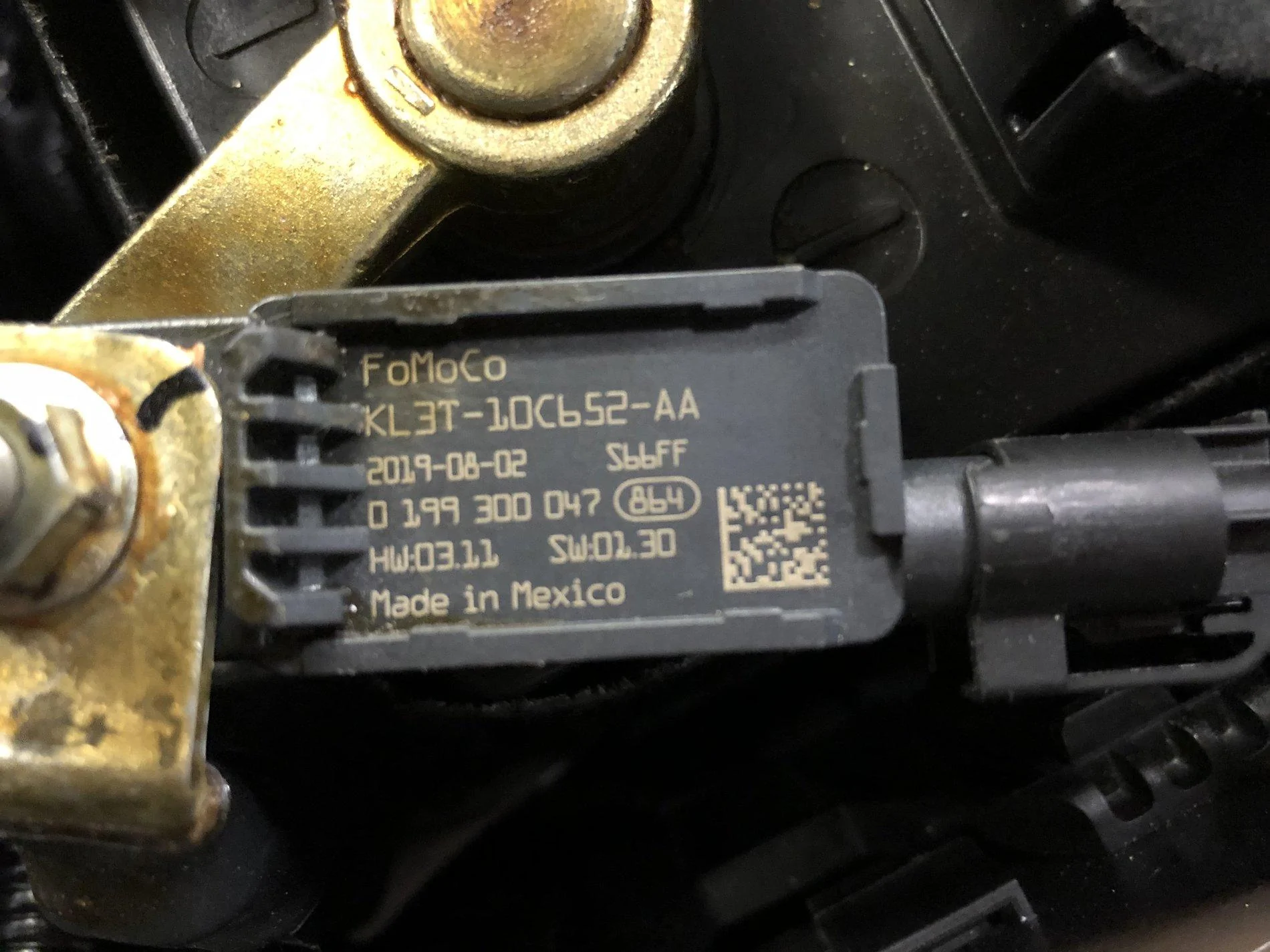
Fellas - Here is a picture of the module that is attached to the negative terminal of the battery. I think it's part of this energy management system I referred to in my earlier post.

Dave, K1PNW, I installed my Icom ID-5100 in the Ranger. The body of the unit is under the passenger seat. The head is on a mount that attaches to a dash vent. Since the main body is on the passenger side, I ran the power leads from the battery, across the back of the engine compartment and through a large rubber grommet which is on the lower right (passenger) side of the firewall. There is a wiring loom that runs through it, but the grommet is large enough that you can poke a hole in it to run the power cable without disturbing the existing wiring. For now I'm using a mag mount antenna. I'm working on welding up a mount that will attach to the driver's side of the trailer hitch, clear the side fender and then come up two feet. A 5/8 wave 2m/70cm antenna will be mounted to it.

Jon
IMG_3458.webp
 

deeve

Well-Known Member
Joined
Nov 18, 2019
Threads
16
Messages
198
Reaction score
72
Location
USA
Vehicle(s)
Ford Ranger
Thanks! Post up your antenna setup when you get that mount squared away. Be interested to see it.
 

zrd

Member
First Name
B
Joined
May 13, 2019
Threads
2
Messages
17
Reaction score
13
Location
Tampa / Puerto Rico
Vehicle(s)
2019 Ford Ranger XLT FX4
Hello @Jon B I am a HAM operator too and am considering installing a mobile unit in my Ranger. Curious to hear what you installed, where and how it was wired up.


DAVE
K1PNW
I have a Yaesu FTM-400XDR.

I installed the bracket below the steering wheel, drilling holes in removable plastic section and securing with the included bolts and nuts.

I used a wire hanger with lubricant to pass the cables through the grommet that is by the steering column on the firewall.

Once inside the engine bay I used electrical tape so it looks like everything else in the engine area.

The Industry standard way of installing it is directly on the battery posts.

You may choose to have the negative on the chassis, and the positive on the battery post, but i would not go far from where the negative post is connected to the chassis by factory.

If there is a circuit at the negative battery post, I would by pass that too and install at the terminal directly. But that's my preference.
Sponsored


Top