
Sponsored

11 MPG over 100+ Miles in 4WD on White Rim Trail, Canyonlands Utah

dtech

Well-Known Member
Joined
May 10, 2020
Threads
39
Messages
3,151
Reaction score
7,656
Location
colorado
Vehicle(s)
Ranger Lariat FX4, chromed and forever damperless
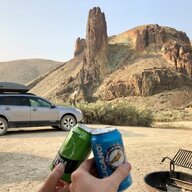
You have to secure a permit and designate campsites, which you cannot stray from. There’s a quota for how many permits each day. Online reservations open months in advance and are immediately booked, like trying to buy a Taylor Swift ticket. You can’t just go and camp wherever. This is a good thing, btw or it’d be loved to death. We spent 3 nights, campsites roughly 30 miles apart, so plenty of leisurely travel and enjoyment at each campsite.
Don't know about Taylor Swift tickets but do know about rafting permits for the Colorado River , they are a lottery and very difficult to get, did one a few years back with son from Grand Junction CO to Moab, beautiful scenery with a few patches of moderate rapids(westwater) You camp in designated sites along the river, gorgeous scenery. Son has done the green river and says it's great as well. And of course using the groover with a lot of younger beer drinking dudes is an adventure in and of itself.
Sponsored


Jhbryaniv

Well-Known Member
First Name
John
Joined
Sep 19, 2022
Threads
5
Messages
2,788
Reaction score
7,470
Location
Colorado
Vehicle(s)
2023 Ranger Tremor
Vehicle Showcase
1
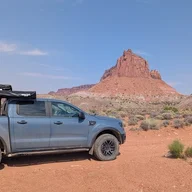
I'll share my surprising finding after completing the White Rim Trail in Canyonlands, Utah. I averaged a very low 11 MPG for this trip. Same truck, with all my gear and supplies, I was getting between 16 and 22 MPG between Washington State and Utah in 2WD. White Rim Trail is mostly bumpy, rocky, and uneven with a couple areas of very steep and semi technical terrain. Average speed I drove was 8 - 10 mph, which the terrain itself informs but also for viewing enjoyment. I was in 4wd the whole time, with a couple notable sections in 4-low.

Truck load is the truck and a Snugtop Rebel canopy with a Yakima Skybox 12 up top (long, narrow). I had a Gazelle T4 tent, Gazelle small gazebo (both pop up, about 55 pounds combined) and two folding camping chairs. I'm guessing 100 pounds total above the canopy. Two occupants, myself and my wife. Iceco JP50 fridge in the back with a Jackery 1500 battery. Two, stacked Milwaukee Packout x2 drawer units with kitchen, hygiene, lights and misc camp tools. 8 gallons of water across x3 containers, 5 gall in a Wavian steel fuel can, air compressor and basic recovery gear, clothing for warm and cold/wet, sleeping bags, bins of dry goods. If you're used to week+ long camping trips, this would be familiar.

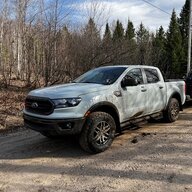
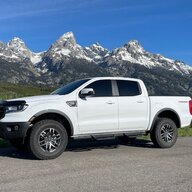
Truck mods are Firestone Destination XT 255/75/17 C Load, Eibach Pro Truck suspension front and back with Icon Multileafs in the rear (option 2), resulting in a near 3" lift in the front, 1" lift in the rear, with just 1" of rake back to front. Totally loaded for the trip, I squatted, resulting in a 1" reverse rake, so nose high (barely).

This is not my first long adventure, but it is the first time I remained in 4wd, driving slow on truly offroad track over 3 days and 100 miles. THAT really did a number on MPGs, and critically, range. Usually, our offroad camp trips blend more forest service road or highway miles with relatively fewer truly 4wd trails. Due to that, I generally don't see the huge MPG declines.

Thought I'd share this should anyone plan on traversing very long 4wd tracks. Continually check your MPGs and range, make sure you have additional fuel or can make it back to town.

We were in Utah for 2 weeks, remote camping and trail driving. Never needed my 5 gall Wavian gas can, but White Rim Trail made me glad for it, should I have been turned around by an obstacle at the 90 mile mark - this happened literally the week before I arrived.
Having seen a few YT vids on this trail, it is for sure a bucket list trip for me.

Thanks for the summary. From YT I would have thought the hog back would have been the most challenging.
 

TheDo114

Well-Known Member
Joined
Aug 2, 2020
Threads
3
Messages
295
Reaction score
746
Location
Canada
Vehicle(s)
2021 Ranger Tremor XLT
Just curious, would it be bad at all to drive off-road in 2wd and only switch to 4wd when needed? Would constant switching cause damage to the transfer case?
No! It's perfectly fine and can make for some interesting challenge.
 
OP
OP
lazynorse

lazynorse

Well-Known Member
Joined
Mar 16, 2022
Threads
41
Messages
317
Reaction score
592
Location
Washington State
Vehicle(s)
Ford Ranger Crew Cab XLT FX4
Occupation
Public Health
Having seen a few YT vids on this trail, it is for sure a bucket list trip for me.

Thanks for the summary. From YT I would have thought the hog back would have been the most challenging.
Hog Back is a short but steep, loose shelf road ascent when traveling clockwise. At the top are two Hog Back campsites, one of which we stayed at on our 2nd night. Exiting the Hog Back camp is a quasi butt puckery descent through steep, loose, narrow bumpiness. Both the ascent and descent out are best done in 4-lo, steady momentum and a close eye on either side of you. Be very careful of rocking into a ledge, from side to side motion.

Hardscrabble is Hog Back x 10, mostly due to length. It just goes and goes, rising, twisting, turning, on and on.

There are deep sandy flats near the exit (going clockwise), so the northwesternmost portion of the WRT. This area was washed out in rain and floods the week before my arrival, and was impassable during that time. So, imagine going 90 of 100 miles, over one or multiple days and having to turn around. This happened to folks. Now, you must have 180 miles of range. Btw, closest gas station is (from memory) 20+ miles from the Park and start of the trail, so that's 40 miles on top of theoretical 180 if you get turned around at the end. Now you need 220 miles of range to for worst case scenario. Not happening with 10 mpgs on our 18 gall tanks.

On the trail, we heard from other folks that this sandy area was still impassable. This ended up being untrue, and we did run into a ranger on our 2nd day who confirmed a crew had recently been out and reopened it. There were no such warnings at the visitor center before hand so we were hoping this was bunk news but we started doing the math and understood we'd absolutely rely on our 5 gall Wavian can if we got to the end and had to turn around. Not to mention we would not be allowed to camp the way back, as you cannot stray from your designated campsite itinerary. We'd probably have to violate that somewhere, that is a huge undertaking to complete in one day, though people do it.

If at all interesting to anyone, I'm a new licensee for GMRS, and have a 5 watt B-Tech GMRS V2 handheld. I also have a long whip Nagoyi 16" antenna. Many times I tried to summon a response on channel 16 and 19, with 16 being the quasi official 4x4 channel (4 times 4 = 16, get it?), and 19 being the 'highway' channel. Of course, people might not monitor that. Anyway, I wanted to see if anyone was listening who knew about the road washouts ahead. Only one answered, but range or line of sight prevented a transmission I could understand. I monitored my new toy quite a bit, scanning channels, leaving it on 16.. I heard no conversations. Sort of a lesson that while a possible method to communicate in an emergency, one cannot rely on it. I have a Garmin inReach for emergency comms. Surprisingly, we did get a bar of cell service in a couple spots along the WRT.
 

Jhbryaniv

Well-Known Member
First Name
John
Joined
Sep 19, 2022
Threads
5
Messages
2,788
Reaction score
7,470
Location
Colorado
Vehicle(s)
2023 Ranger Tremor
Vehicle Showcase
1
Hog Back is a short but steep, loose shelf road ascent when traveling clockwise. At the top are two Hog Back campsites, one of which we stayed at on our 2nd night. Exiting the Hog Back camp is a quasi butt puckery descent through steep, loose, narrow bumpiness. Both the ascent and descent out are best done in 4-lo, steady momentum and a close eye on either side of you. Be very careful of rocking into a ledge, from side to side motion.

Hardscrabble is Hog Back x 10, mostly due to length. It just goes and goes, rising, twisting, turning, on and on.

There are deep sandy flats near the exit (going clockwise), so the northwesternmost portion of the WRT. This area was washed out in rain and floods the week before my arrival, and was impassable during that time. So, imagine going 90 of 100 miles, over one or multiple days and having to turn around. This happened to folks. Now, you must have 180 miles of range. Btw, closest gas station is (from memory) 20+ miles from the Park and start of the trail, so that's 40 miles on top of theoretical 180 if you get turned around at the end. Now you need 220 miles of range to for worst case scenario. Not happening with 10 mpgs on our 18 gall tanks.

On the trail, we heard from other folks that this sandy area was still impassable. This ended up being untrue, and we did run into a ranger on our 2nd day who confirmed a crew had recently been out and reopened it. There were no such warnings at the visitor center before hand so we were hoping this was bunk news but we started doing the math and understood we'd absolutely rely on our 5 gall Wavian can if we got to the end and had to turn around. Not to mention we would not be allowed to camp the way back, as you cannot stray from your designated campsite itinerary. We'd probably have to violate that somewhere, that is a huge undertaking to complete in one day, though people do it.

If at all interesting to anyone, I'm a new licensee for GMRS, and have a 5 watt B-Tech GMRS V2 handheld. I also have a long whip Nagoyi 16" antenna. Many times I tried to summon a response on channel 16 and 19, with 16 being the quasi official 4x4 channel (4 times 4 = 16, get it?), and 19 being the 'highway' channel. Of course, people might not monitor that. Anyway, I wanted to see if anyone was listening who knew about the road washouts ahead. Only one answered, but range or line of sight prevented a transmission I could understand. I monitored my new toy quite a bit, scanning channels, leaving it on 16.. I heard no conversations. Sort of a lesson that while a possible method to communicate in an emergency, one cannot rely on it. I have a Garmin inReach for emergency comms. Surprisingly, we did get a bar of cell service in a couple spots along the WRT.
That is something thta had crossed my kind, being stuck and having to double back, but figured it would be a rare occurance...

Now to source 3 x 5 gallons of fuel cans for our trip next summer... ?

You went solo vehicle ? I guess I should go back and read the first post... ?


AzScorpion

Moderator
First Name
Dave
Joined
Jul 25, 2019
Threads
340
Messages
26,770
Reaction score
135,203
Location
Back Home In AZ!
Vehicle(s)
2023 Ford Ranger Tremor
Occupation
Retired...Full Time Slacker
No! It's perfectly fine and can make for some interesting challenge.
I actually do this a lot but mostly to see what the truck can do. It's pretty impressive at times to see how far you can go in 2wd and while I don't want to get stuck (or high sided) I've gone through some pretty tough areas like this.

I use to do this back in MA in the snow when I had my F150 lol. I lived in a very small town and would sometimes drive through it in 2wd until one night I felt it pilling up underneath and almost got stuck. :oops:
 
OP
OP
lazynorse

lazynorse

Well-Known Member
Joined
Mar 16, 2022
Threads
41
Messages
317
Reaction score
592
Location
Washington State
Vehicle(s)
Ford Ranger Crew Cab XLT FX4
Occupation
Public Health
That is something thta had crossed my kind, being stuck and having to double back, but figured it would be a rare occurance...

Now to source 3 x 5 gallons of fuel cans for our trip next summer... ?

You went solo vehicle ? I guess I should go back and read the first post... ?
We only go solo, my wife and I. Did so for years in a Subaru Outback and the last 3 years in the Ranger. I think good decision-making prevents most recovery situations. Good traction tires, aired down to 18 or 20 psi. Then, a shovel and traction devices but the trick is not to need those. If you're 'overlanding' (I hate that word) like we do, the goal is travel between destinations with moderate offroad conditions, not 4 wheeling for the sake of it, or the challenge of technical wheeling. If I see a mud bog, and I sense uncontrolled variables that could lead me to an unrecoverable situation while solo, I find another route.

Also, having done many 2 week type trips in the American West, you will find few circumstances that require more than a 5 gall gas tank for reserve fuel. You can certainly intentionally stitch together all those miles worth of roads away from services, but you have to really try to do that. Even at my worst mileage along the WRT, 18+5 gallons gets me 250 miles of range getting 11 mpgs. You won't find too many points with 250 miles between them without services, in the continental US.

There's some Youtubers who do a lot of American West, Southwest overland stuff who freely admit they've never needed their 2nd 5 gall fuel tank, many often never needed their 1st. I have no plans for a second 5 gall can.

While I'm rambling, I can't recommend Wavian steel fuel can highly enough. I keep it in my canopy, in an oversized milk crate next to a Sceptre 5 gall water can. No spills, fumes or real need to vent a Wavian, though you want to open slowly if its been pressurized. That was a smart buy once cry once purchase for me. All the other cans are finicky.
 

Jhbryaniv

Well-Known Member
First Name
John
Joined
Sep 19, 2022
Threads
5
Messages
2,788
Reaction score
7,470
Location
Colorado
Vehicle(s)
2023 Ranger Tremor
Vehicle Showcase
1
We only go solo, my wife and I. Did so for years in a Subaru Outback and the last 3 years in the Ranger. I think good decision-making prevents most recovery situations. Good traction tires, aired down to 18 or 20 psi. Then, a shovel and traction devices but the trick is not to need those. If you're 'overlanding' (I hate that word) like we do, the goal is travel between destinations with moderate offroad conditions, not 4 wheeling for the sake of it, or the challenge of technical wheeling. If I see a mud bog, and I sense uncontrolled variables that could lead me to an unrecoverable situation while solo, I find another route.

Also, having done many 2 week type trips in the American West, you will find few circumstances that require more than a 5 gall gas tank for reserve fuel. You can certainly intentionally stitch together all those miles worth of roads away from services, but you have to really try to do that. Even at my worst mileage along the WRT, 18+5 gallons gets me 250 miles of range getting 11 mpgs. You won't find too many points with 250 miles between them without services, in the continental US.

There's some Youtubers who do a lot of American West, Southwest overland stuff who freely admit they've never needed their 2nd 5 gall fuel tank, many often never needed their 1st. I have no plans for a second 5 gall can.

While I'm rambling, I can't recommend Wavian steel fuel can highly enough. I keep it in my canopy, in an oversized milk crate next to a Sceptre 5 gall water can. No spills, fumes or real need to vent a Wavian, though you want to open slowly if its been pressurized. That was a smart buy once cry once purchase for me. All the other cans are finicky.
Appreciate the reasoned responses here.

In Florida we camped out of my subaru forester and my philosophy was don't do anything you can't get out of, alone. I've brought that thinking into my truck, we're going out to have fun, not stress about breaking things.

In the army I'd say, think smarter, not harder. I think that goes a long way out in the middle of no where... Just because I can bomb through that giant puddle, why risk it when I can go around it..

Ok back to my whiskey and reading... ?
Sponsored


Top