
Sponsored
Transmission weird behavior
- Thread starter outdoorphotog
- Start date
- Watchers 3
Loading
OP
OP

outdoorphotog
Well-Known Member
- First Name
- Ian
- Joined
- Dec 15, 2019
- Threads
- 21
- Messages
- 814
- Reaction score
- 2,586
- Location
- Healdsburg, CA
- Vehicle(s)
- 2019 Lincoln Navigator L
- Occupation
- Limo Driver
- Thread starter
- #17
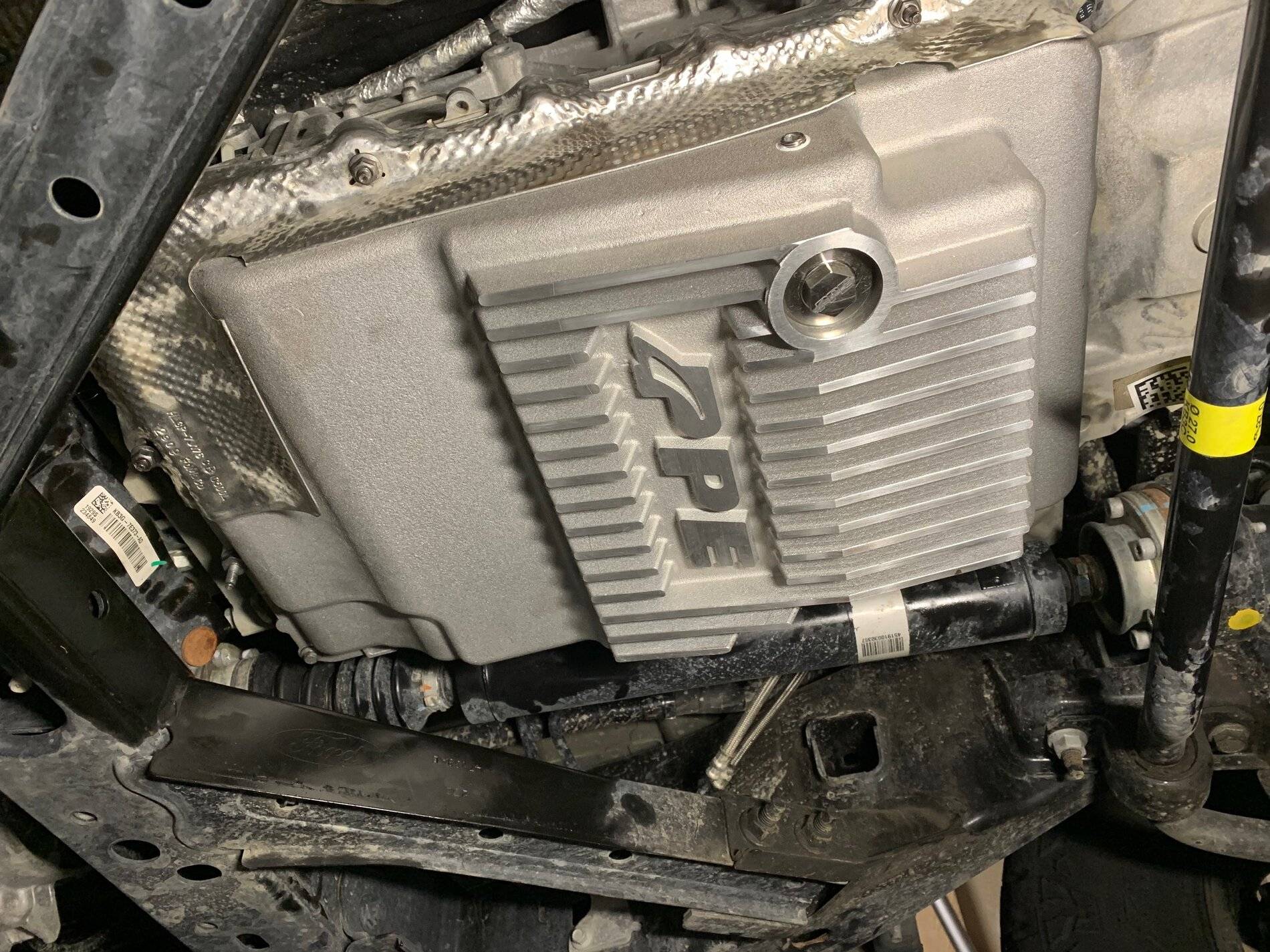
Its a nice pan with extra fluid capacity and a drain plug, its worth it to me. I think time has shown (the F-150 board) that the fluid does not last 100k and it should be changed much sooner. There are many cases in the last 20 years that show these "lifetime fluids" are pretty far from that, nothing is forever. My warranty is only good to 70k so I want to be sure the transmission lasts and that I can more easily change the ATF to help that happen.Just a question, why did you put the PPE pan on? Was it to fix a problem you were having, or was it to avoid a problem you think you might have? Or was because it looks cool when your under your truck? Just wondering why someone would crack open what is an essentually factory sealed highly complex unit, with a 150K mile recommended service interval. Possibly voiding its warranty.
Big Blue
Well-Known Member
So true, mose mods are done for the cool factor without any verifiable need or functional improvement.because he can.
why do people mod their vehicles at all?
because they can.
My bad, I'll crawl back into my old engineer hole and stop asking stupid questions.

OP
OP
outdoorphotog
Well-Known Member
- First Name
- Ian
- Joined
- Dec 15, 2019
- Threads
- 21
- Messages
- 814
- Reaction score
- 2,586
- Location
- Healdsburg, CA
- Vehicle(s)
- 2019 Lincoln Navigator L
- Occupation
- Limo Driver
- Thread starter
- #19
You would think and engineer would appreciate the benefits of an aluminum pan, with cooling fins, that holds extra fluid capacity and has a drain plug.So true, mose mods are done for the cool factor without any verifiable need or functional improvement.
My bad, I'll crawl back into my old engineer hole and stop asking stupid questions.
Big Blue
Well-Known Member
My point is this. Why do I, even though I'm an engineer, think that I know better how to design a piece of equipment. That multiple people, with more experience with that equipment than me, have spent years designing and testing. Just because I think, with my INFINATE wisdom, there might be a issue with it. Who am I to second guess them. This is a transmission different than almost any we have seen before. It is designed to operate within a specific temperature range, why else would they put a heat exchanger on it to help it heat up, instead of a cooler. Thermodynamics was not my specialty so I don't know if aluminum is better than the plastic material they used. As far as plastic goes, I have not heard of anyone punching a hole in their transmission pan have you? I'm sure an unluckly placed rock would take out an aluminum pan just as easily. Obviously through all their hours of testing they have found that their maintenance schedule is sufficiant. Who am I to question, they have the data I don’t. I'm sorry engineers deal in facts amd data not assumptions and maybes.You would think and engineer would appreciate the benefits of an aluminum pan, with cooling fins, that holds extra fluid capacity and has a drain plug.
OP
OP
outdoorphotog
Well-Known Member
- First Name
- Ian
- Joined
- Dec 15, 2019
- Threads
- 21
- Messages
- 814
- Reaction score
- 2,586
- Location
- Healdsburg, CA
- Vehicle(s)
- 2019 Lincoln Navigator L
- Occupation
- Limo Driver
- Thread starter
- #21
Hahaha not all engineers deal in facts, that’s a good one thoughMy point is this. Why do I, even though I'm an engineer, think that I know better how to design a piece of equipment. That multiple people, with more experience with that equipment than me, have spent years designing and testing. Just because I think, with my INFINATE wisdom, there might be a issue with it. Who am I to second guess them. This is a transmission different than almost any we have seen before. It is designed to operate within a specific temperature range, why else would they put a heat exchanger on it to help it heat up, instead of a cooler. Thermodynamics was not my specialty so I don't know if aluminum is better than the plastic material they used. As far as plastic goes, I have not heard of anyone punching a hole in their transmission pan have you? I'm sure an unluckly placed rock would take out an aluminum pan just as easily. Obviously through all their hours of testing they have found that their maintenance schedule is sufficiant. Who am I to question, they have the data I don’t. I'm sorry engineers deal in facts amd data not assumptions and maybes.
FunInTheSun
Well-Known Member
- First Name
- Dave
- Joined
- Jun 6, 2021
- Threads
- 2
- Messages
- 550
- Reaction score
- 1,619
- Location
- South Florida
- Vehicle(s)
- 2021 Ranger XL 4x4, STX, in Velocity Blue
- Occupation
- Engineer (Semi-Retired)
- Vehicle Showcase
- 1
I'd just like to note for the record that Ford engineers, being employed by Ford Motor Company, tailor all the myriad design decisions to suit Ford's requirements. These requirements may differ somewhat from the set of design decisions "I" would consider optimum for "my" personal convenience and profit. They want to have satisfied customers, of course, but they are subject to a whole panoply of factors that may not at first, seem to be related, but DO have an impact on driveability, reliability, performance, fuel economy, etc. There are inputs from Supply Chain managers, OEM contracts for other components that are not even IN this vehicle, Regulatory Agency rulings and agreements, historical engineering practices, impact on other (world) markets, and on and on, beyond anything we can even imagine without operating in the automotive mass production environment for a while.My point is this. Why do I, even though I'm an engineer, think that I know better how to design a piece of equipment. That multiple people, with more experience with that equipment than me, have spent years designing and testing. Just because I think, with my INFINATE wisdom, there might be a issue with it. Who am I to second guess them. This is a transmission different than almost any we have seen before. It is designed to operate within a specific temperature range, why else would they put a heat exchanger on it to help it heat up, instead of a cooler. Thermodynamics was not my specialty so I don't know if aluminum is better than the plastic material they used. As far as plastic goes, I have not heard of anyone punching a hole in their transmission pan have you? I'm sure an unluckly placed rock would take out an aluminum pan just as easily. Obviously through all their hours of testing they have found that their maintenance schedule is sufficiant. Who am I to question, they have the data I don’t. I'm sorry engineers deal in facts amd data not assumptions and maybes.
SO to imagine that Ford has, in their omnipotent wisdom, managed to produce the perfectly engineered ANYTHING, is to vastly overestimate human capacity, and is a fundamental misunderstanding of the nature of the entire engineering enterprise. Everything is engineered to a price point (or several), carefully discussed and refined in consultation with Marketing, Sales, and Accounting knowledge bases, and then the Legal and Compliance Department gets a crack at it too.
To imagine that any mass produced item cannot be improved is just silly. But it is usually not as easy as naive people usually think. Want to improve the engine? Sure! Just be prepared to throw away a lot of highly optimized (and expensive) parts and invent your own (even more expensive) replacements. This is why a lot of aftermarket mods are garbage. They are usually just stickers, badges, or the metal equivalents of a new pair of shoes. They may make a difference, but not usually a drastic one. And frequently the downside disadvantage is more than the upside gain. I can't remember who said it, but a very applicable quote is "You wanna go fast? Fast costs money. How fast ya wanna go?". Ya pay yer money and ya take yer chances. Caveat Emptor.
Oh, and "looks cool" IS a function. Sometimes more important than actual performance improvement. Don't believe me, ask a Sales and Marketing type...
Big Blue
Well-Known Member
Wow! This went places I never expected. I'm not even going to try an answer that @FunInTheSun novel. I will not argue that many things factor in to design decisions. There is and probably never will be a perfect design of anything. By nature that means anything can be improved. On the case of a design change does the change make an improvement on the products performance, in this case longevity and operation. And at what cost. Now to do a proper cost/benefit analysis you need hard data to show the amount of improvement. And as any statastysion will tell you you need multiple data points. One data point does not make a trend. Anything less and you are left with assumptions, feelings and opinions. This is where most mods fall along with your money into the aftermarket manufacturers pocket, with little or no gain for you.
My original question was why he change the pan? Was he having a problem thay he felt this would fix. He return with a couple realy non-answers. @RANGER PRIDE had probably the best answer "Because He Can". Then he came back and asked me why as an engineer (retired) I didn’t think a aluminum pan with more oil was better. My answer was basically "I Don't Know". You don't have any data, you don't have a problem. That's how this engineers mind works.
And here we are!
My original question was why he change the pan? Was he having a problem thay he felt this would fix. He return with a couple realy non-answers. @RANGER PRIDE had probably the best answer "Because He Can". Then he came back and asked me why as an engineer (retired) I didn’t think a aluminum pan with more oil was better. My answer was basically "I Don't Know". You don't have any data, you don't have a problem. That's how this engineers mind works.
And here we are!
OP
OP
outdoorphotog
Well-Known Member
- First Name
- Ian
- Joined
- Dec 15, 2019
- Threads
- 21
- Messages
- 814
- Reaction score
- 2,586
- Location
- Healdsburg, CA
- Vehicle(s)
- 2019 Lincoln Navigator L
- Occupation
- Limo Driver
- Thread starter
- #24
UPDATE : Tow mode helps in "D" a lot especially on flat land. Glad you guys tipped me off to this
RedlandRanger
Moderator
For what it is worth I agree with you. Ford is most certainly not perfect when it comes to engineering, but as Phil can attest, they do a LOT of engineering to produce something that will achieve their longevity standards and other engineering objectives. There are certainly marketing considerations, but at the end of the day, they still have to adhere to the longevity standards.Wow! This went places I never expected. I'm not even going to try an answer that @FunInTheSun novel. I will not argue that many things factor in to design decisions. There is and probably never will be a perfect design of anything. By nature that means anything can be improved. On the case of a design change does the change make an improvement on the products performance, in this case longevity and operation. And at what cost. Now to do a proper cost/benefit analysis you need hard data to show the amount of improvement. And as any statastysion will tell you you need multiple data points. One data point does not make a trend. Anything less and you are left with assumptions, feelings and opinions. This is where most mods fall along with your money into the aftermarket manufacturers pocket, with little or no gain for you.
My original question was why he change the pan? Was he having a problem thay he felt this would fix. He return with a couple realy non-answers. @RANGER PRIDE had probably the best answer "Because He Can". Then he came back and asked me why as an engineer (retired) I didn’t think a aluminum pan with more oil was better. My answer was basically "I Don't Know". You don't have any data, you don't have a problem. That's how this engineers mind works.
And here we are!
This did take a very strange turn, honestly.....
FunInTheSun
Well-Known Member
- First Name
- Dave
- Joined
- Jun 6, 2021
- Threads
- 2
- Messages
- 550
- Reaction score
- 1,619
- Location
- South Florida
- Vehicle(s)
- 2021 Ranger XL 4x4, STX, in Velocity Blue
- Occupation
- Engineer (Semi-Retired)
- Vehicle Showcase
- 1
Nothing like a nice wall of text to moderate a developing flame war...Wow! This went places I never expected. I'm not even going to try an answer that @FunInTheSun novel. <snip>
My original question was why he change the pan? Was he having a problem thay he felt this would fix. He return with a couple realy non-answers. @RANGER PRIDE had probably the best answer "Because He Can". Then he came back and asked me why as an engineer (retired) I didn’t think a aluminum pan with more oil was better. My answer was basically "I Don't Know". You don't have any data, you don't have a problem. That's how this engineers mind works.
And here we are!
It seems like we are all pretty much in agreement on probably 99% of everything said here.
I just get bored sometimes...
I believe OP did give several pretty good reasons why HE thought that pan was more useful for his purposes. Some of them are probably (certainly?) made on the basis of insufficient or nonexistent data, and are basically informed speculation, like improved cooling, etc. Others are on more solid ground, like "holds more oil" and "I like the drain plug better". You can argue about whether more oil is good thing, or whether the extra cooling provided by the fins and material is a good thing or completely inconsequential, but it's exactly that, speculation, so nobody should really get locked into a hard position on that issue. I just want to keep the conversation moving in productive directions, so I decided to put my nickel down to keep the show alive...
You may proceed...

By the way, my other point is "Looks GREAT!" is a legitimate reason to spend money... HAHA!
FunInTheSun
Well-Known Member
- First Name
- Dave
- Joined
- Jun 6, 2021
- Threads
- 2
- Messages
- 550
- Reaction score
- 1,619
- Location
- South Florida
- Vehicle(s)
- 2021 Ranger XL 4x4, STX, in Velocity Blue
- Occupation
- Engineer (Semi-Retired)
- Vehicle Showcase
- 1
LOL Story of my life...For what it is worth I agree with you. <snip>
This did take a very strange turn, honestly.....
OP
OP
outdoorphotog
Well-Known Member
- First Name
- Ian
- Joined
- Dec 15, 2019
- Threads
- 21
- Messages
- 814
- Reaction score
- 2,586
- Location
- Healdsburg, CA
- Vehicle(s)
- 2019 Lincoln Navigator L
- Occupation
- Limo Driver
- Thread starter
- #28
boom


Frenchy
Well-Known Member
- First Name
- Chris
- Joined
- Mar 15, 2020
- Threads
- 168
- Messages
- 7,661
- Reaction score
- 10,921
- Location
- Elizabeth, Colorado
- Vehicle(s)
- 2012 Nissan Frontier, 1994 F150 XL, 2022 Ford Transit
- Occupation
- Field Service Technician
Just as a thought if you havent done so already is get the B&M dip stick. It makes checking the transmission fluid much easier along with filling it like the older vehicles unlike the oh so wonderful mini stick.boom

ChiefQM
Well-Known Member
I have been driving around town in tow mode, with the 7,8,9 and 10 locked out for in-town driving at 35mph or below and that has solved a lot of the performance issues. For speeds up to 45 mph, I change the overdrive gear lockout as needed to keep the rpms above 1500 and below 2000. Anything above that I turn off the tow mode and the lockout. My issue is that if I hit the gas hard, in tow mode and accelerating from about 30 mph or so, the trans will not shift from 3rd to 4th or 4th to 5th; the rpms will get up to 4000 and it doesn't matter if I ease up on the accelerator or not, it won't shift until I take it out of tow mode. It doesn't always do this. Any ideas?Unless you opt for a different tune like Livernois things will basically be the same. Not much else to so here. Understand that the 10R80 is a whole different animal in its own class when it comes to Automatic Transmissions.
One thing you can also do if no one else has mentioned it yet is put the truck in Tow mode. Yes that is right!! Even without a trailer in tow!! What is it going to do? Basically be a little bit more load sensitive and keep you in a more optimal gear for pulling loads even though you wont be pulling a load. Many including myself do this and have not had any major problems that I myself am aware of.
Sponsored


