Sponsored

New Bronco Seems To Confirm What We Suspected

FloggingBishop

Well-Known Member
First Name
Tyler W
Joined
Mar 30, 2021
Threads
1
Messages
254
Reaction score
350
Location
Canada
Vehicle(s)
2020 Ford Ranger Lariat FX4
Occupation
Operator
This software has been around for decades. Knock sensors measure where detonation starts occurring (ignition borderline). From this, it will infer the octane content in the fuel tank. From there, Ford's software will change both ignition timing (higher octane provides borderline relief) & load/boost limits (more advanced timing prevents high load pre-ignition, allowing higher boost). This is well known if you talk to the right people (i.e. not rando's on the forums.) Of course, I'm a rando on the forums, so take it with a grain of salt, as you should :sunglasses:

I'm not going to pull the "I do this for a living" card. If you know what I mean...
I do gas for a living.... higher octane fuels such as premium have more to them then just the octane. RON#, additive levels, lower vapour point, etc.... all depends on engine/tune, compression ratios, etc etc etc. Some people can run premium in an engine that still requires it and based on driving habits see zero difference. A lot of manufacturers recommend high octane fuel so warranty or other reasons, some dont. My 1.3L Toyota recommended 87, sometimes it’s done as a geographic thing as certain area’s regular can mean different things. In some engines premium has zero benefits as the engine will burn it inefficiently, as they don’t have the ability to compute the difference in knock etc... if Ford tests something with premium of course they will recommend it. But our rangers all say (unless it’s required for a tune) which really means premium (E0-E6+) or regular (E0-E15) or any of the in between blends. Tells me that you can run anything in the gasoline range and be fine. Some premiums are in the E grade of fuels. As I usually preach, unless you need premium fuels, 89 (mid-grade) is the best bang for your buck unless you don’t care about cost and just want the best mileage. I care about the costs. Premium gains (if any) will undoubtedly be offset in your wallet at the pump just for the extra money.

but.... if you have a tune either in your truck or your head that says you must run 91+, thanks for keeping me and all other oil and gas workers employed....
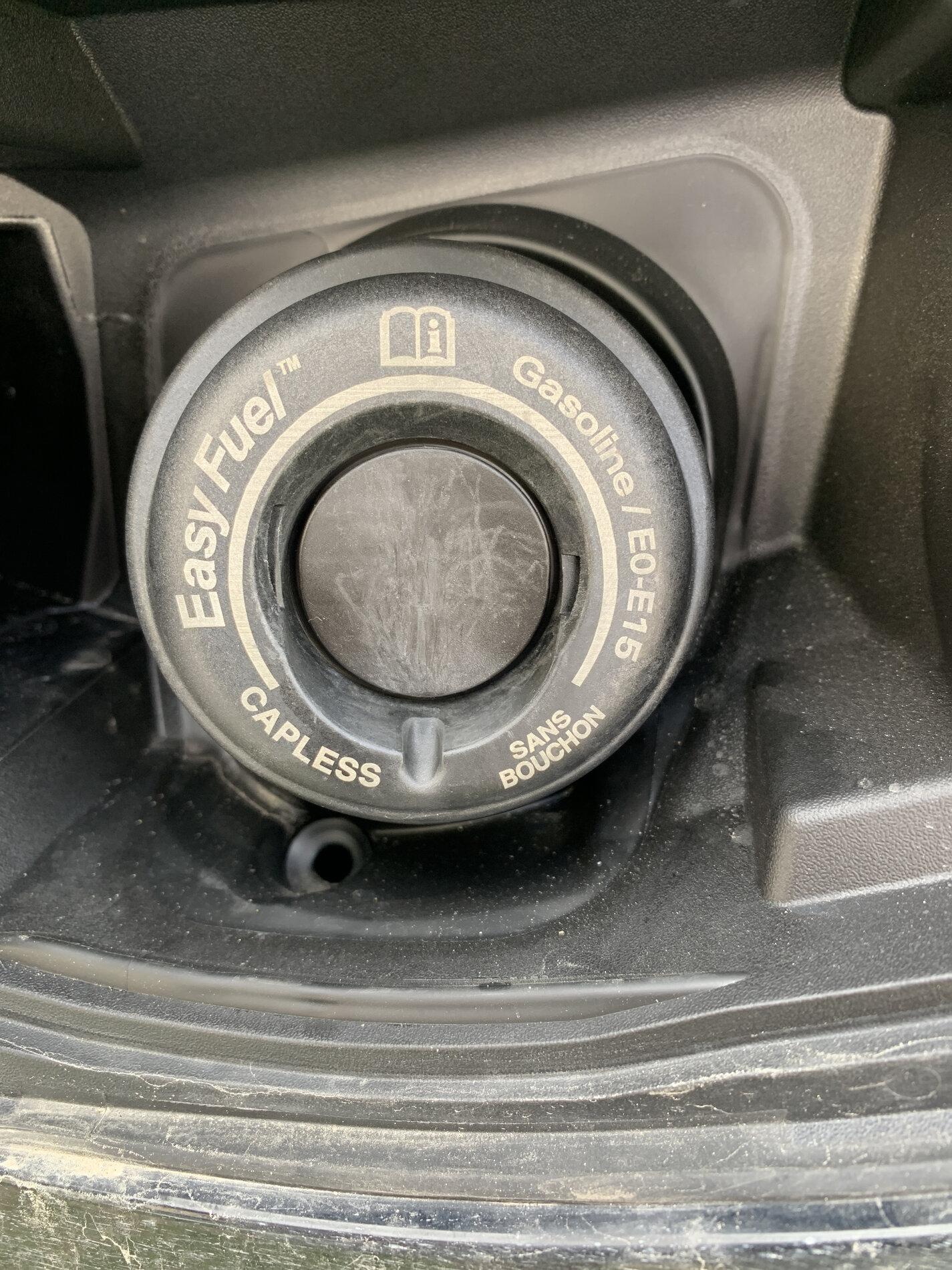
image.jpg
Sponsored

 
Last edited:

Lunchbox88

Well-Known Member
First Name
Logan
Joined
Jun 21, 2019
Threads
3
Messages
335
Reaction score
303
Location
Missouri, USA
Vehicle(s)
2019 Ranger SuperCrew FX4
It's not some wild magic. The ECU uses something called the OAR (octane adjust ratio) to modify performance parameters like timing. The OAR is driven based on the knock sensor and subsequently the octane of the fuel. The closer it is to 1 the more power you can make. You can actually see this ratio in an OBD2 reader like in the Torque app. There are also Dyno graphs showing more power with premium fuel on stock tunes.

well, i read it all. sigh. self abuse and torture at its finest.
i have to admit i teared up reading about the little girl with asthma though. touching story.

only a few guys eluded to a tune as being the reason for the power increase, the need for higher octane is the result of that tune. A few others also made note that octane doesnt increase power, which is the camp i am from.
it amazes me though how many people are in the camp that a few extra dollars at a fill up can get you free horsepower.
I dont buy it. I dont think the software for the ECU is that advanced yet where it can sniff your fuel tank and go...hmmm, thats the high octane go go juice, we can tweak the parameters and give this guy some serious striped ape performance and dial it down later when he puts in the lesser octane.
maybe its a bigger turbo?

its all in your head people. your ass dyno isnt accurate enough for me to be convinced a fill up on high octane fuel turned your truck into something more powerful.
 
Last edited:

FloggingBishop

Well-Known Member
First Name
Tyler W
Joined
Mar 30, 2021
Threads
1
Messages
254
Reaction score
350
Location
Canada
Vehicle(s)
2020 Ford Ranger Lariat FX4
Occupation
Operator
It's not some wild magic. The ECU uses something called the OAR (octane adjust ratio) to modify timing. The OAR is driven based on the knock sensor and subsequently the octane of the fuel. The closer it is to 1 the more power you can make. You can actually see this ratio in an OBD2 reader like in the Torque app. There are also Dyno graphs showing more power with premium fuel on stock tunes.
You aren’t wrong. If your vehicle has the ability to adjust its workings to the knock, sure it will, but there is always this. Those gains are only useful if you’re using them, ie towing, drag racing, heavy load etc... day to day driving you will see zero gain because you aren’t really using the octane efficiently. The truck/engine does it’s thing only if the 200 lbs computer between the seat and steering wheel is asking for it. You might have downsides with premium like higher idle, higher rpm in lower gears, which is good and bad for somethings, bad for mileage good for starting in cold and bringing temperatures up. More octane isn’t a magic solution, if it was we would all be running VP racing fuels that are in the 100s for octane. Now a giant benefit for premium fuels is less or no ethanol and the biggest is higher treatment rate of DCA’s. DCA’s help clean your engine, and reduce deposits from burning hydrocarbons. If your engine is running like garbage running a few tanks of premium can (not always) help, or if you have wet or dirty gas. Those octane additives you buy at Walmart are generally garbage because you need additives to help clean the different burn properties. Injector cleaner or the Lucas oil additive (or similar) are basically DCA in a small bottle that is diluted with something to allow it to dissolve in your tank.

Again, put whatever you want in your truck if you think it’s working for you but do some honest thinking about any perceived gains. Probably offset at the pump to your wallet. 91+ fuels won’t do shit if you don’t need it.
 

tivct

Well-Known Member
Joined
Mar 20, 2019
Threads
6
Messages
194
Reaction score
356
Location
Dearborn, MI
Vehicle(s)
Tremor, Focus RS
I do gas for a living.... higher octane fuels such as premium have more to them then just the octane. RON#, additive levels, lower vapour point, etc.... all depends on engine/tune, compression ratios, etc etc etc. Some people can run premium in an engine that still requires it and based on driving habits see zero difference. A lot of manufacturers recommend high octane fuel so warranty or other reasons, some dont. My 1.3L Toyota recommended 87 minimum, sometimes it’s done as a geographic thing as certain area’s regular can mean different things. In some engines premium has zero benefits as the engine will burn it inefficiently, as they don’t have the ability to compute the difference in knock etc... if Ford tests something with premium of course they will recommend it. But our rangers all say (unless it’s required for a tune) which really means premium (E0-E6+) or regular (E0-E15) or any of the in between blends. Tells me that you can run anything in the gasoline range and be fine. Some premiums are in the E grade of fuels. As I usually preach, unless you need premium fuels, 87 (mid-grade) is the best bang for your buck unless you don’t care about cost and just want the best mileage. I care about the costs. Premium gains (if any) will undoubtedly be offset in your wallet at the pump just for the extra money.

but.... if you have a tune either in your truck or your head that says you must run 91+, thanks for keeping me and all other oil and gas workers employed....
I don't think we disagree. You will certainly be fine on the recommended octane. But on Ford GTDI engines, you will make more power & torque on premium. Their software is specifically written to do so. Obviously, you'll only benefit if you're using it. I run high octane when pulling the boat, 87 everywhere else.
 

Lunchbox88

Well-Known Member
First Name
Logan
Joined
Jun 21, 2019
Threads
3
Messages
335
Reaction score
303
Location
Missouri, USA
Vehicle(s)
2019 Ranger SuperCrew FX4
You aren’t wrong. If your vehicle has the ability to adjust its workings to the knock, sure it will, but there is always this. Those gains are only useful if you’re using them, ie towing, drag racing, heavy load etc... day to day driving you will see zero gain because you aren’t really using the octane efficiently. The truck/engine does it’s thing only if the 200 lbs computer between the seat and steering wheel is asking for it. You might have downsides with premium like higher idle, higher rpm in lower gears, which is good and bad for somethings, bad for mileage good for starting in cold and bringing temperatures up. More octane isn’t a magic solution, if it was we would all be running VP racing fuels that are in the 100s for octane. Now a giant benefit for premium fuels is less or no ethanol and the biggest is higher treatment rate of DCA’s. DCA’s help clean your engine, and reduce deposits from burning hydrocarbons. If your engine is running like garbage running a few tanks of premium can (not always) help, or if you have wet or dirty gas. Those octane additives you buy at Walmart are generally garbage because you need additives to help clean the different burn properties. Injector cleaner or the Lucas oil additive (or similar) are basically DCA in a small bottle that is diluted with something to allow it to dissolve in your tank.

Again, put whatever you want in your truck if you think it’s working for you but do some honest thinking about any perceived gains. Probably offset at the pump to your wallet. 91+ fuels won’t do shit if you don’t need it.
No one is saying it's a magic solution to anything. Just that the truck can indeed make more power with premium fuel. I switch in-between the two depending on what's going on or where I'm at but the difference between 87 and 93 to me is definitely noticable.


tivct

Well-Known Member
Joined
Mar 20, 2019
Threads
6
Messages
194
Reaction score
356
Location
Dearborn, MI
Vehicle(s)
Tremor, Focus RS
Thats tweaking though.
Does tweaking get you that much HP?
On Ford's turbo engines yes, because it's two-fold (ignition & boost are both increased with octane.) The numbers stated in the bronco figures are in-line with all the other engines. N/A engines... not so much. But it's still there.
 

FloggingBishop

Well-Known Member
First Name
Tyler W
Joined
Mar 30, 2021
Threads
1
Messages
254
Reaction score
350
Location
Canada
Vehicle(s)
2020 Ford Ranger Lariat FX4
Occupation
Operator
No one is saying it's a magic solution to anything. Just that the truck can indeed make more power with premium fuel. I switch in-between the two depending on what's going on or where I'm at but the difference between 87 and 93 to me is definitely noticable.
That’s I guess my main point, if you’re doing something and need the gains, that’s the best time to use it. If you’re daily driving, don’t bother. Just some people act like the 91/93/94 is magic potion. When the do these tests it’s all dyno going balls out, no one really drives like that. I do wonder if off-roading is a good application for premium or not based on the lower gears and amount of time in 4WD. Towing would be a decent use for it
 

FloggingBishop

Well-Known Member
First Name
Tyler W
Joined
Mar 30, 2021
Threads
1
Messages
254
Reaction score
350
Location
Canada
Vehicle(s)
2020 Ford Ranger Lariat FX4
Occupation
Operator
I don't think we disagree. You will certainly be fine on the recommended octane. But on Ford GTDI engines, you will make more power & torque on premium. Their software is specifically written to do so. Obviously, you'll only benefit if you're using it. I run high octane when pulling the boat, 87 everywhere else.
That’s my crusade it seems. 89 is probably the best bang for your buck on day to day. The gas buddy website did some polls/bro science study’s and found for most engines 89 was the best for mileage vs. Cost. I have run 91 and 93/94 in my truck a few times when doing long highway drives and although it was a little more peppy the mileage was worse in some case because once I got up to cruising speeds the engine does it’s thing and settles in for the haul. If I were towing whilst on said trips I would run premium gasoline for sure. If you’re doing a lot of driving in 4wd I don’t think premium fuels will help much, but this one I am sure I could be wrong, as I haven’t done enough of it where I specifically put different grades of gas in. Another thing I have done based on prices is fill up with 91+ then if the price is really low I will top up with 87 and again with 91+ depending on the prices. Now when COVID lockdowns in the summer killed prices yeah this fella ran 91+ but only for the added DCA’s and no ethanol (Canadian Shell VPower).
 
Last edited:

TORQUERULES

Well-Known Member
Joined
May 4, 2020
Threads
31
Messages
758
Reaction score
1,142
Location
US
Vehicle(s)
Ranger
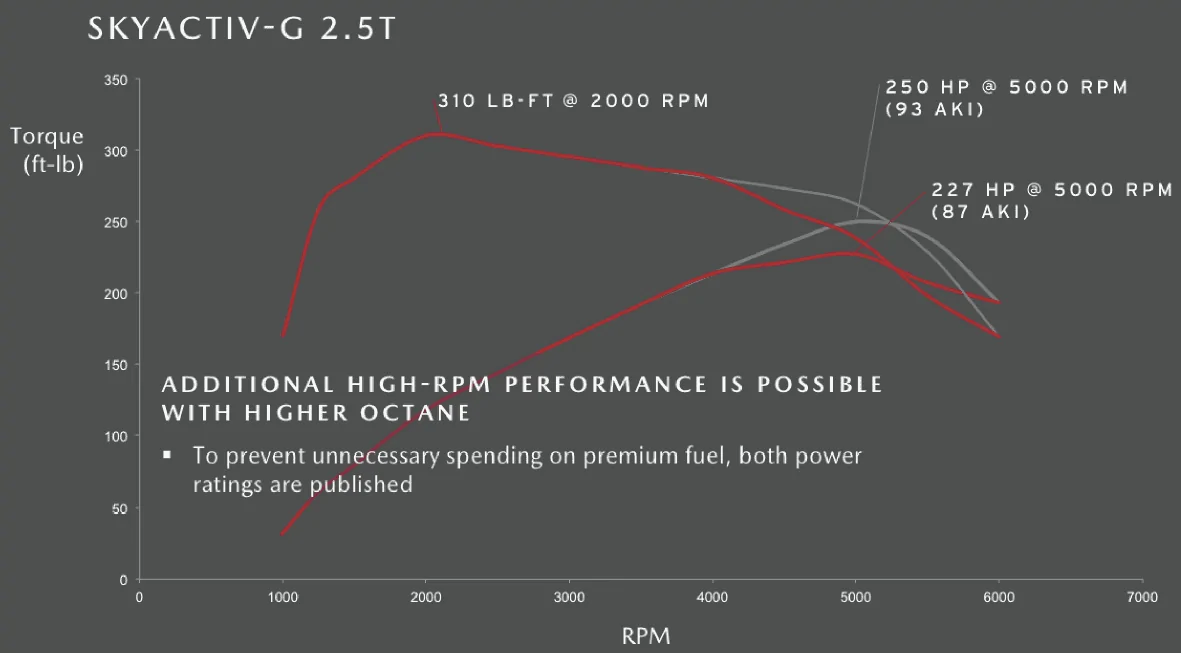
If they really did tune the engine to make use of it, you would probably see it advertised. Mazda does that with the CX-5 2.5T, which my wife drives. The benefit of running 93, vs 87 is only achieved above 4k RPM. (see chart)

We have run both over the two years she's owned it. Since we don't take it to the track, 87 is what we use.

cx-5 chart.png
Ford advertises this for the Mustang Ecoboost and the GT I believe. I'll see if I can look it up.

Also, I had a 2.5 Skyactive in a Mazda 6 GT and It was a huge difference between 87 (what the dealer put in when I got it) and 93. Much more so than I think they advertise.
 

FloggingBishop

Well-Known Member
First Name
Tyler W
Joined
Mar 30, 2021
Threads
1
Messages
254
Reaction score
350
Location
Canada
Vehicle(s)
2020 Ford Ranger Lariat FX4
Occupation
Operator
Ford advertises this for the Mustang Ecoboost and the GT I believe. I'll see if I can look it up.

Also, I had a 2.5 Skyactive in a Mazda 6 GT and It was a huge difference between 87 (what the dealer put in when I got it) and 93. Much more so than I think they advertise.
Yeah you can see some differences by vehicle. My last vehicle I noticed it had more get up and go but rev’d a lot higher before shifting and had bad mileage, that was a Toyoda 1.3L in it. I don’t really notice huge differences that give me the smiles based on the cost difference. I have noticed big differences between regular and mid grades tho
 

TORQUERULES

Well-Known Member
Joined
May 4, 2020
Threads
31
Messages
758
Reaction score
1,142
Location
US
Vehicle(s)
Ranger
so, now im getting confused.

Fords tune bumps up 45HP and you have to run premium and it costs me less than a grand for the program.
these numbers for the Bronco are because the computer can tweak the parameters and give me around 300, without a tune.
30 more than stock and 15 less than the tune that costs me extra cash, kills parts of my warranty and i'll never really feel the difference anyways??

Why would anyone buy the Ford tune?

Im curious though on the octane itself increasing boost claim?
i may just be misunderstanding your statement, I thought the wastegate controlled by the PCM controlled boost pressure and the octane rating prevents detonation from the higher boost pressure.
I believe that Ford's tune is 45hp above stock power with 93 octane, not 87. I am unsure if Ford rates the Ranger at 93 octane or 87. I'll see if I can find out.


Top