

Sponsored

GMRS Radio Antenna Question

Frenchy

Well-Known Member
First Name
Chris
Joined
Mar 15, 2020
Threads
164
Messages
7,548
Reaction score
10,757
Location
Elizabeth, Colorado
Vehicle(s)
2012 Nissan Frontier, 1994 F150 XL, 2022 Ford Transit
Occupation
Field Service Technician
For the Radio Enthusiasts here, I have a question for you.

So I currently am running the Midland MXT575(50 Watt) Radio in my truck. Overall I think it is an awesome Radio to have. One thing that has been bothering me lately is the Antenna itself.

So currently I am running the 3 DBI Ghost Antenna. I also have the 6 DBI Antenna from when I had the Pathfinder. I noticed both had their benefits and I personally prefer the 3 DBI.

Fairly recently(during 2023 I believe) Midland decided to release the Heavy Duty Antenna's ranging from 3 DBI all the way up to 7.5 DBI. Even the 3 DBI is fairly tall at 28 inches vs the 3 inch Ghost Antenna.

Now I would be mounting the Antenna on the Roof Regardless as it would provide the best possible Communication Range in all directions. My question is should I stay with the Ghost Antenna or should I get the taller 3 DBI Antenna? It is a bit spendy and I would need to have the folding bracket(easy enough to get). I'm just not sure if it is a great idea or not.
Sponsored
 

Racket

Well-Known Member
First Name
John
Joined
Jan 21, 2020
Threads
22
Messages
2,206
Reaction score
3,408
Location
Here and There
Vehicle(s)
2019 Lariat Supercrew 2WD
Occupation
Transient
From my days doing installs my recollection is the higher the dB gain the more elevated and obstruction free you want the antenna.
 
OP
OP
Frenchy

Frenchy

Well-Known Member
First Name
Chris
Joined
Mar 15, 2020
Threads
164
Messages
7,548
Reaction score
10,757
Location
Elizabeth, Colorado
Vehicle(s)
2012 Nissan Frontier, 1994 F150 XL, 2022 Ford Transit
Occupation
Field Service Technician
From my days doing installs my recollection is the higher the dB gain the more elevated and obstruction free you want the antenna.
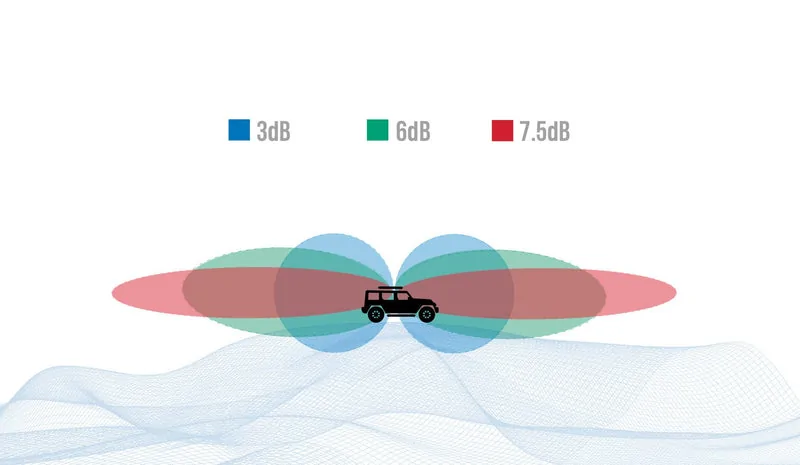
The higher the dB gain isn't always better. I say that because of the way the antenna projects it's beam. A higher dB is going to project further, but be narrower vs the smaller dB that sill project more of a ball. The attached picture helps give an idea of the general pattern for each dB rating.

Understanding-Decibel-Coverage_1_1720x1000_1_d45dcb70-624f-49d1-b748-ae76421d1770-176625_800x...webp
 

Awg9Tech

Well-Known Member
Joined
May 28, 2023
Threads
2
Messages
71
Reaction score
126
Location
Maryland
Vehicle(s)
2023 Ranger XLT SCAB
For the Radio Enthusiasts here, I have a question for you.

So I currently am running the Midland MXT575(50 Watt) Radio in my truck. Overall I think it is an awesome Radio to have. One thing that has been bothering me lately is the Antenna itself.

So currently I am running the 3 DBI Ghost Antenna. I also have the 6 DBI Antenna from when I had the Pathfinder. I noticed both had their benefits and I personally prefer the 3 DBI.

Fairly recently(during 2023 I believe) Midland decided to release the Heavy Duty Antenna's ranging from 3 DBI all the way up to 7.5 DBI. Even the 3 DBI is fairly tall at 28 inches vs the 3 inch Ghost Antenna.

Now I would be mounting the Antenna on the Roof Regardless as it would provide the best possible Communication Range in all directions. My question is should I stay with the Ghost Antenna or should I get the taller 3 DBI Antenna? It is a bit spendy and I would need to have the folding bracket(easy enough to get). I'm just not sure if it is a great idea or not.
If the Ghost antenna is regularly hitting the repeaters you use, I’d stick with the Ghost. All around less intrusive when dealing with overhead branches, drive throughs, etc.

I tend to go with the higher gain for a base station/stationary use.

That being said, if they both use the same base (I believe the ghost is NMO), keep the higher gain behind the back seat and swap it out when you have the dire need to hit a far away repeater.
 
OP
OP
Frenchy

Frenchy

Well-Known Member
First Name
Chris
Joined
Mar 15, 2020
Threads
164
Messages
7,548
Reaction score
10,757
Location
Elizabeth, Colorado
Vehicle(s)
2012 Nissan Frontier, 1994 F150 XL, 2022 Ford Transit
Occupation
Field Service Technician
If the Ghost antenna is regularly hitting the repeaters you use, I’d stick with the Ghost. All around less intrusive when dealing with overhead branches, drive throughs, etc.

I tend to go with the higher gain for a base station/stationary use.

That being said, if they both use the same base (I believe the ghost is NMO), keep the higher gain behind the back seat and swap it out when you have the dire need to hit a far away repeater.
The two Antenna's I have now are both NMO base types. That said I'm looking to stay with the 3 dB type as I do have a 50 Watt Radio and can tell that it can reach far. The only question is, if I have a taller antenna that is the same rating, will I be able to see some sort of advantage with it? Maybe, maybe not. At the moment the only advantage I can see is making it easier to not have obstruction from item mounted on the roof. Other then that it is hard to say.


Awg9Tech

Well-Known Member
Joined
May 28, 2023
Threads
2
Messages
71
Reaction score
126
Location
Maryland
Vehicle(s)
2023 Ranger XLT SCAB
The two Antenna's I have now are both NMO base types. That said I'm looking to stay with the 3 dB type as I do have a 50 Watt Radio and can tell that it can reach far. The only question is, if I have a taller antenna that is the same rating, will I be able to see some sort of advantage with it? Maybe, maybe not. At the moment the only advantage I can see is making it easier to not have obstruction from item mounted on the roof. Other then that it is hard to say.
Sorry, I’m confused by the:
So currently I am running the 3 DBI Ghost Antenna. I also have the 6 DBI Antenna from when I had the Pathfinder.
If you have already have a 3db and a 6db, use the 3db for daily use and whip out the 6db for the rare occasion you need to reach out, preferably stationary. If this is the case and you’re looking at a 7.5db, I don’t believe the extra 1.5db would be noticeable in the real world except on the very fringes. In a lab, sure the 1.5db extra could be measured.

If what you have are both 3db, stick with the shorter. If you want to purchase a higher db, again stick with the shorter for daily use and use the higher db if conditions demand.

As a general rule, and at first glance, longer is better for efficient transmission of the RF energy. However, if two antennas are rated at 3db well, 3db is 3db.

Next comes VSWR. Do you have a way of checking VSWR? VSWR is a measure of how efficient the antenna is at transmitting the RF energy. Lower VSWR is better and Amazon has cheap VSWR meters. VSWR can usually be adjusted lower, if needed, on whip type(longer) antennas. The ghost antenna, I’m not sure about; I don’t think VSWR can be adjusted on the ghost, I could be wrong.

If you have a 6db gain antenna, but high VSWRs, those 6db’s aren’t doing you much good. If you have a 3db antenna with low VSWR, it will do much better than a 6db antenna with high VSWR. If you have a 3db antenna with high VSWRs and can’t be adjusted lower, it’s kind of a brick.
 
OP
OP
Frenchy

Frenchy

Well-Known Member
First Name
Chris
Joined
Mar 15, 2020
Threads
164
Messages
7,548
Reaction score
10,757
Location
Elizabeth, Colorado
Vehicle(s)
2012 Nissan Frontier, 1994 F150 XL, 2022 Ford Transit
Occupation
Field Service Technician
Sorry, I’m confused by the:

If you have already have a 3db and a 6db, use the 3db for daily use and whip out the 6db for the rare occasion you need to reach out, preferably stationary. If this is the case and you’re looking at a 7.5db, I don’t believe the extra 1.5db would be noticeable in the real world except on the very fringes. In a lab, sure the 1.5db extra could be measured.

If what you have are both 3db, stick with the shorter. If you want to purchase a higher db, again stick with the shorter for daily use and use the higher db if conditions demand.

As a general rule, and at first glance, longer is better for efficient transmission of the RF energy. However, if two antennas are rated at 3db well, 3db is 3db.

Next comes VSWR. Do you have a way of checking VSWR? VSWR is a measure of how efficient the antenna is at transmitting the RF energy. Lower VSWR is better and Amazon has cheap VSWR meters. VSWR can usually be adjusted lower, if needed, on whip type(longer) antennas. The ghost antenna, I’m not sure about; I don’t think VSWR can be adjusted on the ghost, I could be wrong.

If you have a 6db gain antenna, but high VSWRs, those 6db’s aren’t doing you much good. If you have a 3db antenna with low VSWR, it will do much better than a 6db antenna with high VSWR. If you have a 3db antenna with high VSWRs and can’t be adjusted lower, it’s kind of a brick.
You are definitely confused. That said I can help with that.

Yes I have MXTA25(AKA Ghost Antenna) and the MXTA26.

What I'm looking at is the MXAT03 and MXAT05. Both are 3 dB Antenna's, bust much taller than the MXTA25(and I want to say close to the height of the MXTA26).

Did that help clarify?
 
OP
OP
Frenchy

Frenchy

Well-Known Member
First Name
Chris
Joined
Mar 15, 2020
Threads
164
Messages
7,548
Reaction score
10,757
Location
Elizabeth, Colorado
Vehicle(s)
2012 Nissan Frontier, 1994 F150 XL, 2022 Ford Transit
Occupation
Field Service Technician
Sorry, I’m confused by the:

If you have already have a 3db and a 6db, use the 3db for daily use and whip out the 6db for the rare occasion you need to reach out, preferably stationary. If this is the case and you’re looking at a 7.5db, I don’t believe the extra 1.5db would be noticeable in the real world except on the very fringes. In a lab, sure the 1.5db extra could be measured.

If what you have are both 3db, stick with the shorter. If you want to purchase a higher db, again stick with the shorter for daily use and use the higher db if conditions demand.

As a general rule, and at first glance, longer is better for efficient transmission of the RF energy. However, if two antennas are rated at 3db well, 3db is 3db.

Next comes VSWR. Do you have a way of checking VSWR? VSWR is a measure of how efficient the antenna is at transmitting the RF energy. Lower VSWR is better and Amazon has cheap VSWR meters. VSWR can usually be adjusted lower, if needed, on whip type(longer) antennas. The ghost antenna, I’m not sure about; I don’t think VSWR can be adjusted on the ghost, I could be wrong.

If you have a 6db gain antenna, but high VSWRs, those 6db’s aren’t doing you much good. If you have a 3db antenna with low VSWR, it will do much better than a 6db antenna with high VSWR. If you have a 3db antenna with high VSWRs and can’t be adjusted lower, it’s kind of a brick.
Go to Midland site to lookup the antennas and you will see what I'm talking about.

Also don't expect me to be checking the VSWR. I don't care what is said, modern Radios and Antenna's have come a long way(and even then it hasn't changed much) where you should not have to worry about an adjustment of sorts. It more comes down to selecting the right Antenna for the application one needs.
 

73Elsinore

Member
First Name
Pete
Joined
Aug 22, 2024
Threads
1
Messages
11
Reaction score
10
Location
Central California
Vehicle(s)
23 Ranger Tremor
Occupation
Oil Field Trash
Also don't expect me to be checking the VSWR. I don't care what is said, modern Radios and Antenna's have come a long way(and even then it hasn't changed much) where you should not have to worry about an adjustment of sorts. It more comes down to selecting the right Antenna for the application one needs.
Not to be argumentative, but unless your radio has an internal automatic antenna tuner ("autotuner"), there will likely not be a 1:1 VSWR between transceiver and antenna. The current state of radio and antenna technology has nothing to do with it unless you are referring to an autotuner. I did not look up that Midland transceiver but maybe it has an autotuner, if so, you're good to go, no external VSWR match is needed. If there's no autotuner, and if you don't have a reasonable SWR match, transmit power is being left on the table, and in the worst case it's possible to overheat or damage the transmitter although there is probably a protection circuit in the TX.
 
OP
OP
Frenchy

Frenchy

Well-Known Member
First Name
Chris
Joined
Mar 15, 2020
Threads
164
Messages
7,548
Reaction score
10,757
Location
Elizabeth, Colorado
Vehicle(s)
2012 Nissan Frontier, 1994 F150 XL, 2022 Ford Transit
Occupation
Field Service Technician
Well I did take some time to contact Midland to get a better answer. As much as I hate to say it I didn't exactly get the answer I was looking for but I did get the right answer. Essentially there would be no difference in range at all with the antenna. If anything those particular antennas just have a better advantage with height. I'll probably just stick with what I have so it's obviously we're just fine
 

Awg9Tech

Well-Known Member
Joined
May 28, 2023
Threads
2
Messages
71
Reaction score
126
Location
Maryland
Vehicle(s)
2023 Ranger XLT SCAB
Not to be argumentative, but unless your radio has an internal automatic antenna tuner ("autotuner"), there will likely not be a 1:1 VSWR between transceiver and antenna. The current state of radio and antenna technology has nothing to do with it unless you are referring to an autotuner. I did not look up that Midland transceiver but maybe it has an autotuner, if so, you're good to go, no external VSWR match is needed. If there's no autotuner, and if you don't have a reasonable SWR match, transmit power is being left on the table, and in the worst case it's possible to overheat or damage the transmitter although there is probably a protection circuit in the TX.
You mean, I just can’t stick a coat hanger on my radio and call it good?!?! Whatayatakingbout??

Yeah, physics hasn’t changed in a few billion years.
 
OP
OP
Frenchy

Frenchy

Well-Known Member
First Name
Chris
Joined
Mar 15, 2020
Threads
164
Messages
7,548
Reaction score
10,757
Location
Elizabeth, Colorado
Vehicle(s)
2012 Nissan Frontier, 1994 F150 XL, 2022 Ford Transit
Occupation
Field Service Technician
Not to be argumentative, but unless your radio has an internal automatic antenna tuner ("autotuner"), there will likely not be a 1:1 VSWR between transceiver and antenna. The current state of radio and antenna technology has nothing to do with it unless you are referring to an autotuner. I did not look up that Midland transceiver but maybe it has an autotuner, if so, you're good to go, no external VSWR match is needed. If there's no autotuner, and if you don't have a reasonable SWR match, transmit power is being left on the table, and in the worst case it's possible to overheat or damage the transmitter although there is probably a protection circuit in the TX.
Good luck breaking into a Midland GMRS Radio. At best you might have some adjustments through the menus, but that's it. BTW I have never felt the need for making said adjustments on a Midland GMRS especially with a 50 Watt Radio.
 

73Elsinore

Member
First Name
Pete
Joined
Aug 22, 2024
Threads
1
Messages
11
Reaction score
10
Location
Central California
Vehicle(s)
23 Ranger Tremor
Occupation
Oil Field Trash
You mean, I just can’t stick a coat hanger on my radio and call it good?!?! Whatayatakingbout??

Yeah, physics hasn’t changed in a few billion years.
Indeed. When I first was studying for the General ticket, I talked to a guy who, years ago, would light up anything for an antenna for fun. Window screens, rain gutter around the house, clothesline, whatever. The contacts that can be made with just a few watts and a window screen is unbelievable really. Some of the field expedient military antennas are the same way especially if you only need NVIS or short range tactical. Propagation depends so much on the band conditions, which still generally suck as compared to years ago, but one of these days when I get some time I am going to dial my HF TX down to 5 watts, hook it to the clothesline, and see what happens...
 

73Elsinore

Member
First Name
Pete
Joined
Aug 22, 2024
Threads
1
Messages
11
Reaction score
10
Location
Central California
Vehicle(s)
23 Ranger Tremor
Occupation
Oil Field Trash
Good luck breaking into a Midland GMRS Radio. At best you might have some adjustments through the menus, but that's it. BTW I have never felt the need for making said adjustments on a Midland GMRS especially with a 50 Watt Radio.
Roger, got you 5 by. Charlie Mike.
Sponsored


Top