
Sponsored
gfitzge2
Well-Known Member
- First Name
- Gregg
- Joined
- Nov 7, 2018
- Threads
- 6
- Messages
- 1,233
- Reaction score
- 7,001
- Location
- Louisville, Kentucky
- Vehicle(s)
- 2016 Focus RS, 2019 Ranger, 2021 Mustang Mach 1
- Occupation
- Retired Electrician
- Vehicle Showcase
- 1
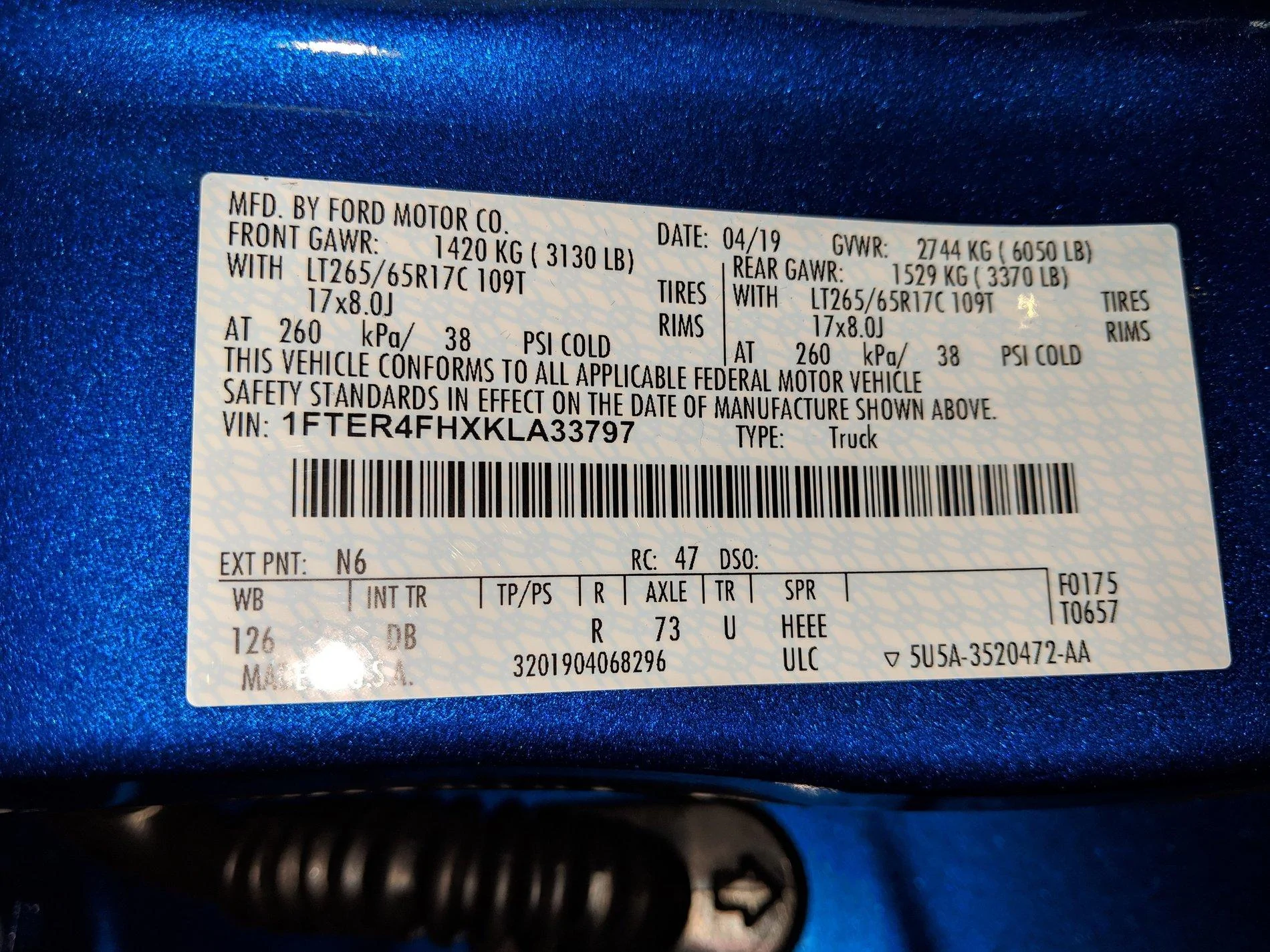
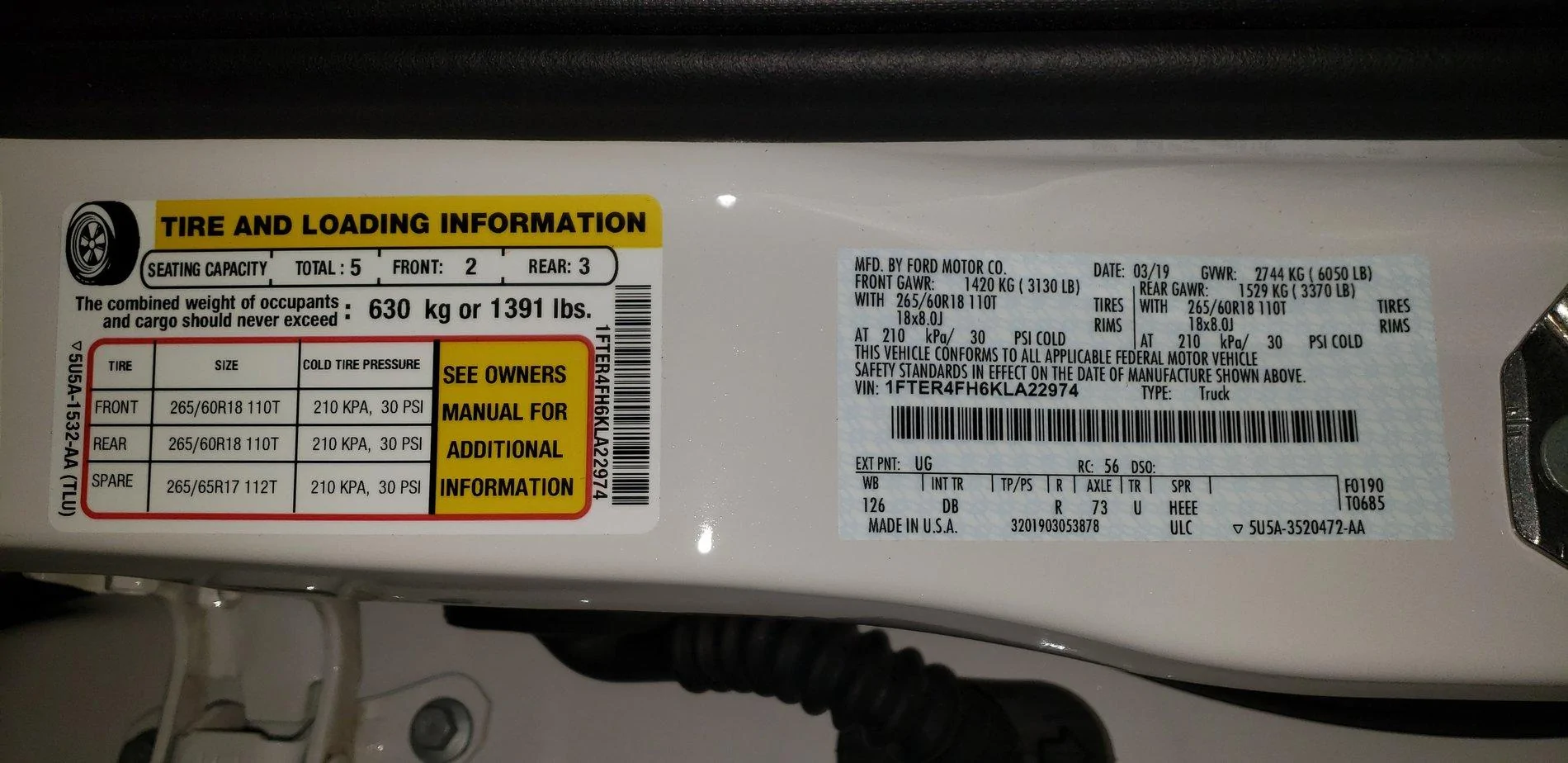
Can someone post a picture for the factory ordered door sticker (tire specs, GVWR, etc.) for LT265/65R17 A/T OWL tires?
VAMike
Well-Known Member
Some people would rather trade a more durable tire for a harsher ride. It probably only matters if the truck spends most of its time near max load.Nothing is different that I see besides 30 psi vs. 38 psi cold. No ratings change. For some reason this surprises me. Why run LTs, and why is it an option, then?
OP
OP
fusseli
Well-Known Member
- Thread starter
- #6
Understand, I'm looking for ways to quantify it. It seems that payload and everything else is unchanged on paper.Some people would rather trade a more durable tire for a harsher ride. It probably only matters if the truck spends most of its time near max load.
I also wonder if we can debunk some myths about heavier tires. Your tires are Hankook ATM in an LT, or what are they? If the mpg truly drops appreciably with the heavier tire then it would be evident from comparing your factory EPA mileage to mine. Does your window sticker say 20 and 24 mpg like mine?
The higher ply rating, thus sidewall strength, is inarguably there for the LT tire because that's what it's designed for. The other thing I am trying to figure out is if that actually means a more puncture and tear resistant sidewall, which I don't think it does. The higher ply rating is simply a way of describing the tires ability to hold pressure, and thus higher load, without blowing out. This seems to be supported also by the response below.
I contacted support from a tire company and they gave the safe/legal answer:
In response to:Thank you for contacting Customer Relations.
There is no difference beside the higher load. Both sizes have rim protector.
To maintain tire safety, purchase new tires that are the same size as the vehicle’s original tires. Look at the tire information placard, the owner’s manual, or the sidewall of the tire you are replacing to find this information.
I have a truck that comes with a tire of 112 load index, T speed.
Which is the best tire version for me to choose? Is the sidewall stronger or is there any other consideration besides the higher load rating on the LT? I had P-rated AT tire from you on my last vehicle, where I tore the rim protector once and popped some sidewall cords another time.
Which is best for me to choose?
265/70 R17 115T SL
LT265/70 R17 121S E1
RedlandRanger
Moderator
I'm no tire expert but I always thought more plies equal better protection against punctures (at least in the tread - not sure about the sidewall). In general, I always thought more plies meant a tougher tire.Understand, I'm looking for ways to quantify it. It seems that payload and everything else is unchanged on paper.
I also wonder if we can debunk some myths about heavier tires. Your tires are Hankook ATM in an LT, or what are they? If the mpg truly drops appreciably with the heavier tire then it would be evident from comparing your factory EPA mileage to mine. Does your window sticker say 20 and 24 mpg like mine?
The higher ply rating, thus sidewall strength, is inarguably there for the LT tire because that's what it's designed for. The other thing I am trying to figure out is if that actually means a more puncture and tear resistant sidewall, which I don't think it does. The higher ply rating is simply a way of describing the tires ability to hold pressure, and thus higher load, without blowing out. This seems to be supported also by the response below.
I contacted support from a tire company and they gave the safe/legal answer:
In response to:
VAMike
Well-Known Member
LT tires aren't going to increase the load capacity of the ranger, it's not a heavy enough truck to require LT tires. Some people may prefer LT tires based on how they use the truck, but that's it--personal preference. You don't really need LT tires even on a full size pickup until you're into the 3/4 ton or 1 ton categories. So there really isn't anything to "quantify". If you want maybe longer tire life if you always have the truck loaded and you're running on crappy roads, and you're willing to sacrifice ride quality and possibly other attributes like handling in wet conditions, get the LT tires. If you want better ride quality and rarely or never carry a load or tow in rough terrain, get the P tires. The differences here are not going to be huge: at a GVWR of only 6k pounds it's not going to really stress any tires like a 10k or 14k pound truck would.Understand, I'm looking for ways to quantify it. It seems that payload and everything else is unchanged on paper.
OP
OP
fusseli
Well-Known Member
- Thread starter
- #9
All signs are pointing toward no need to get an LT tire on the ranger, even for off road. Given an aggressive all terrain tire I am interested in comes in both SL/P and LT/E1, there is no advantage or upgrade to getting the LT in load range E1. This is surprisingly not obvious but it is the conclusion I am coming to.
t4thfavor
Well-Known Member
It's not needed, but it will be more durable (at least on the sidewall) than the regular AT's.
The ride will suffer with LT's, but I doubt most would notice the difference on most roads. I will probably get LT's for my next set as the rear of my Ranger feels "woggly" when I have my camper hitched. I'm hoping the extra sidewall plies combined with an aftermarket stabilizer bar will correct that feeling.
The ride will suffer with LT's, but I doubt most would notice the difference on most roads. I will probably get LT's for my next set as the rear of my Ranger feels "woggly" when I have my camper hitched. I'm hoping the extra sidewall plies combined with an aftermarket stabilizer bar will correct that feeling.
Sponsored
Similar threads


- Replies
- 32
- Views
- 18,025


- Replies
- 34
- Views
- 17,034


