Sponsored

Charging Sys-Full Description-Trigger Voltages-Test Results

got3fords

Well-Known Member
First Name
James
Joined
Apr 12, 2021
Threads
131
Messages
5,319
Reaction score
13,805
Location
22973
Vehicle(s)
2026 Marsh Gray Ranger Raptor, 1995 Harley XLH1200
Occupation
Mom Joke Professional
This entire thread makes my head spin, and should be documented as a shop manual.
Now, if OP ever gets a different vehicle, what's next?
Sponsored

 

colin39

Active Member
First Name
Colin
Joined
Sep 12, 2025
Threads
1
Messages
36
Reaction score
23
Location
Y-uk
Vehicle(s)
3.2 ranger with issues
Occupation
Mechanic believe it or not
Correct - The Alternator has 2 connections:
B+ and a single wire (LIN) control - this is a data bus wire and its PWM variable voltage.
This is also 2 way communication.
The LIN here is between the PCM & Alternator
The PCM itself is the master for controlling the Alternator / Regulator Output using various inputs the PCM is receiving from other sensors and modules.
(This is where the manuals lack - DETAILED information)
What are the exact factors that determine the output.

One of the factors is the BMS (Battery Mgmt System) which incorporates a sensor on the (-Neg) battery post.
This system also works via LIN between the BMS sensor and the BCM
Ref my post (Pic) of the BCM PIDs

The data the BCM sees here is relayed to the PCM to (play a partial role) in factoring the Alternator output and the Desired Setpoint. (Via - Can Bus) communication


BMS Sensor:
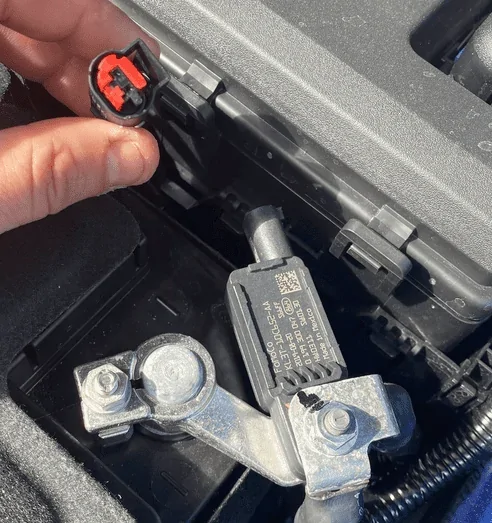
2-Wire but 3 total connections

It's connected to the (Neg) terminal (Grd) - (1)-connection
The Connector: (2-Wire)
one routes to the BCM (LIN) and the other routes over to the (+ Pos) side of the battery BMFL as noted in my pic.

Keep in mind that the Alternator (B+) is also connected to the BMFL, so by chance this BMS sensor is shorted the (Alternator) may be picking it up via the (Bat+) feed
This is why I recommended disconnecting this connector and see what it does.

You need to set up the scan tool to view and monitor 2 separate modules.
The PCM and BCM to see all the relevant PIDs - I posted ALL Available
You should also be able to (Bi-Direction) control the Desired Voltage by adjusting the Duty Cycle (PCM)
This is depending on the (Level of the Scan Tool) you have.


1763418008014-g9.webp
I use forscan with
Correct - The Alternator has 2 connections:
B+ and a single wire (LIN) control - this is a data bus wire and its PWM variable voltage.
This is also 2 way communication.
The LIN here is between the PCM & Alternator
The PCM itself is the master for controlling the Alternator / Regulator Output using various inputs the PCM is receiving from other sensors and modules.
(This is where the manuals lack - DETAILED information)
What are the exact factors that determine the output.

One of the factors is the BMS (Battery Mgmt System) which incorporates a sensor on the (-Neg) battery post.
This system also works via LIN between the BMS sensor and the BCM
Ref my post (Pic) of the BCM PIDs

The data the BCM sees here is relayed to the PCM to (play a partial role) in factoring the Alternator output and the Desired Setpoint. (Via - Can Bus) communication


BMS Sensor:
2-Wire but 3 total connections

It's connected to the (Neg) terminal (Grd) - (1)-connection
The Connector: (2-Wire)
one routes to the BCM (LIN) and the other routes over to the (+ Pos) side of the battery BMFL as noted in my pic.

Keep in mind that the Alternator (B+) is also connected to the BMFL, so by chance this BMS sensor is shorted the (Alternator) may be picking it up via the (Bat+) feed
This is why I recommended disconnecting this connector and see what it does.

You need to set up the scan tool to view and monitor 2 separate modules.
The PCM and BCM to see all the relevant PIDs - I posted ALL Available
You should also be able to (Bi-Direction) control the Desired Voltage by adjusting the Duty Cycle (PCM)
This is depending on the (Level of the Scan Tool) you have.



1763418008014-g9.webp
I will come back to you at the weekend mate with information we have had the first snow of the winter im gunna throw it in a mates garage at the weekend, i use forscan with genuine vcm2, i have frds but having issues with the licence
 
OP
OP
airline tech

airline tech

Well-Known Member
Joined
Aug 24, 2022
Threads
28
Messages
4,448
Reaction score
8,501
Location
Midwest - KS
Vehicle(s)
2022 Ranger Lariat-Super Crew, Cactus Gray
Occupation
Aircraft Tech
I use forscan with

I will come back to you at the weekend mate with information we have had the first snow of the winter im gunna throw it in a mates garage at the weekend, i use forscan with genuine vcm2, i have frds but having issues with the licence
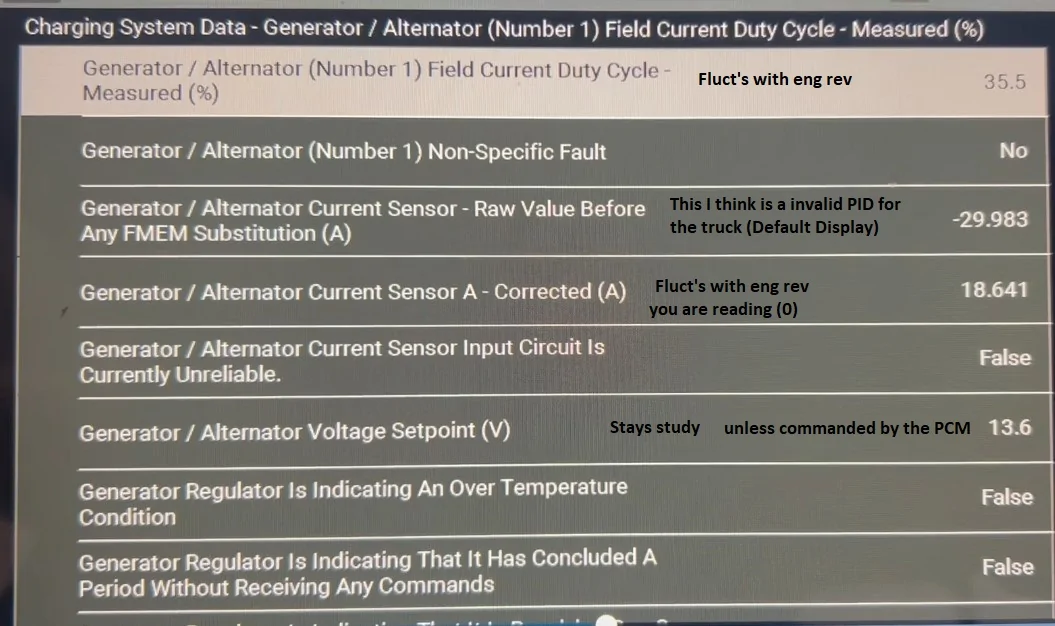
This is where you are faulting - this screenshot is at idle, if I rev the engine (duplicating) yours
the Duty Cycle & Current Sensor rapidly increase (quick snaps)
The PCM is not picking up (receiving) that the alternator is producing output current which is feedback (ref) on the LIN.
You can see the PCM side of the circuit is working as its setting a desired setpoint, so either the alternator is bad, or the LIN circuit is bad, most likely a bad connection (heat) increases the resistance on the circuit, and a bad connection is disabling the output.

Chargeing PIDs.webp
 

colin39

Active Member
First Name
Colin
Joined
Sep 12, 2025
Threads
1
Messages
36
Reaction score
23
Location
Y-uk
Vehicle(s)
3.2 ranger with issues
Occupation
Mechanic believe it or not
This is where you are faulting - this screenshot is at idle, if I rev the engine (duplicating) yours
the Duty Cycle & Current Sensor rapidly increase (quick snaps)
The PCM is not picking up (receiving) that the alternator is producing output current which is feedback (ref) on the LIN.
You can see the PCM side of the circuit is working as its setting a desired setpoint, so either the alternator is bad, or the LIN circuit is bad, most likely a bad connection (heat) increases the resistance on the circuit, and a bad connection is disabling the output.
Chargeing PIDs.webp

Im of a similar opinion tbh , im going to run a surface lin wire saturday and see if my , and your theory is the same 👍🏻
 

RangerBill

Well-Known Member
First Name
Bob
Joined
Jun 8, 2022
Threads
3
Messages
1,601
Reaction score
2,123
Location
PA
Vehicle(s)
2019 Ford Ranger Lariat Super Crew FX4
Occupation
retired
This is where you are faulting - this screenshot is at idle, if I rev the engine (duplicating) yours
the Duty Cycle & Current Sensor rapidly increase (quick snaps)
The PCM is not picking up (receiving) that the alternator is producing output current which is feedback (ref) on the LIN.
You can see the PCM side of the circuit is working as its setting a desired setpoint, so either the alternator is bad, or the LIN circuit is bad, most likely a bad connection (heat) increases the resistance on the circuit, and a bad connection is disabling the output.
I can't see the alternator causing the engine to cut out. I can see the PCM having a problem causing the engine cut out and the alternator voltage to dip at the same time, since it controls both.


As I said earlier, you can (as a test) unplug the LIN connector on the alternator and run the engine to eliminate it as a possible problem.
 
Last edited:


TJC

Well-Known Member
First Name
Tony
Joined
Aug 28, 2020
Threads
45
Messages
3,930
Reaction score
9,851
Location
North Carolina
Vehicle(s)
93 Miata, 05 Ranger 4x4, 20 Ranger 4x4, 23 CX-5
I know that I drove 125 miles to my destination on Christmas Eve when the alternator in my 2005 Ranger failed halfway into the trip. Few stores open, and the only parts store that had a replacement alternator in stock was at my destination. I don't think I could have made another 5 miles further down the road either! My Optima yellow top never fully recovered from that deep discharge.

But that was the old Ranger with the regulator built into the alternator, the charging system was largely independent of the ECU, not like the digitally controlled overly complicated charging system found in the 5G Rangers. The more complicated the plumbing the easier it is to stop it up!

These knew systems are so intertwined that systems failures show themselves in other (what would normally be) distinct and separate systems.

Example - A DPFE EGR sensor failure creates serious transmission shift issues. I no longer doubt the wildest of ramifications from any system malfunction in modern autos.
 

got3fords

Well-Known Member
First Name
James
Joined
Apr 12, 2021
Threads
131
Messages
5,319
Reaction score
13,805
Location
22973
Vehicle(s)
2026 Marsh Gray Ranger Raptor, 1995 Harley XLH1200
Occupation
Mom Joke Professional
I know that I drove 125 miles to my destination on Christmas Eve when the alternator in my 2005 Ranger failed halfway into the trip. Few stores open, and the only parts store that had a replacement alternator in stock was at my destination. I don't think I could have made another 5 miles further down the road either! My Optima yellow top never fully recovered from that deep discharge.

But that was the old Ranger with the regulator built into the alternator, the charging system was largely independent of the ECU, not like the digitally controlled overly complicated charging system found in the 5G Rangers. The more complicated the plumbing the easier it is to stop it up!

These knew systems are so intertwined that systems failures show themselves in other (what would normally be) distinct and separate systems.

Example - A DPFE EGR sensor failure creates serious transmission shift issues. I no longer doubt the wildest of ramifications from any system malfunction in modern autos.
I had a 90's something Oldsmobile that the alternator crapped out in. I looked at local prices and decided my buddy in Southern Maryland could rebuild it for far cheaper. So I grabbed an extra battery connected in parallel to the one under the hood, jumper cables running from passenger floor to the engine compartment, and took off for the 5ish hour drive. Made it with juice to spare. Stayed the night at buddy's house and drove back the next day with my newly rebuilt alternator.
 
Last edited:

TJC

Well-Known Member
First Name
Tony
Joined
Aug 28, 2020
Threads
45
Messages
3,930
Reaction score
9,851
Location
North Carolina
Vehicle(s)
93 Miata, 05 Ranger 4x4, 20 Ranger 4x4, 23 CX-5
Great story!

You now, I thought I could go further than the 125 miles with my 2005 Ranger, but it was much too close a call. I barely made it and didn't dare turn it off. The last stop light 3 miles from my parent's home had the engine stumbling at idle, and I used the emergency brake to stop as the stop lights drew too much juice and the truck threatened to stall. All of the Christmas tree lights on the dash had lit up 20 miles out, and 5 miles out they went off...but it kept running, miss firing on cylinders as I coasted into their driveway...

And yes the alternator was an easy swap, 15 minutes and done.
 
Last edited:
OP
OP
airline tech

airline tech

Well-Known Member
Joined
Aug 24, 2022
Threads
28
Messages
4,448
Reaction score
8,501
Location
Midwest - KS
Vehicle(s)
2022 Ranger Lariat-Super Crew, Cactus Gray
Occupation
Aircraft Tech
FYI - I updated my OP with some more data.

EDIT: UPDATE: Nov 22, 2025

Overtime I have gained some extra knowledge on the charging system, note still never found a full (This is how the Ranger system works)

Let's Start with this:
I was not having any charging issues but every time I plugged in my scanner, I noted that my Estimated SOC PID was always reading 86% or 87%, despite my raising my SOC to 90% then recently to 95%.
Decided I would perform a BMS Reset - and see if that corrected the issue - so it did
Since I did a new reset (even with the OE Battery - 3 yrs old)

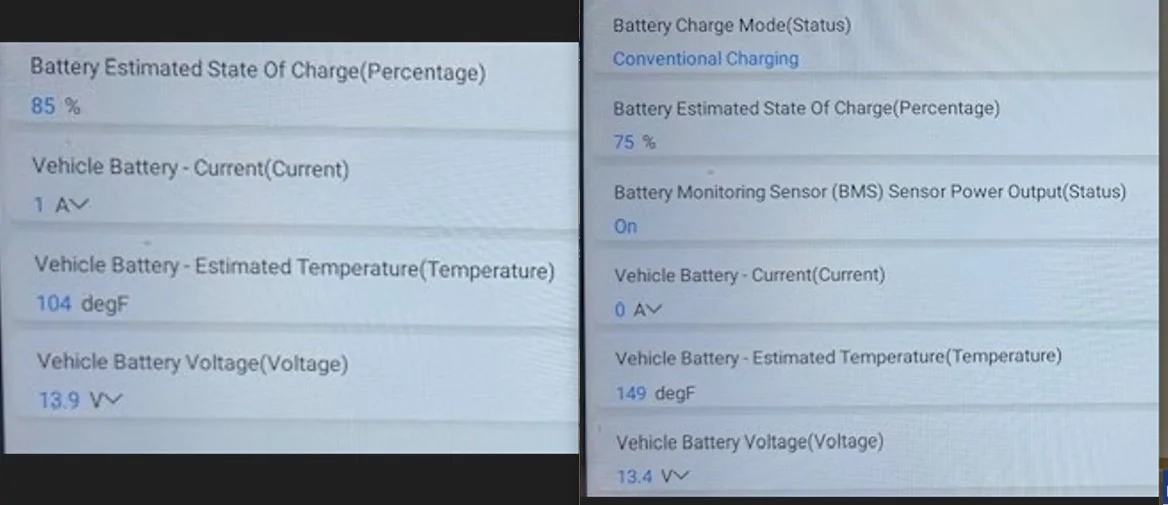
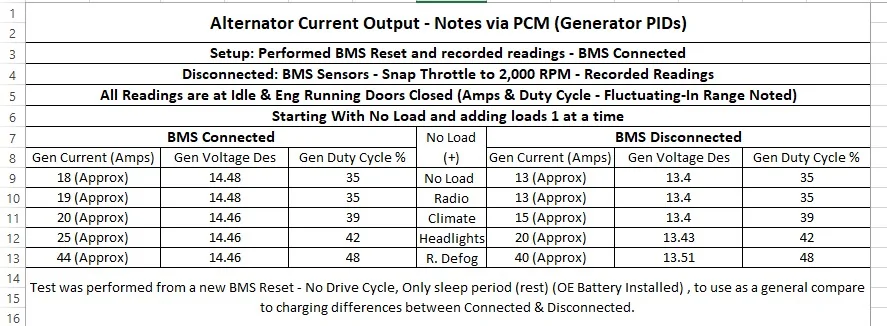
So, compare readings from a newly reset BMS Connected & The BMS Disconnected


Gen Output Data Compare.webp


Although I did not perform this test - Long Term it gave me some indication on what the system actually does with the BMS Sensor Disconnected.

The BMS Sensor: Measures
(Current Flow) In & Out of the battery
Indicated by example (3) = 3 Amps Charge or (-10) = Discharge

Estimated Battery Temperature:
I also CONFIRMED the BMS sensor includes a Temp Sensor, although it's not a direct reading sensor - I hit the sensor with a heat gun, no immediate response with the Estimated Battery Temperature Sensor (PID) after a couple of quick passes I was able to get a change in the temp reading.
Note: It held that reading for quite some time before it began dropping back down

Battery Voltage:
The Battery Voltage is picked up from the (+) wire that runs to the sensor.

This is where the BMS system calculates the Battery SOC, based on all parameters
This information is (Confirmed)

I figured out the reason for the statement in the manuals regarding the BMS (Recalibration) cycle
during SLEEP cycles -6 to 8 Hours of sleep to accurately determine the battery SOC.
It's a combination of 2 things:
1. Allow all modules to enter sleep
2. Allow the BMS Sensor to Reach (At Rest) temperatures without being influenced by Engine Running Temp & Electrical Influence from charging. - This is the main reason for the Time Length.
From my testing with the Heat Gun (Influence)
3. The BMS Sensor samples Battery Voltage after all modules are asleep and factors in (resting) sensor temp - To calculate the ESTIMATED BATTERY SOC and at next engine start this data table is used by the PCM to determine charging rate. (Desired Generator Output) Voltage via the Duty Cycle.

Information from the BMS Sensor is sent to the BCM, The BCM sends this data to the PCM via HS-CAN 1 data and this data is used by the PCM in partial factor of how it controls the Generator Output - Sets the Generator Voltage Desired & PWM Duty Cycle

Now, this is where the manuals leave you hanging and the following will be noted as confirmed or not confirmed

The PCM uses various data inputs to determine Generator output:
The PCM uses the (IAT) Intake Air Temp as a ref to perceived battery temp (Not Confirmed)
The PCM uses Throttle Position / Eng RPM / Vech Speed / Engine Load (Confirmed)
The PCM uses the BCM (input Data from the BMS Sensor) (Confirmed)
The Generator Regulator (has its own temp sensor) reports OH condition PID (Confirmed)
The PCM uses feedback (LIN) data to read the Generator -output current (Load) (Confimed)


The PCM has various MODES of operation:

Start-Up Mode: (Confirmed)
This mode turns off the gen output power, and it defaults to:
0% Duty Cycle and a Gen Voltage Desired of 10.6 Volts, I have noted with my voltmeter plugged into the Power Point - When you Crank the engine - the voltage reading drops to around this voltage. (This explains why)
This takes the load off of the crankshaft, faster starts
The system (if needed) ramps up (boosts) the Gen Desired Voltage up to 14.5 Volts, just after start to replenish voltage lost for engine start (approx. 30-Seconds) if battery was full charge.
Then drops the voltage back down to (normal charge mode)

Charge Mode: (Confirmed)
Activates when SOC is low, now if you have set the SOC to a higher SOC than the factory, it will spend most of its time in this mode.
Charge voltage still fluctuates depending on the PCM parameters it is seeing.
It also activates when there is a high load

Fuel Economy Mode / Voltage Reduction Mode: (Confirmed)
(This is mainly for the factory low SOC)
This is the PCM control to set the Desired Voltage Setpoint to a lower value, as low as 12.2 Volts (Float Charge)
This reduces load on the crankshaft and improves fuel economy - (PERCIEVED Statement)
This lets the generator turn off the charge voltage and the system relies on battery voltage.
More noted @ low RPM /idle settings, alternator not seeing RPM increase.
Since this Mode is not always seen (as I have raised my SOC) I never see it anymore.
Some D&O's State mode activates (IF) - (Not-Confirmed)
AMB Temp - above 32 Deg F
Caliculated Battery Current is less than 15 Amps and Greater Than (-8) Amps
Battery SOC is Greater Than 75%


Boost Charging: (Confirmed)
This is more noted if you have the factory SOC set.
This mode triggers during deceleration and uses the Alternator (OAD) pulley to achieve this
this will create the momentary boost charge using kinetic energy - More noted on a downhill coast.

Maintenance Refresh Mode: (Confirmed)
This is the mode that covers battery sulfation, and the manuals state that if the battery has been holding at 75% for extended periods of time it boosts the charge voltage up to 15.2 volts.
Another D&O - states if battery voltage is less than 13.2 Volts for 45-Minutes it sets a target charge voltage between 13.9 and 15.2 Volts for 5-Minutes.
I think this is where those that monitor the voltage with a meter are seeing some charging voltage variations.
Its intended function is to get the SOC to advance up out of the 75% setting.

The System Off to Save Battery Message: (Not Confirmed)
We know that the BMS Sensor (what it is reading) triggers this message, but I believe it's not really about the actual battery voltage reading, it's what the BMS Sensor is registering as the SOC reading.
This would explain why you have a good battery voltage test (12.2 Volts or Greater) but if you get this message (Check what the BCM is showing for the Estimated Battery SOC) this calculated reading comes from the BMS Sensor- it periodically updates the sensor while driving and performs a (True & Accurate) reading during sleep (rest)
Note: I think what is happening over time this sensor builds a (Drift Error) and reports false readings - throwing off the charging system and minimum error parameters that trigger the message.
Be it a - Sidetrack of the manuals and perform a BMS Reset, although there is only one Ford Document (GSB) that calls for a BMS Reset for System Error (T-Shoot) most of the document's state only with Battery Replacement
or
Replace as a precautionary maintenance item - depending on what your PID data is showing.


Something I have noticed but never really paid attention to:
All the BMS Sensor and Charging Targets - Relate to the SOC, in my mind it always went to battery voltage:
BUT if you actually think about it and with the BMS (Calibration) it references it being used to get an ACCURATE SOC - Hmm - What if the SOC is off, then then charging system will follow that SOC Calculation, no matter what the actual voltage is.
This would be the SOC Drift - Which is supposed to correct itself on the (Sleep Calibration)
So, a more accurate reading to correct the drift
During (Engine Running) it is measuring the in & Out Current as well as voltage & Temp so the SOC may drift while driving


PCM Control of the Generator (Note all PID data = Generator)
This is a single wire (LIN) circuit than takes place of the old (Gen-Com) & (Gen-Mon) & Sense Wire

LIN (Local Interconnect Network) - PWM with a Ground

PCM: (Master Node)
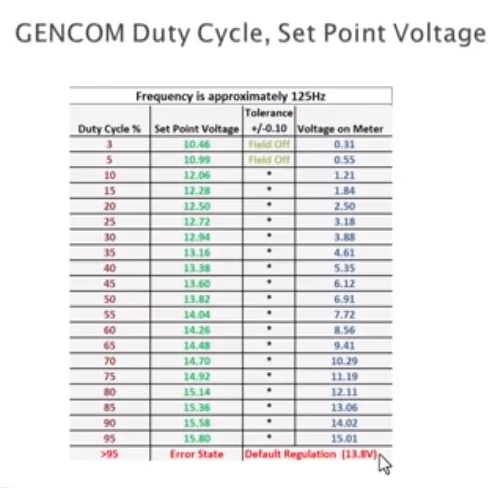
The PCM sets a Desired Generator Voltage (Setpoint) to the Regulator (PWM) 125 Hz Frequency
This is determined by the PCM From:
Set operation Mode: From Above
Engine Parameters -Such as: Throttle Position, RPM, VSS, Engine Load.
IAT (Intake Air Temp) (Perceived Battery Temp) outside of the BMS Sensor Reading
BCM - Input of Battery Condition (BMS Sensor Input)
Feedback from Generator (Current) Load
The Generator is also sending feedback of Generator Temp (Internal) as there is a PID for Gen Overtempt being reported (True/False) - so this would only be a DTC code monitor along with any other failure code DTCs that the PCM is monitoring for the LIN circuit.

Regulator (Slave-Node)
The Regulator in turn from the received data pulses the signal to ground rapidly producing a square wave signal (Duty Cycle) - The field current is being pulsed to ground this in turn controls the output voltage. (Based on the PCM Desired Voltage Setpoint)
The Duty Cycle is measured as a percent (On-Time)
The Duty Cycle (is what controls the voltage output) of the Generator, this is the current (Amps) reading.
The Higher the Duty Cycle - The Higher the output voltage will be.


So, on a PID data list you will see the Duty Cycle and Gen Current PIDs fluctuating.
Every 5-Seconds the Desired Generator Output Voltage is pulsed for change, if no change is required it will not change
To truly see the PWM (Duty Cycle Signals) it needs to be viewed on a Lab Scope

Here is a Ref Data Chart for Duty Cycle T-Shooting - Semi Accurate as a REF Only Guide
Note this is from the old style 3 Wire Control, but works for the LIN Control

Gen Com Duty Cycle Chart.webp


This is me playing:
Wanted to see the BCM PIDs -
Sensor Disconnected Defaults and Sensor Disconnected & a BMS Reset Defaults
Sorry I did not realize I did not have matching PID data for the pics

But before disconnecting:
Bat Volt was 14.1 Volts
SOC 91%
Batt Temp 55 Deg


I was curious if (even though) it's not updating the BCM for data, is this data being transmitted to the PCM for charging data - or is is not being sent due to the fault code that is generated with it disconnected.

As Noted, The BCM still has it powered (ON) by its LIN Bus - so the LIN is still powering the connector for data (dead end connection)
I was questioning how long this default data remained and wanted to know if any of this default data was being transmitted to the PCM. IDK for sure but I believe the fault code blocks the data from being used and the PCM uses IAT as the back-up for battery temp

-----BMS - Disconnected ----------------------- BMS - Disconnected & Then BMS Reset

BMS Disconnected & Reset Disconnected.webp


Attachments
 
Last edited:

colin39

Active Member
First Name
Colin
Joined
Sep 12, 2025
Threads
1
Messages
36
Reaction score
23
Location
Y-uk
Vehicle(s)
3.2 ranger with issues
Occupation
Mechanic believe it or not
I can't see the alternator causing the engine to cut out. I can see the PCM having a problem causing the engine cut out and the alternator voltage to dip at the same time, since it controls both.


As I said earlier, you can (as a test) unplug the LIN connector on the alternator and run the engine to eliminate it as a possible problem.
So i disconnected the lin wire and other than a warning light on the dash it ran fine, and the generator desired voltage didnt change and under load still cut.
I have the engine loom out at the moment looking at all the wiring as i need to find this "generator desired voltage" line but im suspecting its can related.

I have a full wiring diagram
 

colin39

Active Member
First Name
Colin
Joined
Sep 12, 2025
Threads
1
Messages
36
Reaction score
23
Location
Y-uk
Vehicle(s)
3.2 ranger with issues
Occupation
Mechanic believe it or not


Link ☝🏻☝🏻☝🏻 i cant find this generator desired voltage
 

RangerBill

Well-Known Member
First Name
Bob
Joined
Jun 8, 2022
Threads
3
Messages
1,601
Reaction score
2,123
Location
PA
Vehicle(s)
2019 Ford Ranger Lariat Super Crew FX4
Occupation
retired
So i disconnected the lin wire and other than a warning light on the dash it ran fine, and the generator desired voltage didnt change and under load still cut.
I have the engine loom out at the moment looking at all the wiring as i need to find this "generator desired voltage" line but im suspecting its can related.

I have a full wiring diagram
That would be the LIN wiring. That communicates the PCM generator voltage setpoint to the generator.

I am thinking that the generator or its controls is not the cause of your problem, but a symptom of the real problem. I still think you should monitor the power feed to the PCM to see if it is cutting out, causing the engine issue. I can't see a problem with the charging system causing an intermittent engine cut-out.
 
OP
OP
airline tech

airline tech

Well-Known Member
Joined
Aug 24, 2022
Threads
28
Messages
4,448
Reaction score
8,501
Location
Midwest - KS
Vehicle(s)
2022 Ranger Lariat-Super Crew, Cactus Gray
Occupation
Aircraft Tech
That would be the LIN wiring. That communicates the PCM generator voltage setpoint to the generator.

I am thinking that the generator or its controls is not the cause of your problem, but a symptom of the real problem. I still think you should monitor the power feed to the PCM to see if it is cutting out, causing the engine issue. I can't see a problem with the charging system causing an intermittent engine cut-out.
Although you are correct to possibly address the voltage to the PCM as this still may be the issue or something causing a voltage spike (short) as the throttle is increased.

What we need to actually see is (ALL) related PIDs for the charging system to pin it down, we are not seeing that and can only make suggestions at this point.

However, note that a issue on the LIN circuit (voltage rises) as the throttle is increased may be triggering the PCM into LIMP Mode, the same goes for it being disconnected.
So, note: That even with the LIN disconnected there is still power feeding on that wire, if its shorted it will back feed into the PCM - I think this is what we are seeing.
The Ground is being applied via the wire instead of the Regulator and the PCM still thinks the LIN is connected because it is seeing a ground - so it's not going into default charging (Mode) the way it should if you disconnect the LIN wire -it's not seeing an open circuit.
This is why I am FOCUSED on the LIN Circuit.
We are not seeing (ALL) the PIDs for what the Generator does with it disconnected @ Idle and when the RPMs are raised.

So, I agree it's either the PCM (Module Supply) voltage dropping or its the (System Voltage Supply) or the (Inferred Battery Voltage) all of these plus the Desired Set Point Voltage as well as the various other module voltages need to be viewed and the Gen Current and Battery Current.
So, we have a long list of PIDs that we are not being shown, as well as the various PID (fault monitoring) related to the charging system.
It may also be possible that the (LIN) was shorted which again took out the generator (2nd) after it was replaced.
Basically, bottom line is - the PCM appears to have forced LIMP Mode, and this is why the PCM is limiting the RPMs.
Again, a full system scan and or Self-Test Reset of the PCM will / should reveal something as with this test (Automatic) RPM Increase is performed, and it may show something at this point as it will not be able to get a valid response.
 
Last edited:

colin39

Active Member
First Name
Colin
Joined
Sep 12, 2025
Threads
1
Messages
36
Reaction score
23
Location
Y-uk
Vehicle(s)
3.2 ranger with issues
Occupation
Mechanic believe it or not
Although you are correct to possibly address the voltage to the PCM as this still may be the issue or something causing a voltage spike (short) as the throttle is increased.

What we need to actually see is (ALL) related PIDs for the charging system to pin it down, we are not seeing that and can only make suggestions at this point.

However, note that a issue on the LIN circuit (voltage rises) as the throttle is increased may be triggering the PCM into LIMP Mode, the same goes for it being disconnected.
So, note: That even with the LIN disconnected there is still power feeding on that wire, if its shorted it will back feed into the PCM - I think this is what we are seeing.
The Ground is being applied via the wire instead of the Regulator and the PCM still thinks the LIN is connected because it is seeing a ground - so it's not going into default charging (Mode) the way it should if you disconnect the LIN wire -it's not seeing an open circuit.
This is why I am FOCUSED on the LIN Circuit.
We are not seeing (ALL) the PIDs for what the Generator does with it disconnected @ Idle and when the RPMs are raised.

So, I agree it's either the PCM (Module Supply) voltage dropping or its the (System Voltage Supply) or the (Inferred Battery Voltage) all of these plus the Desired Set Point Voltage as well as the various other module voltages need to be viewed and the Gen Current and Battery Current.
So, we have a long list of PIDs that we are not being shown, as well as the various PID (fault monitoring) related to the charging system.
It may also be possible that the (LIN) was shorted which again took out the generator (2nd) after it was replaced.
Basically, bottom line is - the PCM appears to have forced LIMP Mode, and this is why the PCM is limiting the RPMs.
Again, a full system scan and or Self-Test Reset of the PCM will / should reveal something as with this test (Automatic) RPM Increase is performed, and it may show something at this point as it will not be able to get a valid response.
Ok i have pulled the engine harness and checked it end to end with a load device (bulb) and dont get a fault shown.
I will build it back up over the weekend and run it and video a complete engine pid list as it fails and post it up on my youtube page during the week and see what we can see.
Im not giving up on this and at 55 using it as a learning aid 🤣😂 and patience tutorial 👍🏻
 
  • Like
Reactions: TJC
OP
OP
airline tech

airline tech

Well-Known Member
Joined
Aug 24, 2022
Threads
28
Messages
4,448
Reaction score
8,501
Location
Midwest - KS
Vehicle(s)
2022 Ranger Lariat-Super Crew, Cactus Gray
Occupation
Aircraft Tech
I am working on a hunch - but when you get it back together, I need to know any other issues you are having other than throttle limitation.
Anything else noted - hard starting, IPC Messages, door locks not working and I am focused on the Gen Desired Voltage - defaulting to 10.6
Plus, it would help to know, what has been Replaced and or checked so far - Detailed

I have a hunch that the PCM is losing the ISP-R. (Input)
Ignition Switch Position Run - This data is sent across all the data busses.
But for the PCM:
BCM to PAM & PCM - via HSCAN 1

With KOEO (Key on Engine Off) that is the normal Gen Desired Voltage 10.6 Volts, so it MAY possibly be an issue on this circuit, the PCM is thinking the engine should be off as it may be losing the ignition switch position.
I need to dig some more, to see what other factors could trigger the 10.6.
Just throwing out possible.
Sponsored


Top