
Sponsored

Charging Sys-Full Description-Trigger Voltages-Test Results

OP
OP
airline tech

airline tech

Well-Known Member
Joined
Aug 24, 2022
Threads
28
Messages
4,448
Reaction score
8,499
Location
Midwest - KS
Vehicle(s)
2022 Ranger Lariat-Super Crew, Cactus Gray
Occupation
Aircraft Tech
Quick Checks before a deep dive.

Disconnect the BMS Sensor, I have a hunch it may be shorted and taking out the LIN circuit feed
plus, ck and ensure the (Positive) wire from the BMS sensor is connected to the Positive side of the battery.
Pull and inspect the 225 Amp Fuse on the BMFL, do not just visually inspect it.

From here its wire checks on the
1. PCM Power Relay Circuit
2. Battery Cable Runs (Pos & Neg)
3. LIN Circuit to the Alternator
4. BMS Sensor - Feeds to the BCM
5. CAN Bus Data - Monitor (ISPR) Ignition Switch Position (Run)

So, between the PCM & BCM and Live Data PIDs, look for any other PIDs that fluctuate

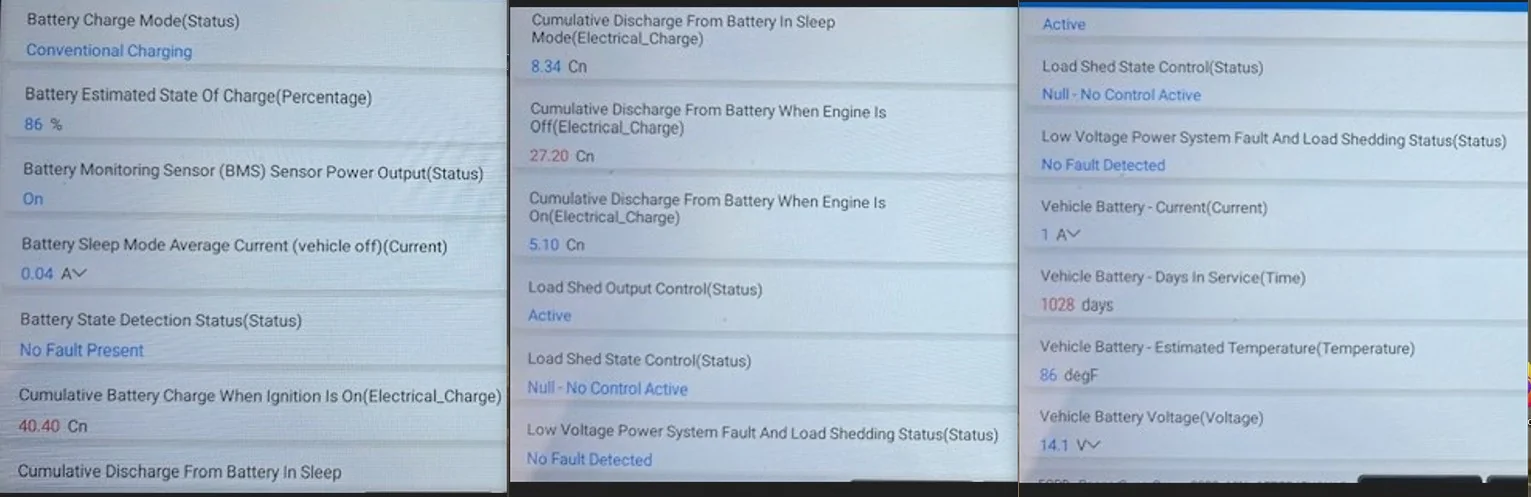
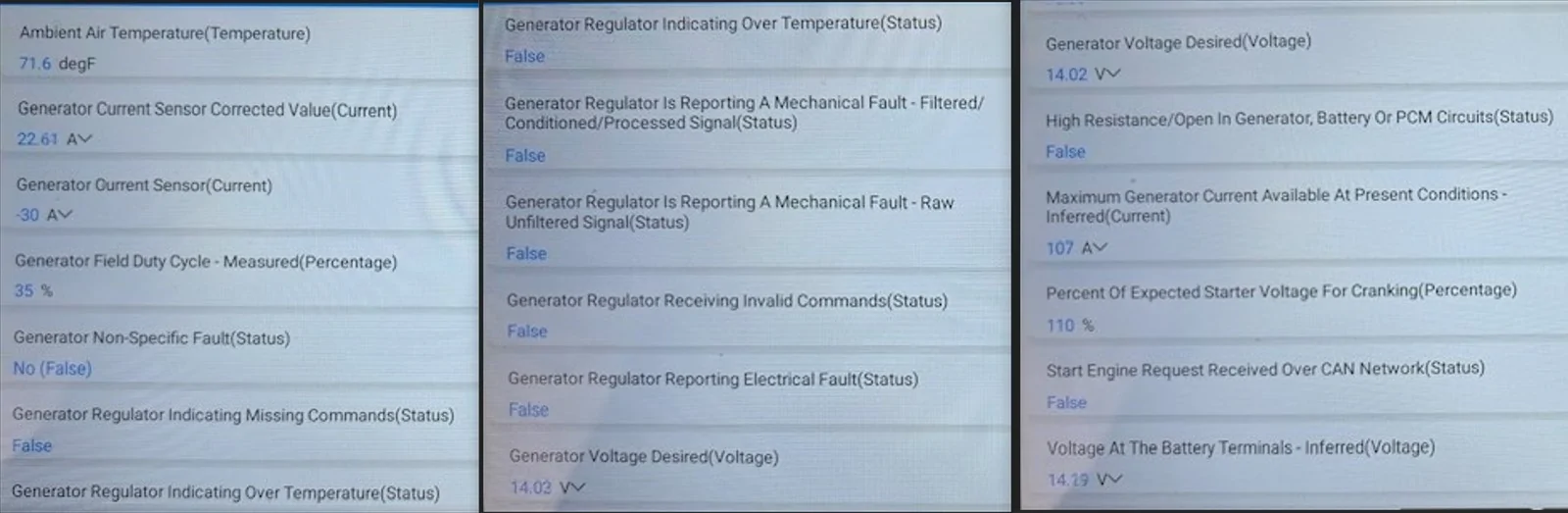
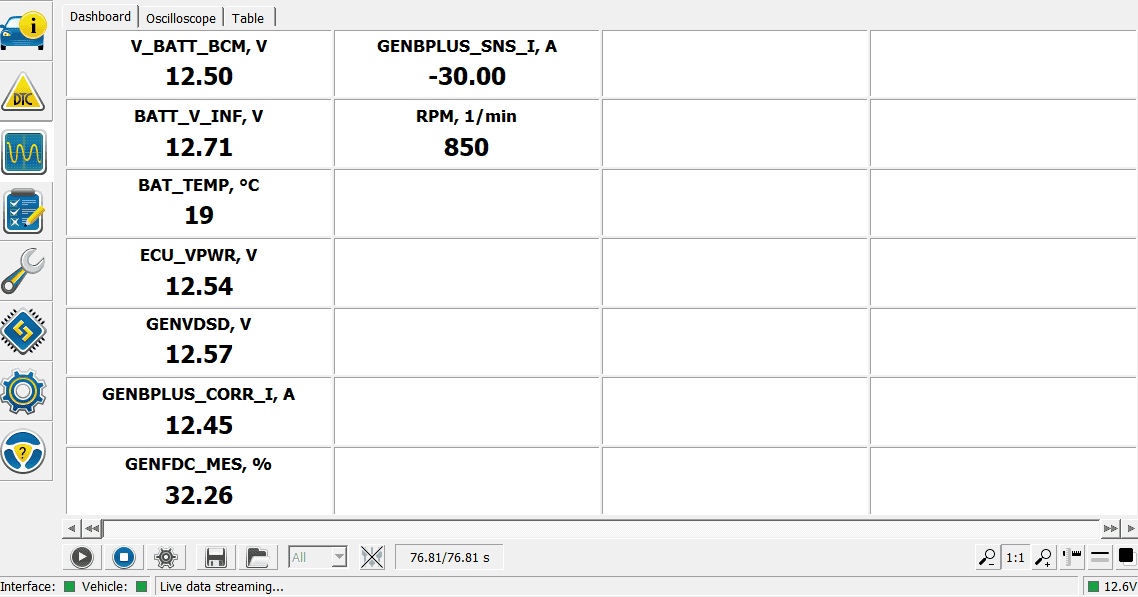
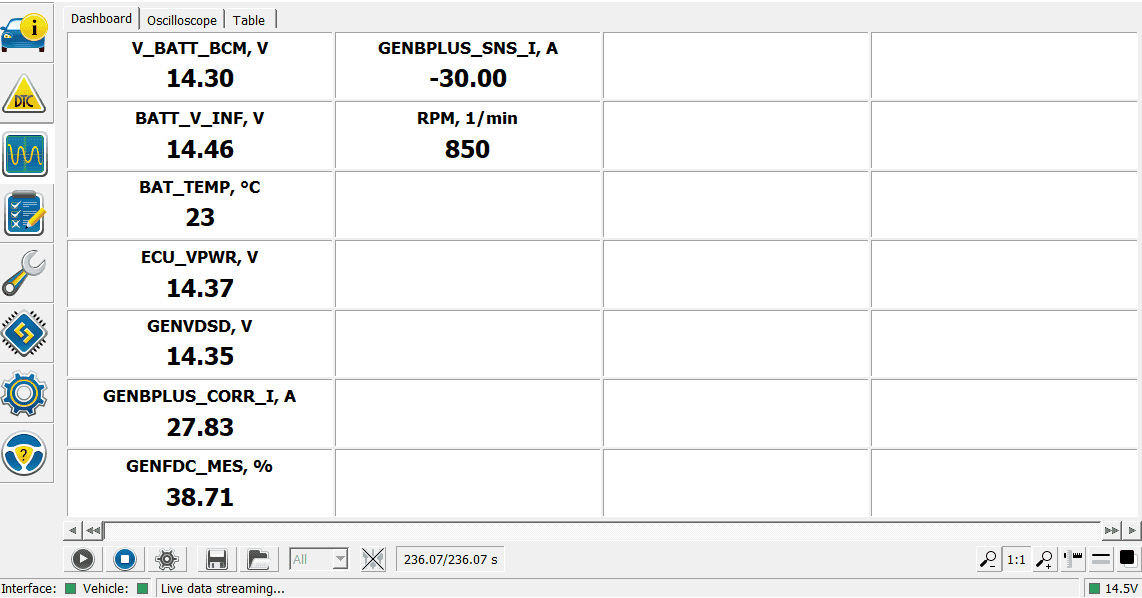
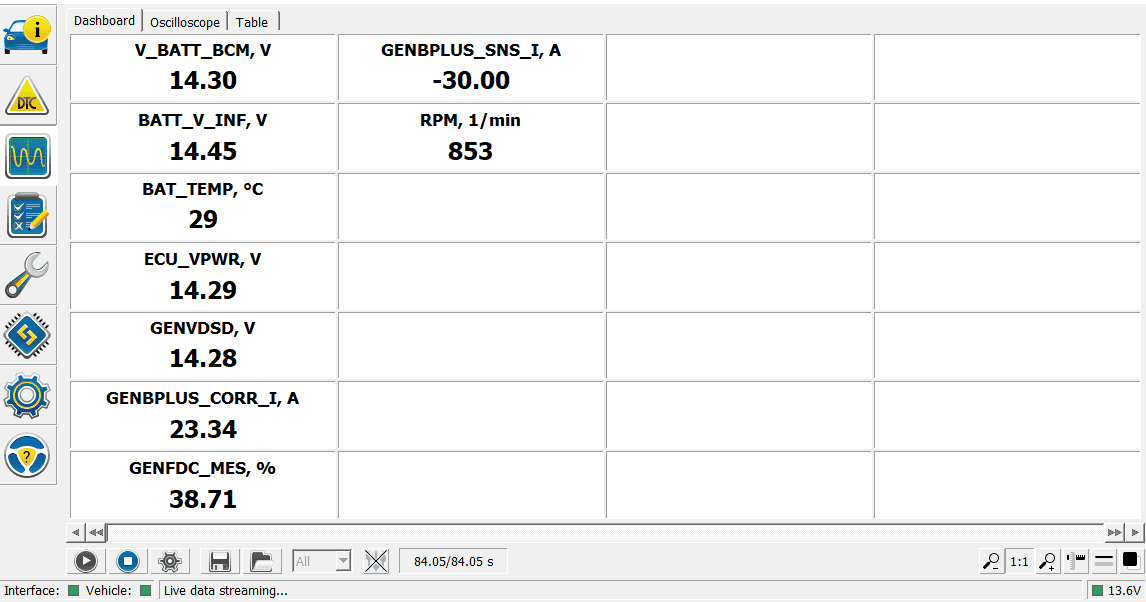
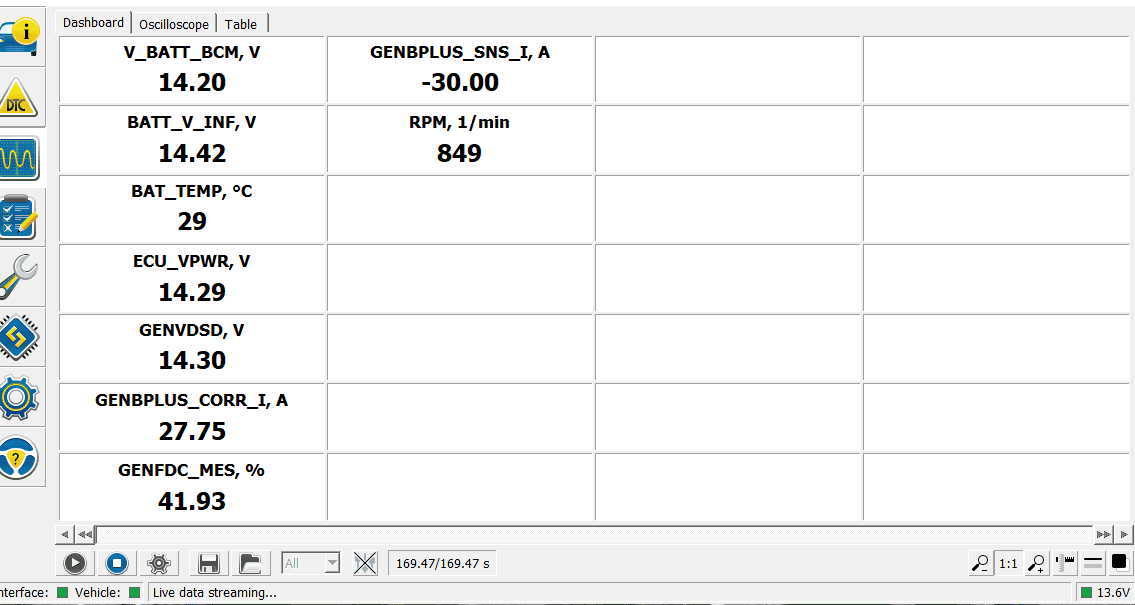
Here are 2 data points of reference from my scan tool for all related PIDs for battery and charging.

All Battery PIDs from the BCM

BCM Battery Final.webp


All Charging PIDs from the PCM

Look at - Generator Current Sensor here, then double check yours again - I see (0) on yours

PCM Charging Final.webp


I am going to backtrack on my initial thought for now and focus on the charging system control vs PCM Power Loss or Short.
I am NOT seeing a normal charging voltage (output) from the alternator - Its intermittent)
If there is a fault on the circuit (It defaults to around 13.5 Volts) and the PCM is being under powered and struggling to stay awake other modules pulling power away.
Your throttle issues are (LIMP Mode) activating - voltage loss / under voltage

My hunch is telling me the issue is on the LIN Circuit either to the BCM or PCM.

You may try - Bi-Directional Control of the Gen Voltage Desired - and see if you can control the circuit - I have a hunch (No) and you will not get a valid result of full control.

The problem is (posting a US vs) diagram - you have a different engine and most likely different pinouts especially on the PCM as you have a TCM, the US Version the (TCM is merged into the PCM)

I suspect the basic circuit itself is the same - it's just most likely going to pinned differently
The BCM and PCM crosstalk on what the BMS Sensor sees, and it is relayed to the PCM for actual control of the charging output.
So, a deeper dive into the PIDs or Bi-Direction control will reveal what's actually happening

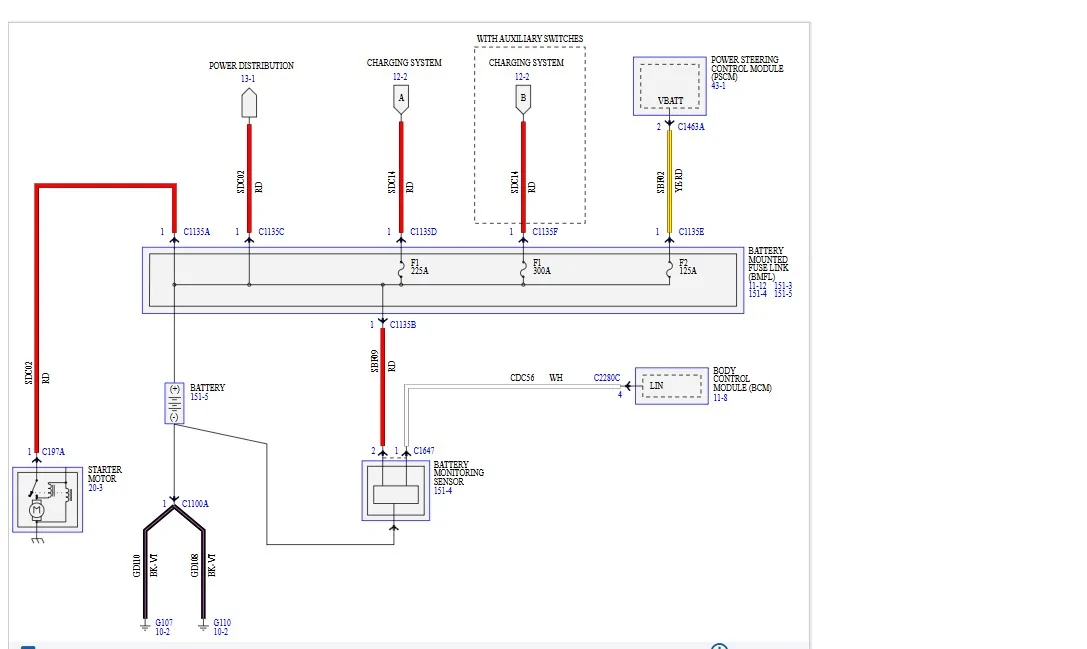
BMS Circuit.webp


Note: The Inline connector C136 - it should be a (2 - Cavity) Single Wire connector near the battery

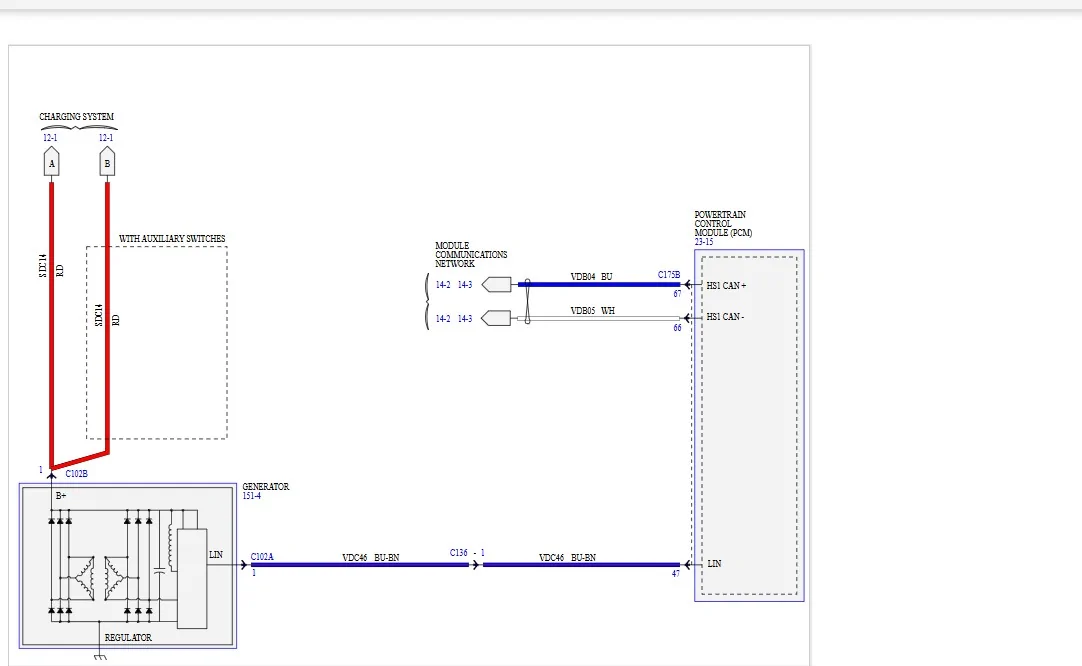
Charging Circuit.webp


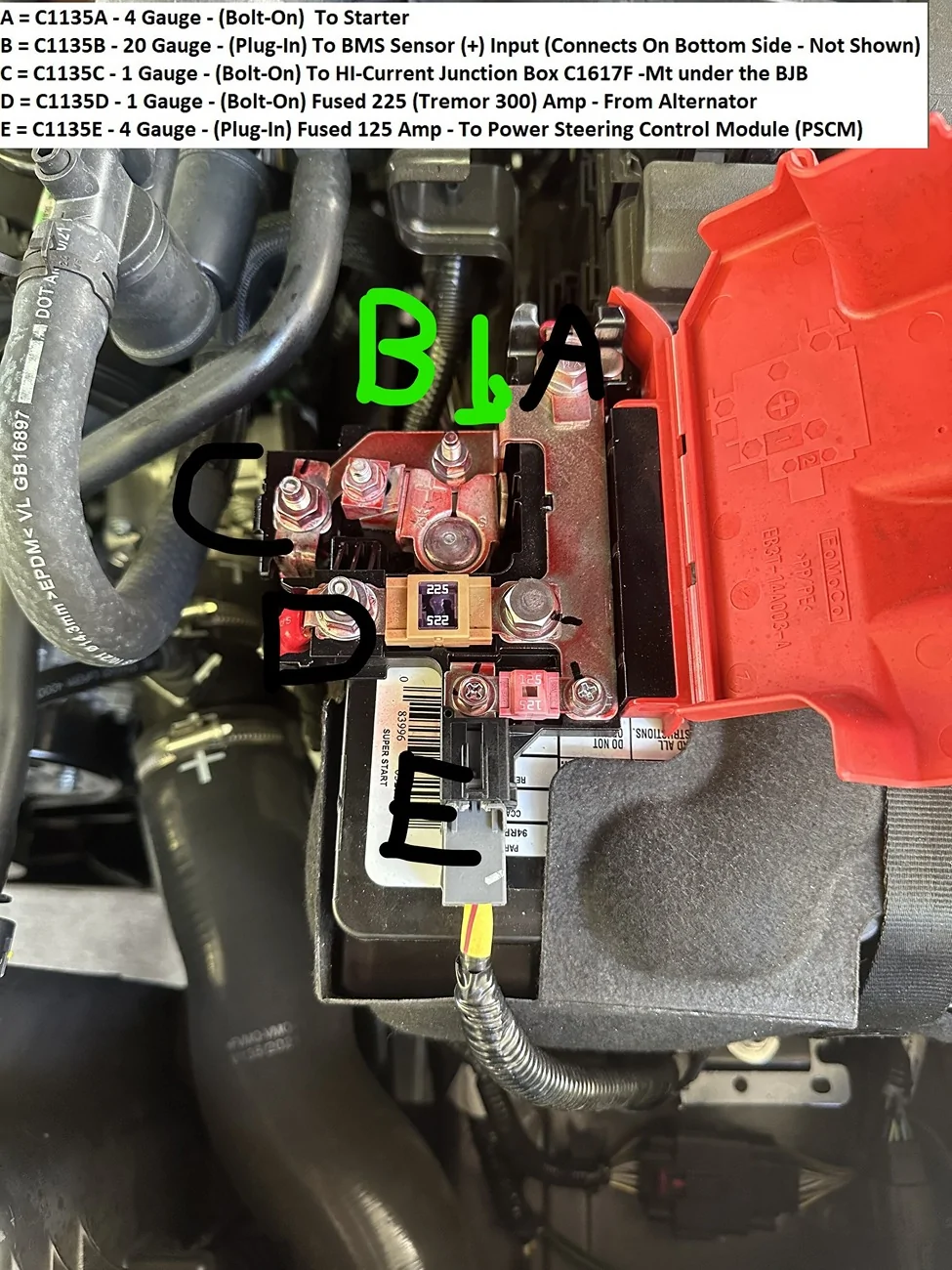
Ensure the 225-Amp fuse is good - remove & inspect, this fuse is prone to vibration damage
Ensure the (Pos) wire from the BMS sensor is connected @ B
Ensure integrity & security of (ALL) battery cables
Ensure the Battery is good and not internally shorted cell


BMFL Detailed.webp


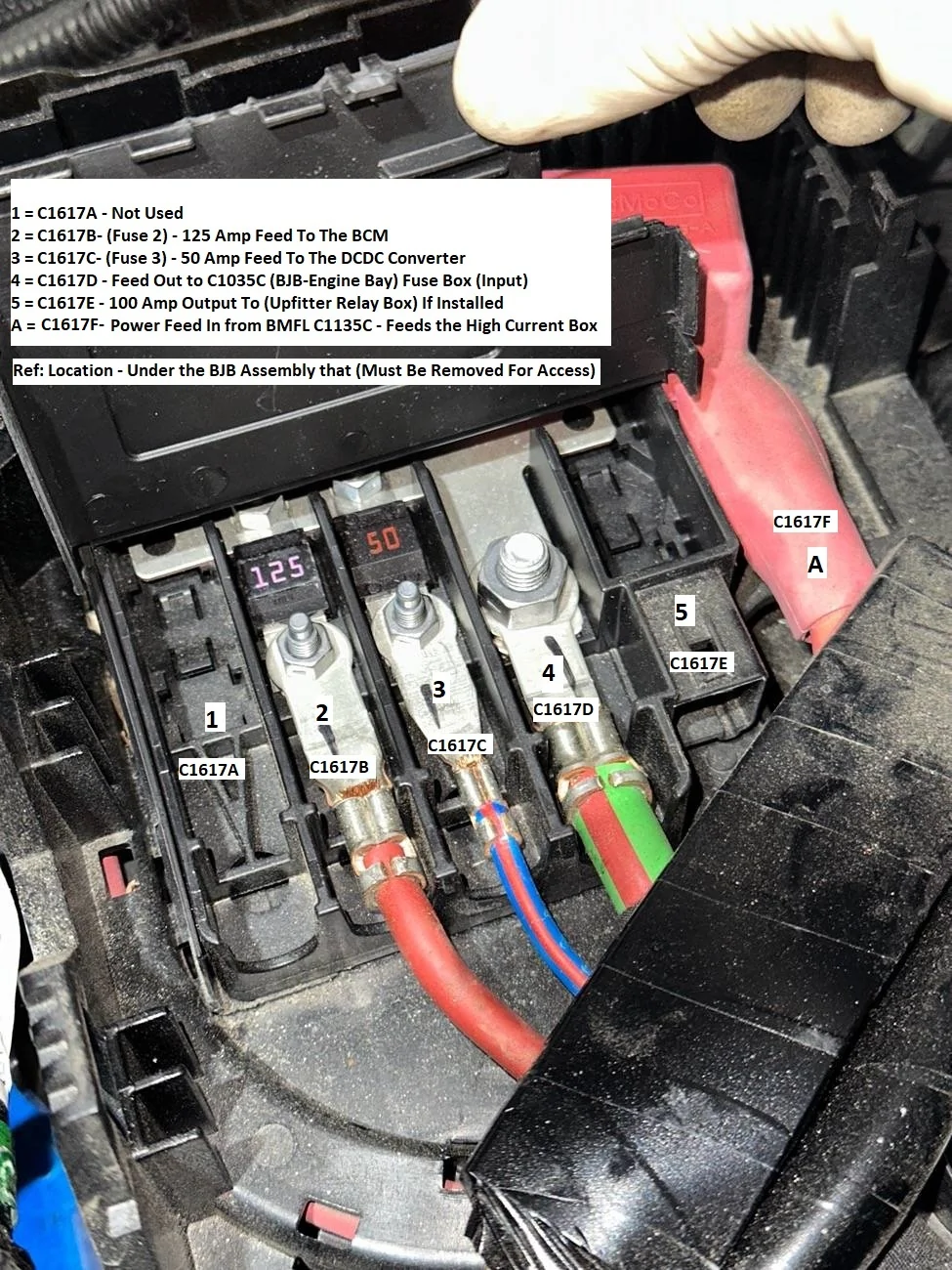
High Current Box - Detailed.webp


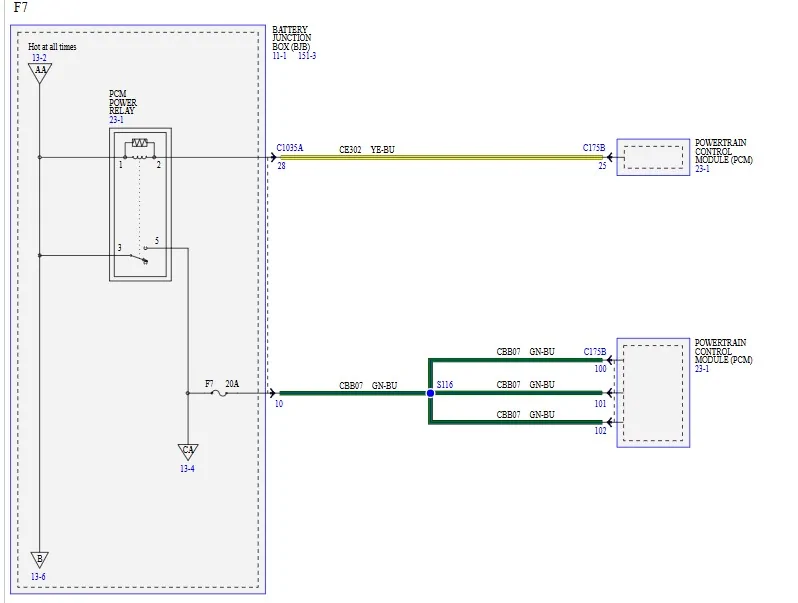
Note: This is for a US Version Ranger
Showing the VPWR feeds to the PCM
Granted I can only offer (this diagram)
Ck Fuse 20 (for corrosion)
Pull and Inspect the PCM Power Relay Contacts (for corrosion)
Pull and inspect the PCM Connector C175B
Pull and Inspect (BJB) Connector C1035A

If needed - Voltage and Resistance Checks on all wiring


If the LIN Circuit checks good, then the issue is here most likely.
But honestly with your video, I am seeing the Gen Desired drop off before the module voltage and its rapidly fluctuating and not holding steady - so this tells me it cannot communicate with the Alternator or the Can Bus Communication between the BCM and PCM is corrupted by a shorted BMS Sensor on that LIN Circuit.


PCM Power Feed.webp
Sponsored

 
Last edited:

TJC

Well-Known Member
First Name
Tony
Joined
Aug 28, 2020
Threads
45
Messages
3,929
Reaction score
9,838
Location
North Carolina
Vehicle(s)
93 Miata, 05 Ranger 4x4, 20 Ranger 4x4, 23 CX-5
I added some test results to my original post.

Edit: Adding Some Further Test Results
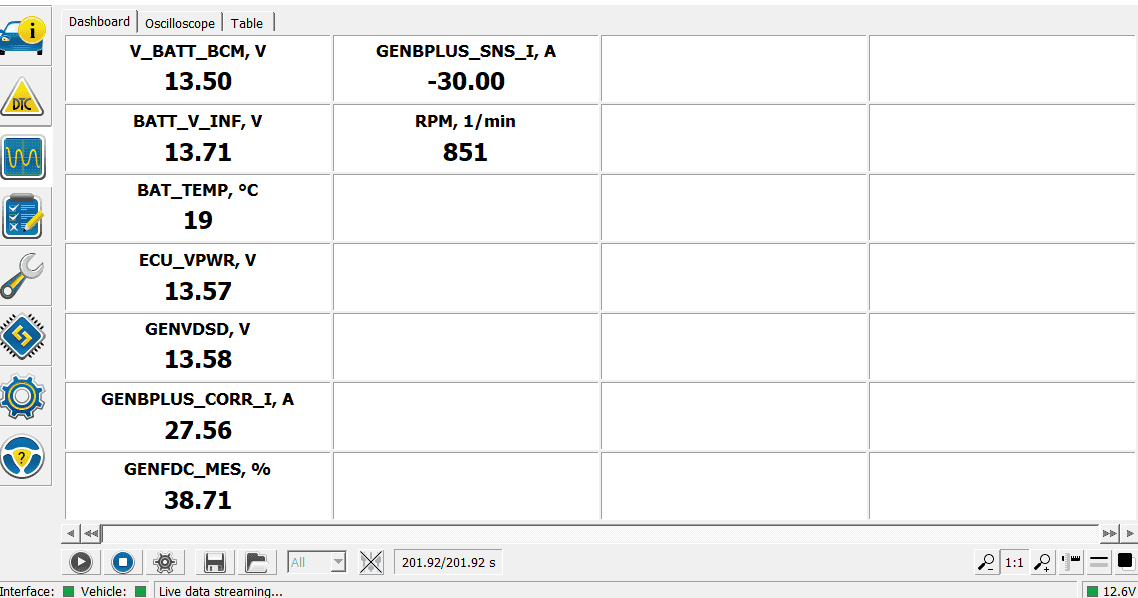
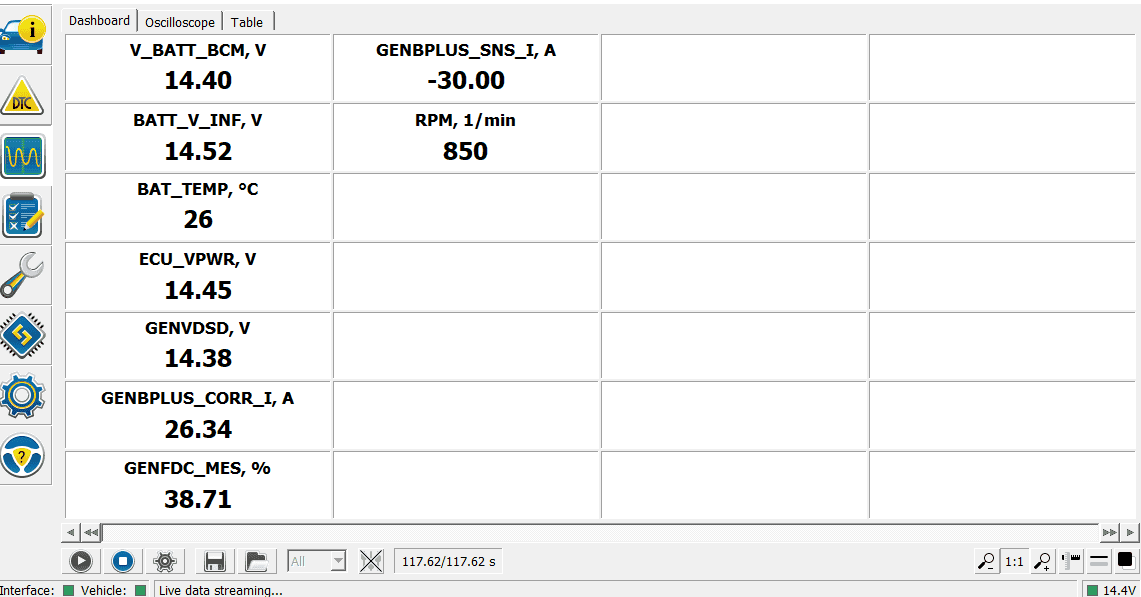
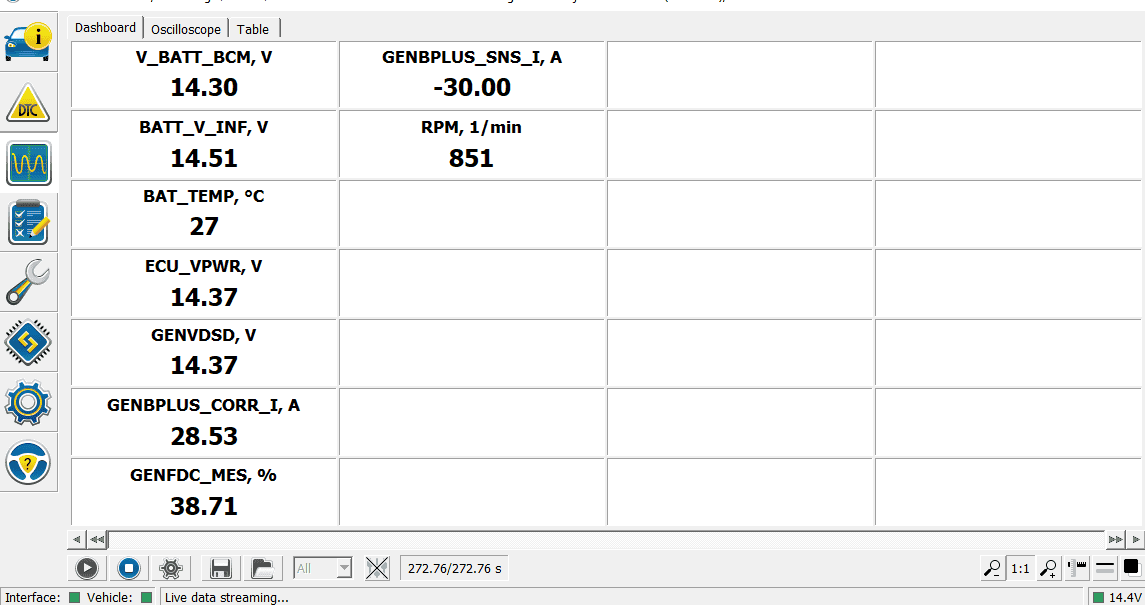
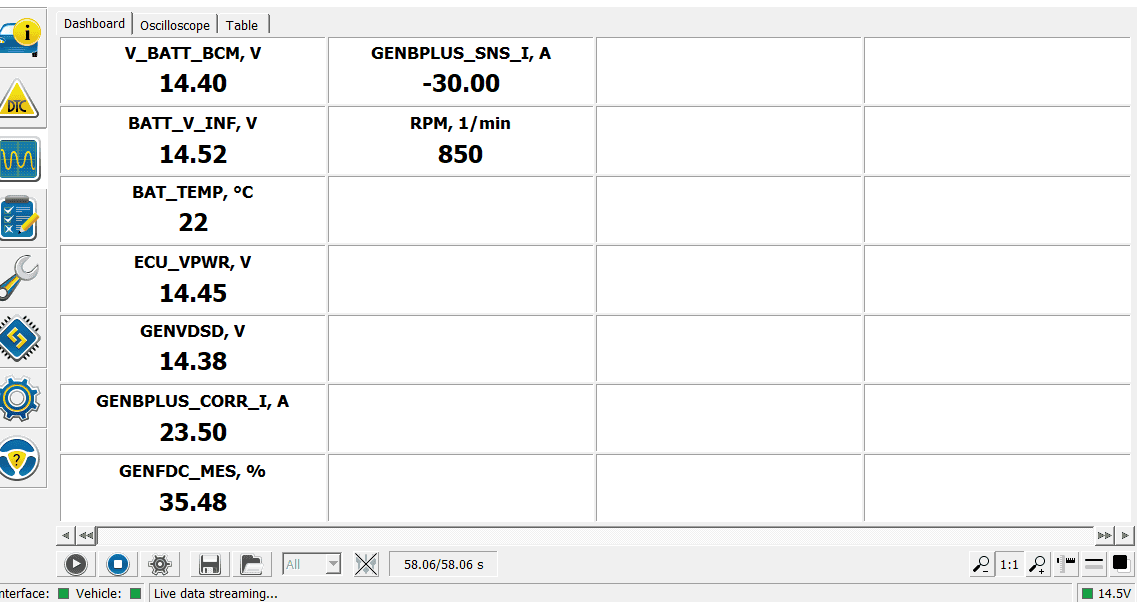
Test Performed At Idle- Monitoring Battery Temp and Amperage
Ran Each Mode 5 Minutes
Noted: The Disable A/Start BCM 726-48-02, does in fact disable BMS function along with A/Start, as this was unclear to me if just the input required for A/Start or the complete system was disabled.

At Factory 75% - Idle, Lights Off

1-idle-75-lights-off-png.png


At Factory 75% - Idle Lights on

2-idle-75-lingts-on-png.png


BMS - Disabled using BCM 726-48-02 Hex Change - Lights off

3-disable-bms-lights-off-png.png


BMS - Disabled using BCM 726-48-02 Hex Change - Lights on

4-disable-bms-lights-on-png.png


Battery Target SOC-Change to 90% - Idle- Lights Off

5-idle-90-lights-off-png.png


Battery Target SOC-Change to 90% - Idle- Lights on

6-idle-90-lights-on-png.png


BMS Sensor-Disconnected - Idle Lights off

7-bms-disconnect-lights-off-png.png


BMS Sensor Disconnected - Idle - Lights on

8-bms-disconnect-lights-on-png.png


Will need to do some actual driving for good numbers on the battery temp, I don't know why I was getting a temp reading with the sensor disconnected, might be default value.
Noted nothing major and no off gassing of the battery during this test run. Outside Air Temp was 48 deg
So, this at least gives a basic indication of the different charging modes:
Main PIDs are Batt BCM = Battery Charging Voltage
GENVDSD = Generator Desired Voltage
Bat Temp
Gen B Plus Corr = Gen Output Amperage
I think for the next tests, I will just focus on Battery Target SOC of 80% and 90%, and complete some drive cycles, then hook up and see what battery temp is reading after a drive.

I attempted and failed to get Forscan to display the Battery SOC, again and determined it is not an option for the Ranger, that would be a great PID to view for testing
A couple of thoughts...

When I disconnect the BMS sensor, I no longer receive Batt Amp or SOC. They remain constant at the last reading.

Re: voltage differentials
I see variances in charge voltages depending on the SOC and temp, even with SOC at 100%. But I see a much greater variance in charge amperage. The closer to the SOC target the lower the charge amperage. It will drop to 0 when it reaches the SOC. A percent or 3 below the SOC target it will drop to 1 amp.

Re: Strange Inconsistencies

There have been 2 times that (SOC at 100) the BMS began dropping charge amperage well before the target SOC.
  • The first time was at 95% SOC. Charge amperage started dropping the typical 3% before reaching the target, except it began dropping to 1 amp charge rate at 92%, and went to 0 at 95%.

  • The second time the truck had sat for 2 weeks and was at a SOC of 80%. Driving 50 miles the same behavior occurred, except it stopped (Amperage) charging at 85% of SOC.
During all this time the Charge Voltage never exceeded 14.3v, and would drop to 14.0 when hitting the target SOC, and at the two instances mentioned above.

Re: Resetting the BMS

After the BMS reset, the battery charge voltage initially went down to 13.5v, and over the next few days slowly adjusted back to 14.0v- 14.3v. If it hits 14.3v, it is momentary. It generally charges at 14.2v, and stays at 14.0v with 0 amperage charge when it reaches the target SOC.

Re: Difference with lights on or off

I'm only monitoring Voltage and Amperage. And both behave the same with lights off or on. I've tested all scenarios, Headlights, High beams, and Fog lights all on at once.

Re: Full charge of Battery via Battery Charger
I use a BatteryMinder 8amp Smart Charger that desulfates as it charges the battery, then goes into Maintenance mode with Desulation on.

After FULLY CHARGING the battery, the next drive out the BMS is back to charging the battery to target of 100% SOC. When BMS sees SOC at 94% it begins to taper the Amperage Charge (typically at 5amps) down to ~3amps, then 2 amps, and by 98% it is at 1 amp charge rate. At 99% it flucuates between 1 and 0. At 100% it is contant 0. Voltage stays at 14v.

It has been a week since the initial manual charge and drive afterwards where BMS charged to my target of 100% SOC. I'll drive it today and see if the BMS has adjusted the SOC Target down again.

I can't explain the behavior, but I can report it... and it appears the BMS is intelligent enough to dynamically adjust the SOC target.
 

colin39

Active Member
First Name
Colin
Joined
Sep 12, 2025
Threads
1
Messages
36
Reaction score
23
Location
Y-uk
Vehicle(s)
3.2 ranger with issues
Occupation
Mechanic believe it or not
IMG_20251117_085606.webp
IMG_20251117_085652.webp


@airline tech , some great and useful info Ok I can check these later this week, my nightmare is I'm on 4am to 1400 shifts this week and work in the centre of London , so I'm not home till 1700 and its dark here then.

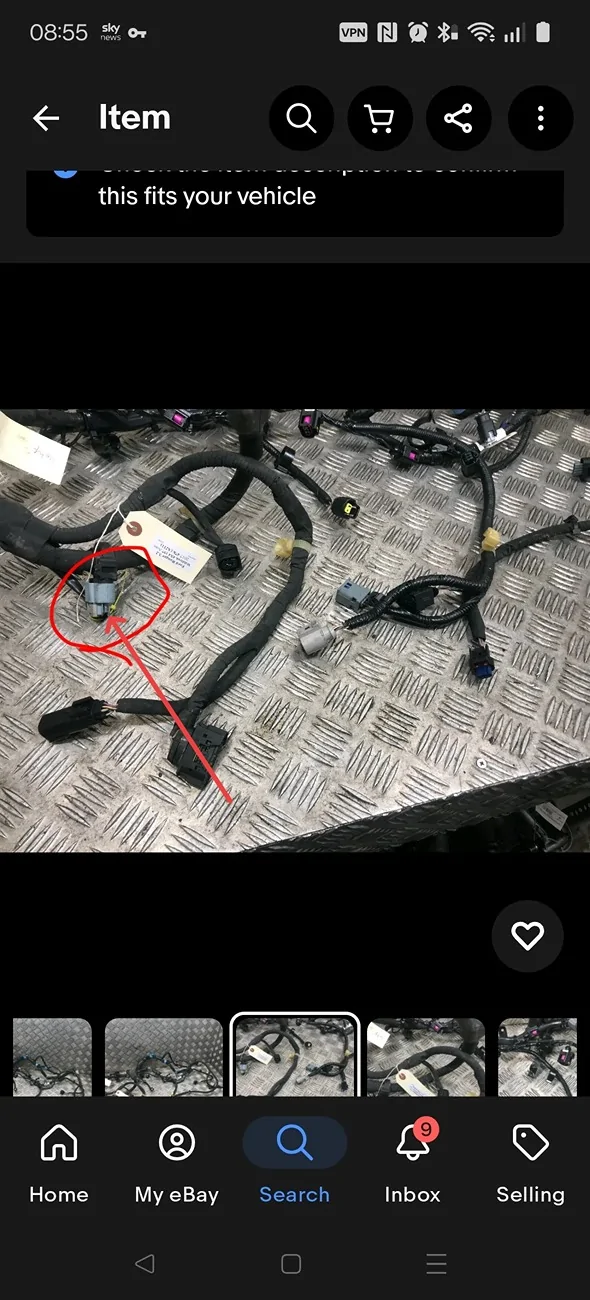
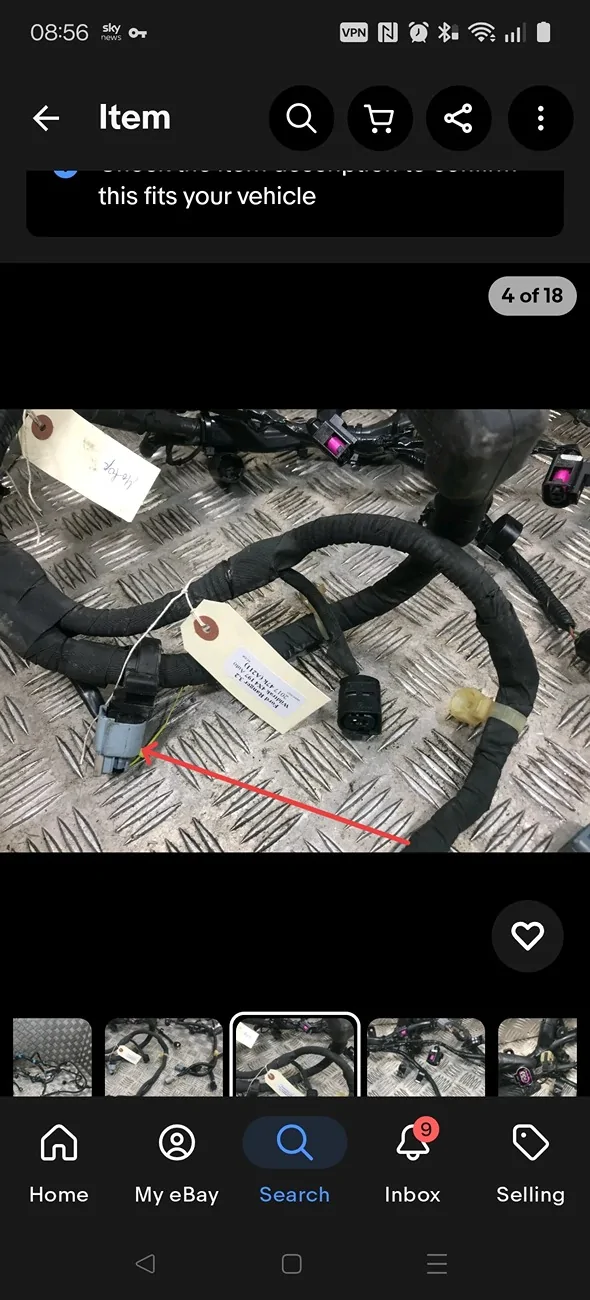
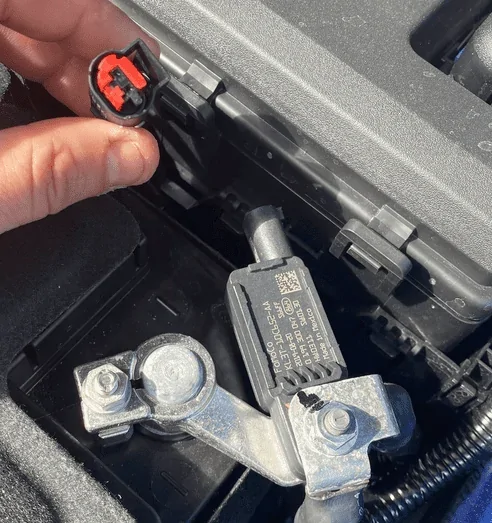
I've posted a couple of images , my alternator only has a 2wire circuit, main b+ and 8.7 volt pcm signal.
But the picture above shows a odd 2 wire plug that is really pushed up against the chassis and if I'm gunna have an issue I'm suspecting it's in that area, but I don't know what it is, years ago we had similar here on imports and it was to do with BMS systems and read a field signal 🤷🏻 obviously I've ripped the images off eBay rather than trying to get a pic of it squashed up in the engine bay.

Colin
 
OP
OP
airline tech

airline tech

Well-Known Member
Joined
Aug 24, 2022
Threads
28
Messages
4,448
Reaction score
8,499
Location
Midwest - KS
Vehicle(s)
2022 Ranger Lariat-Super Crew, Cactus Gray
Occupation
Aircraft Tech
Correct - The Alternator has 2 connections:
B+ and a single wire (LIN) control - this is a data bus wire and its PWM variable voltage.
This is also 2 way communication.
The LIN here is between the PCM & Alternator
The PCM itself is the master for controlling the Alternator / Regulator Output using various inputs the PCM is receiving from other sensors and modules.
(This is where the manuals lack - DETAILED information)
What are the exact factors that determine the output.

One of the factors is the BMS (Battery Mgmt System) which incorporates a sensor on the (-Neg) battery post.
This system also works via LIN between the BMS sensor and the BCM
Ref my post (Pic) of the BCM PIDs

The data the BCM sees here is relayed to the PCM to (play a partial role) in factoring the Alternator output and the Desired Setpoint. (Via - Can Bus) communication


BMS Sensor:
2-Wire but 3 total connections

It's connected to the (Neg) terminal (Grd) - (1)-connection
The Connector: (2-Wire)
one routes to the BCM (LIN) and the other routes over to the (+ Pos) side of the battery BMFL as noted in my pic.

Keep in mind that the Alternator (B+) is also connected to the BMFL, so by chance this BMS sensor is shorted the (Alternator) may be picking it up via the (Bat+) feed
This is why I recommended disconnecting this connector and see what it does.

You need to set up the scan tool to view and monitor 2 separate modules.
The PCM and BCM to see all the relevant PIDs - I posted ALL Available
You should also be able to (Bi-Direction) control the Desired Voltage by adjusting the Duty Cycle (PCM)
This is depending on the (Level of the Scan Tool) you have.


1763418008014-g9.webp
 
OP
OP
airline tech

airline tech

Well-Known Member
Joined
Aug 24, 2022
Threads
28
Messages
4,448
Reaction score
8,499
Location
Midwest - KS
Vehicle(s)
2022 Ranger Lariat-Super Crew, Cactus Gray
Occupation
Aircraft Tech
A couple of thoughts...

When I disconnect the BMS sensor, I no longer receive Batt Amp or SOC. They remain constant at the last reading.

Re: voltage differentials
I see variances in charge voltages depending on the SOC and temp, even with SOC at 100%. But I see a much greater variance in charge amperage. The closer to the SOC target the lower the charge amperage. It will drop to 0 when it reaches the SOC. A percent or 3 below the SOC target it will drop to 1 amp.

Re: Strange Inconsistencies
There have been 2 times that (SOC at 100) the BMS began dropping charge amperage well before the target SOC.
  • The first time was at 95% SOC. Charge amperage started dropping the typical 3% before reaching the target, except it began dropping to 1 amp charge rate at 92%, and went to 0 at 95%.

  • The second time the truck had sat for 2 weeks and was at a SOC of 80%. Driving 50 miles the same behavior occurred, except it stopped (Amperage) charging at 85% of SOC.
During all this time the Charge Voltage never exceeded 14.3v, and would drop to 14.0 when hitting the target SOC, and at the two instances mentioned above.

Re: Resetting the BMS
After the BMS reset, the battery charge voltage initially went down to 13.5v, and over the next few days slowly adjusted back to 14.0v- 14.3v. If it hits 14.3v, it is momentary. It generally charges at 14.2v, and stays at 14.0v with 0 amperage charge when it reaches the target SOC.

Re: Difference with lights on or off
I'm only monitoring Voltage and Amperage. And both behave the same with lights off or on. I've tested all scenarios, Headlights, High beams, and Fog lights all on at once.

Re: Full charge of Battery via Battery Charger
I use a BatteryMinder 8amp Smart Charger that desulfates as it charges the battery, then goes into Maintenance mode with Desulation on.

After FULLY CHARGING the battery, the next drive out the BMS is back to charging the battery to target of 100% SOC. When BMS sees SOC at 94% it begins to taper the Amperage Charge (typically at 5amps) down to ~3amps, then 2 amps, and by 98% it is at 1 amp charge rate. At 99% it flucuates between 1 and 0. At 100% it is contant 0. Voltage stays at 14v.

It has been a week since the initial manual charge and drive afterwards where BMS charged to my target of 100% SOC. I'll drive it today and see if the BMS has adjusted the SOC Target down again.

I can't explain the behavior, but I can report it... and it appears the BMS is intelligent enough to dynamically adjust the SOC target.
I am interested in your testing results as we know that even with the BMS sensor disconnected or disabled the PCM takes full control and does not use the BCM (updated) input.
I think the PCM is still using an algorithm for its charging control, it’s not a SET voltage output as most think - operates just like any old school alternator.
Since the manuals do not get specific on this.
You mention- BMS (Last Known) as an example with it disconnected.
How long does it use it?
It may be a permanent factor for ref for the PCM vs updating.
We know that the PCM is using various engine data to factor the voltage output- I do not know which specific data points.
So - we need to see all:
PCM - As-Builts for charging & Live Data
BCM - As- Builts for Charging & Live Data
most of the PCM as builts is hidden from public view

Do some full testing - Via Live Data
I want to visually see the PCM data response with the BMS disconnected, possibly do a BMS reset with the sensor disconnected and see what the readings default to.
As I said the BCM side of the circuit is only one factor for the charging and it has the factor for the load shed.
The operation of the system is mostly within the PCM control and as of now it’s unknown what specific factors is it using - Temperature is one of them, which specifically IDk I am thinking it’s the IAT
Or Ambient as it’s estimating what the battery temp is. This is where the SOC target is moving on its own (I think)
It’s not looking at actual battery voltage.
Again I am only (thinking) here and since I cannot locate anything that shows the PCM adjust the output voltage by all of these inputs - it’s a guessing game.
This is where a current factory training class would be helpful as my last automotive training course was in the early 90s.
And this is what frustrates me between Aircraft and Automotive, Aircraft gives DETAILED operation where automotive a basic description.
This is very helpful when you work on multiple fleet types and you are in a deep t-shoot of something that is not working correctly.
Same with wiring diagrams they are very detailed and you can see inside the boxes not just a rectangular box with wire pins to terminals.


TJC

Well-Known Member
First Name
Tony
Joined
Aug 28, 2020
Threads
45
Messages
3,929
Reaction score
9,838
Location
North Carolina
Vehicle(s)
93 Miata, 05 Ranger 4x4, 20 Ranger 4x4, 23 CX-5
I am interested in your testing results as we know that even with the BMS sensor disconnected or disabled the PCM takes full control and does not use the BCM (updated) input.
I think the PCM is still using an algorithm for its charging control, it’s not a SET voltage output as most think - operates just like any old school alternator.
Since the manuals do not get specific on this.
You mention- BMS (Last Known) as an example with it disconnected.
How long does it use it?
It may be a permanent factor for ref for the PCM vs updating.
We know that the PCM is using various engine data to factor the voltage output- I do not know which specific data points.
So - we need to see all:
PCM - As-Builts for charging & Live Data
BCM - As- Builts for Charging & Live Data
most of the PCM as builts is hidden from public view

Do some full testing - Via Live Data
I want to visually see the PCM data response with the BMS disconnected, possibly do a BMS reset with the sensor disconnected and see what the readings default to.
As I said the BCM side of the circuit is only one factor for the charging and it has the factor for the load shed.
The operation of the system is mostly within the PCM control and as of now it’s unknown what specific factors is it using - Temperature is one of them, which specifically IDk I am thinking it’s the IAT
Or Ambient as it’s estimating what the battery temp is. This is where the SOC target is moving on its own (I think)
It’s not looking at actual battery voltage.
Again I am only (thinking) here and since I cannot locate anything that shows the PCM adjust the output voltage by all of these inputs - it’s a guessing game.
This is where a current factory training class would be helpful as my last automotive training course was in the early 90s.
And this is what frustrates me between Aircraft and Automotive, Aircraft gives DETAILED operation where automotive a basic description.
This is very helpful when you work on multiple fleet types and you are in a deep t-shoot of something that is not working correctly.
Same with wiring diagrams they are very detailed and you can see inside the boxes not just a rectangular box with wire pins to terminals.
A thoughtful response.

Re: possibly do a BMS reset with the sensor disconnected and see what the readings default to.

Can you define readings? I can do a BMS reset, and tell you SOC, Charge Voltage and Amperage. To do more I need the PID data for each entry... Unless ForScan has them predefined. I could look on my D8 add them to a monitor list and record for some duration. If you could a supply me a list of readings you are looking for, I can see what I can do.

Maybe I should monitor my present settings environment as a baseline, then perform the reset, this would give the delta differences.

I already know that the reset baseline will start to be immediately begin to be adapted to my current condition. I monitored that happen with a couple hundred miles (at most).

FWIW, the Ford Tech in the video I referenced earlier mentioned that the BMS sensor monitored amperage via hall effect sensor, voltage, and temperature. He compared it to the earlier Ford versions with were literally nothing more than a Hall Effect Amp meter. He did not go into specifics. but he seemed to know more than what is documented in the Ford documentation.

That said I am sure ambient temps are being measured at the air intake track to aid in accurate timing, Air fuel ratio, and knock avoidance (not just with knock sensors). So there are at least 2 (maybe 3 if there is a sensor after the intercooler - I always installed one there, right at the throttle body) air temp sensors at work here and Ford is likely using them all.

I don't own the manuals, so I am flying blind. I've got copies of the manual from this site, but they are short on theory, and big on black box signals in and out, but nothing on the firmware or even hardware inside those black boxes.
 

RangerBill

Well-Known Member
First Name
Bob
Joined
Jun 8, 2022
Threads
3
Messages
1,601
Reaction score
2,122
Location
PA
Vehicle(s)
2019 Ford Ranger Lariat Super Crew FX4
Occupation
retired
A thoughtful response.

Re: possibly do a BMS reset with the sensor disconnected and see what the readings default to.
Can you define readings? I can do a BMS reset, and tell you SOC, Charge Voltage and Amperage. To do more I need the PID data for each entry... Unless ForScan has them predefined. I could look on my D8 add them to a monitor list and record for some duration. If you could a supply me a list of readings you are looking for, I can see what I can do.

Maybe I should monitor my present settings environment as a baseline, then perform the reset, this would give the delta differences.

I already know that the reset baseline will start to be immediately begin to be adapted to my current condition. I monitored that happen with a couple hundred miles (at most).

FWIW, the Ford Tech in the video I referenced earlier mentioned that the BMS sensor monitored amperage via hall effect sensor, voltage, and temperature. He compared it to the earlier Ford versions with were literally nothing more than a Hall Effect Amp meter. He did not go into specifics. but he seemed to know more than what is documented in the Ford documentation.

That said I am sure ambient temps are being measured at the air intake track to aid in accurate timing, Air fuel ratio, and knock avoidance (not just with knock sensors). So there are at least 2 (maybe 3 if there is a sensor after the intercooler - I always installed one there, right at the throttle body) air temp sensors at work here and Ford is likely using them all.

I don't own the manuals, so I am flying blind. I've got copies of the manual from this site, but they are short on theory, and big on black box signals in and out, but nothing on the firmware or even hardware inside those black boxes.
See this from the shop manual. Near the end of the document it describes the battery monitoring sensor functions.
 

Attachments

RangerBill

Well-Known Member
First Name
Bob
Joined
Jun 8, 2022
Threads
3
Messages
1,601
Reaction score
2,122
Location
PA
Vehicle(s)
2019 Ford Ranger Lariat Super Crew FX4
Occupation
retired
The operation of the system is mostly within the PCM control and as of now it’s unknown what specific factors is it using - Temperature is one of them, which specifically IDk I am thinking it’s the IAT
Or Ambient as it’s estimating what the battery temp is. This is where the SOC target is moving on its own (I think)
It’s not looking at actual battery voltage.
The BMS supplies battery temperature (from a built-in temp sensor) and battery measured voltage feedback to the PCM. There is a wire from the BMS sensor to the battery positive connection for voltage measurement.
 

TJC

Well-Known Member
First Name
Tony
Joined
Aug 28, 2020
Threads
45
Messages
3,929
Reaction score
9,838
Location
North Carolina
Vehicle(s)
93 Miata, 05 Ranger 4x4, 20 Ranger 4x4, 23 CX-5
The BMS supplies battery temperature (from a built-in temp sensor) and battery measured voltage feedback to the PCM. There is a wire from the BMS sensor to the battery positive connection for voltage measurement.
Thanks for the PDF.

A good overview, but lacking detail. It gives a 50,000' level overview stating what it does, but none of the details such as thresholds, or tables documenting things such as charge voltages, charge amps, and the conditions dictate those charge rates.

For instance, the BMS changes the charging parameters based upon battery age. See the Ford statement below.
NOTICE: Unless the battery is being replaced, DO NOT reset the battery monitoring system using
the diagnostic scan tool. This reset is reserved for new battery installation only. This reset will
clear the learned battery data, the battery time in service, and will affect the aging algorithm
parameters, which have been learned since the installation of the battery.

We all know that as a typical battery ages, internal resistance rises. Ford didn't build a desulfation system into our truck, but they could have, and I strongly believe that they should have.

So I must assume that Ford designed the BMS to not consider the possibility of sulfation being nonexistant in a 5 year old battery.... simply because is it a naturally occuring result of countless discharge cycles and low battery charge conditions (remember the 70%-75% SOC target). Batteries actively sulfate at those charge levels, but that is where Ford not only charges, but actively discharges the batteries in a effort to meet that SOC target!

But does age matter if your battery is well maintained and is still "youthful" after 5 years? I reset the BMS because I want the BMS to maintain my battery at optimal levels based upon the condition of the battery, not its age.

Does Ford take age into the equation? Yes

How about the physics of what is happening inside the battery? I think so, but they expect the worse case.

What weight is put on the above data points? Which is more important?

They clearly want the date data for a reason. How does that info play into the equation. They don't tell us!

My battery is in better condition at this moment then it was 5 years ago when I had low battery warnings sounding off.

BTW, Note that the PDF states that the Electrical Energy Management System monitors the battery current flow, voltage, and temperature to determine the battery state of charge. We assume (it is all we can do) this is all monitored from the data sent from the BMS Sensor module output, but Ford doesn't speak to it.

Proper Engineering maintenance manuals have this type of design data in them.... not simply black boxes with inputs and outputs.

Bottomline here is - All we can do is test to validate our hypothesis, and try to tune the parameters Ford has published in order to maximize battery life. Ford hasn't made that very easy. And based upon my recent observations, there is far more going on than can be explained that the PDF file. Think dynamic SOC targets.

The BMS is a lot like the transmission from a Ford maintenace perpective... Kinda like NOT providing a dipstick and drain plug since Ford states there is no need to change transmission fluid for the life of the vehicle.

Again, just my opinion...
 

RangerBill

Well-Known Member
First Name
Bob
Joined
Jun 8, 2022
Threads
3
Messages
1,601
Reaction score
2,122
Location
PA
Vehicle(s)
2019 Ford Ranger Lariat Super Crew FX4
Occupation
retired
Thanks for the PDF.

A good overview, but lacking detail. It gives a 50,000' level overview stating what it does, but none of the details such as thresholds, or tables documenting things such as charge voltages, charge amps, and the conditions dictate those charge rates.

For instance, the BMS changes the charging parameters based upon battery age. See the Ford statement below.
NOTICE: Unless the battery is being replaced, DO NOT reset the battery monitoring system using
the diagnostic scan tool. This reset is reserved for new battery installation only. This reset will
clear the learned battery data, the battery time in service, and will affect the aging algorithm
parameters, which have been learned since the installation of the battery.

We all know that as a typical battery ages, internal resistance rises. Ford didn't build a desulfation system into our truck, but they could have, and I strongly believe that they should have.

So I must assume that Ford designed the BMS to not consider the possibility of sulfation being nonexistant in a 5 year old battery.... simply because is it a naturally occuring result of countless discharge cycles and low battery charge conditions (remember the 70%-75% SOC target). Batteries actively sulfate at those charge levels, but that is where Ford not only charges, but actively discharges the batteries in a effort to meet that SOC target!

But does age matter if your battery is well maintained and is still "youthful" after 5 years? I reset the BMS because I want the BMS to maintain my battery at optimal levels based upon the condition of the battery, not its age.

Does Ford take age into the equation? Yes

How about the physics of what is happening inside the battery? I think so, but they expect the worse case.

What weight is put on the above data points? Which is more important?

They clearly want the date data for a reason. How does that info play into the equation. They don't tell us!

My battery is in better condition at this moment then it was 5 years ago when I had low battery warnings sounding off.

BTW, Note that the PDF states that the Electrical Energy Management System monitors the battery current flow, voltage, and temperature to determine the battery state of charge. We assume (it is all we can do) this is all monitored from the data sent from the BMS Sensor module output, but Ford doesn't speak to it.

Proper Engineering maintenance manuals have this type of design data in them.... not simply black boxes with inputs and outputs.

Bottomline here is - All we can do is test to validate our hypothesis, and try to tune the parameters Ford has published in order to maximize battery life. Ford hasn't made that very easy. And based upon my recent observations, there is far more going on than can be explained that the PDF file. Think dynamic SOC targets.

The BMS is a lot like the transmission from a Ford maintenace perpective... Kinda like NOT providing a dipstick and drain plug since Ford states there is no need to change transmission fluid for the life of the vehicle.

Again, just my opinion...
Seems that there is some level of de-sulfation that can be commanded by the PCM / BCM.

From the pdf:

The smallest possible set value for the generator voltage is 12.2 volts, while the maximum charging voltage can be anywhere between 14.5 and 14.9 volts. However, when the battery is in a refresh phase, the voltage may occasionally reach up to 15.2 volts. These refresh phases are required when the battery charge status is 80% over long periods of time, which increases the risk of sulfation in the battery cells.
 

dtech

Well-Known Member
Joined
May 10, 2020
Threads
37
Messages
3,135
Reaction score
7,574
Location
colorado
Vehicle(s)
Ranger Lariat FX4, chromed and forever damperless
What I don't believe that the Ford documentation (which may not be 100% accurate, like the Ford tech's Macakalopo youtube vid) are the details of the charging algorithm employed. Most modern charging systems employ a 3 stage algorithm, some 4 (see link below) . With these algorithms and dealing with a chemical entity such as a battery - one can expect to see swings , sometimes difficult to decipher in reported info such as SOC - because it's a calculation based on a number of variables. Likewise a topdon tester showing CCA greatly above the mfg rating can be misleading as CCA has to be taken a 0 degrees F , at that temp a battery is significantly less potent than a room temp reading and I don't know this for sure but I don't believe these inexpensive testers make any adjustments based on temps above 0 F . So I've often seen LiFePO4 batteries when they go into float mode leave the battery at what appears to be less than 100% SOC, those batteries are in a more stable environment (less variables such as temps, BMS, etc) than that in our autos. Why would I not have 100% confidence in Ford's documentation - because like the BMS which essentially is an add-on to existing charging system the documentation is likely just updated as new features were added, when you see that oft times there can be oversights/inaccuracies.

https://www.chargetek.com/assets/equal.pdf
 
OP
OP
airline tech

airline tech

Well-Known Member
Joined
Aug 24, 2022
Threads
28
Messages
4,448
Reaction score
8,499
Location
Midwest - KS
Vehicle(s)
2022 Ranger Lariat-Super Crew, Cactus Gray
Occupation
Aircraft Tech
Seems that there is some level of de-sulfation that can be commanded by the PCM / BCM.

From the pdf:

The smallest possible set value for the generator voltage is 12.2 volts, while the maximum charging voltage can be anywhere between 14.5 and 14.9 volts. However, when the battery is in a refresh phase, the voltage may occasionally reach up to 15.2 volts. These refresh phases are required when the battery charge status is 80% over long periods of time, which increases the risk of sulfation in the battery cells.
That statement never really made full sense to me.
First - we need to substitute 80% for 70% or 75 % (Depending on trim)
The (Refresh Phase) - I believe is 2 things
1. The initial (charge ramp up - just after start)
2. The (Regenerative) boost charge when coasting (off throttle)

So, for both of these - its only momentary

The manuals do not tell you anymore than this.

Plus: a side note for the battery temperature (Estimated)
Depending on which D&O you read for this, as you stated it is incorporated into the BMS sensor itself.
Others it is derived from the temp sensors such as the IAT or AMB

As from an above post and TJC's findings, as one of my tests when disconnecting the sensor was, I still had (Battery Temp) PID indicating.

Now, with TJC reporting he still has indications (Using -LAST KNOWN)
then the Battery Temp (may be coming from the BMS sensor after all)
I guess a check with a handheld meter (Temp) - may provide a resolution as it would be reading the temperature at the sensor - it would at least tell us if it is an actual reading (Estimating the Battery Temp) since there is not an actual sensor touching the battery case.
Or is it (Estimating) using the current flow

Ref: TJC - The readings you lose when you disconnect the sensor, resort to last known.
I am curious (how long) the last known will display before it (dashes) out to (Unknown)

If it stays at (Last Known) - then I am thinking that this data parameter is still being sent to the PCM and it is now a (SET) parameter vs (Updating) parameter.

Either way - The PCM has its own control algorithm of some type and the BCM input is only part of the equation.
This is what I want to figure out - (Curiosity)
It's not a super big deal to me - but more of curiosity of wanting to know how something operates. (In-Detail)
 

RangerBill

Well-Known Member
First Name
Bob
Joined
Jun 8, 2022
Threads
3
Messages
1,601
Reaction score
2,122
Location
PA
Vehicle(s)
2019 Ford Ranger Lariat Super Crew FX4
Occupation
retired
That statement never really made full sense to me.
First - we need to substitute 80% for 70% or 75 % (Depending on trim)
The (Refresh Phase) - I believe is 2 things
1. The initial (charge ramp up - just after start)
2. The (Regenerative) boost charge when coasting (off throttle)

So, for both of these - its only momentary


The manuals do not tell you anymore than this.

Plus: a side note for the battery temperature (Estimated)
Depending on which D&O you read for this, as you stated it is incorporated into the BMS sensor itself.
Others it is derived from the temp sensors such as the IAT or AMB

As from an above post and TJC's findings, as one of my tests when disconnecting the sensor was, I still had (Battery Temp) PID indicating.

Now, with TJC reporting he still has indications (Using -LAST KNOWN)
then the Battery Temp (may be coming from the BMS sensor after all)
I guess a check with a handheld meter (Temp) - may provide a resolution as it would be reading the temperature at the sensor - it would at least tell us if it is an actual reading (Estimating the Battery Temp) since there is not an actual sensor touching the battery case.
Or is it (Estimating) using the current flow

Ref: TJC - The readings you lose when you disconnect the sensor, resort to last known.
I am curious (how long) the last known will display before it (dashes) out to (Unknown)

If it stays at (Last Known) - then I am thinking that this data parameter is still being sent to the PCM and it is now a (SET) parameter vs (Updating) parameter.

Either way - The PCM has its own control algorithm of some type and the BCM input is only part of the equation.
This is what I want to figure out - (Curiosity)
It's not a super big deal to me - but more of curiosity of wanting to know how something operates. (In-Detail)
I have seen my battery voltage at 15.1 volts for a couple of days (short trips), so I don't think the refresh stage is momentary. Since the BMS is clamped to the negative post, it may be able to fairly accurately measure battery temps as internal heat will conduct up the battery post to some unknown degree.
 

TJC

Well-Known Member
First Name
Tony
Joined
Aug 28, 2020
Threads
45
Messages
3,929
Reaction score
9,838
Location
North Carolina
Vehicle(s)
93 Miata, 05 Ranger 4x4, 20 Ranger 4x4, 23 CX-5
Firs, I think you are correct about the "refresh" of the battery.

Ref: TJC - The readings you lose when you disconnect the sensor, resort to last known.
I am curious (how long) the last known will display before it (dashes) out to (Unknown)


2nd, I am using a ScanGauge 3 to read the sensors. I suspect the ScanGauge is only reporting its last known data that it contains in its local memory.

With the BMS sensor disconnected it isn't reporting anything back to the PCM. But there are several possibilities to closely estimate the missing dataset parameters.

I suspect that the PCM has default data in such instances and may use a secondary temperature and voltage source (voltage was received by ScanGauge 3). It certainly can't see an accurate current (amp) draw, but Ford could have easily calculated the current draw of various key devices and come up with a close estimation of current. Voltage could still be measured.

I may be wrong, but if I were coding this work, I'd have a back up firmware algo to cover a failure of the BMS, and apparently Ford has just that, as the BMS still functions well without the sensor.
 
Last edited:

TJC

Well-Known Member
First Name
Tony
Joined
Aug 28, 2020
Threads
45
Messages
3,929
Reaction score
9,838
Location
North Carolina
Vehicle(s)
93 Miata, 05 Ranger 4x4, 20 Ranger 4x4, 23 CX-5
I have seen my battery voltage at 15.1 volts for a couple of days (short trips), so I don't think the refresh stage is momentary. Since the BMS is clamped to the negative post, it may be able to fairly accurately measure battery temps as internal heat will conduct up the battery post to some unknown degree.
I've only seen the 15+ volts when in regenerative mode (coasting or braking even with ASS turned off). But I didn't leave the BMS in that mode very long.

15.1 volts is a very high charge voltage... perhaps your battery SOC charge was low at the time.

I do remember 14.4v for longer periods., but not since I have had the desulfator installed and battery optimized. Now a days, it is 14.0v-14.2v, and this is the real charge voltage, not what is seen from the 12v socket which reads 0.2v low. I do see large amperage swings, esp when just starting the truck... up to 28amps (usually under 20) that very quickly drops to low to mid single digits, the 0 when SOC is reached.
Sponsored

 
Last edited:


Top