
Sponsored

How about some Jokes [Admin: No Politics, Religion, Nudity, Explicit Posts]

Motorpsychology

Well-Known Member
First Name
Chris
Joined
Nov 13, 2019
Threads
21
Messages
3,302
Reaction score
11,535
Location
Prescott, WI
Vehicle(s)
2021 Ranger STX SuperCab 4X4 Carbonized grey; 2025 Mazda CX-90 Platinum Quartz
Occupation
Vagabond


LaBalbe

Well-Known Member
Joined
Dec 14, 2021
Threads
18
Messages
2,197
Reaction score
13,417
Location
Ontario / part-time NC
Vehicle(s)
2020 Ranger Lariat
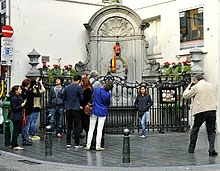
There's a statue in Brussels, Belgium, called the Manneken Pis (Flemish for "Little Pissing Man", "manneken" being "little man" or boy). No one really knows why it was built, but there's a few legends around it; the following are from its Wikipedia entry: https://en.wikipedia.org/wiki/Manneken_Pis

Legends[edit]
220px-Bruselas%2C_Manneken_Pis_3.webp

The surroundings of Manneken Pis give an idea of its size.
There are several legends behind Manneken Pis, but the most famous is one involving Duke Godfrey III of Leuven. In 1142, the troops of this two-year-old lord were battling against the troops of the Berthouts, the lords of Grimbergen, in Ransbeke (now Neder-Over-Heembeek, a northern part of the City of Brussels). To give themselves courage, the soldiers placed the infant lord in a basket which they hung from a large oak tree overlooking the battlefield. While his men were in dire straits, the little duke rose up in the basket, and from his perch, urinated onto the troops of the Berthouts, who eventually lost the battle.[5] The fountain perpetuates the memory of this victory. The name of the Rue du ChĂŞne/Eikstraat ("Oak Tree Street"), at the corner of which the statue is located, recalls the famous tree.[34]

  • Another legend suggests that, in the 14th century, Brussels was under siege by a foreign power. The city had held its ground for some time, so the attackers conceived of a plan to place explosive charges at the city walls. A little boy named Julianske happened to be spying on them, as they were preparing. He urinated on the burning fuse and thus saved the city.[35] There was, at the time (middle of the 15th century, perhaps as early as 1388), a similar statue made of stone. The statue was stolen several times.[5]
  • Another story tells of a wealthy merchant who, during a visit to the city with his family, had his beloved young son go missing. The merchant hastily formed a search party, which scoured all corners of the city, until the boy was found happily urinating in a small garden. The merchant, as a gift of gratitude to the locals who helped out during the search, had the fountain built.[5]
  • Another legend tells that a small boy went missing from his mother, when shopping in the centre of the city. The woman, panic-stricken by the loss of her child, called upon everyone she came across, including the mayor of the city. A citywide search began, and when at last the child was found, he was urinating on the corner of a small street. The story was passed down over time and the statue was erected as a tribute to the well-known legend.[5]
  • Another legend tells of the young boy who was awoken by a fire and was able to put out the fire with his urine. In the end, this helped stop the king's castle from burning down.


Top