
Sponsored

Maximizing Battery Life

airline tech

Well-Known Member
Joined
Aug 24, 2022
Threads
28
Messages
4,458
Reaction score
8,520
Location
Midwest - KS
Vehicle(s)
2022 Ranger Lariat-Super Crew, Cactus Gray
Occupation
Aircraft Tech
I used to see those higher voltages with the old battery and my SOC set to 95% mostly in the cold mornings (40-50 degrees) or colder. When I first put in the new battery and saw the voltage swings I'd sometimes see the voltage briefly go to 14.5 but since setting it to 100% is seems to have calmed things down a bit. It's only been a couple of weeks.

BTW, I tried to reset the battery in both Forscan and using method in the manual but Forscan keeps telling me the battery is almost 1500 days old. Anyone else seen that?

peterb
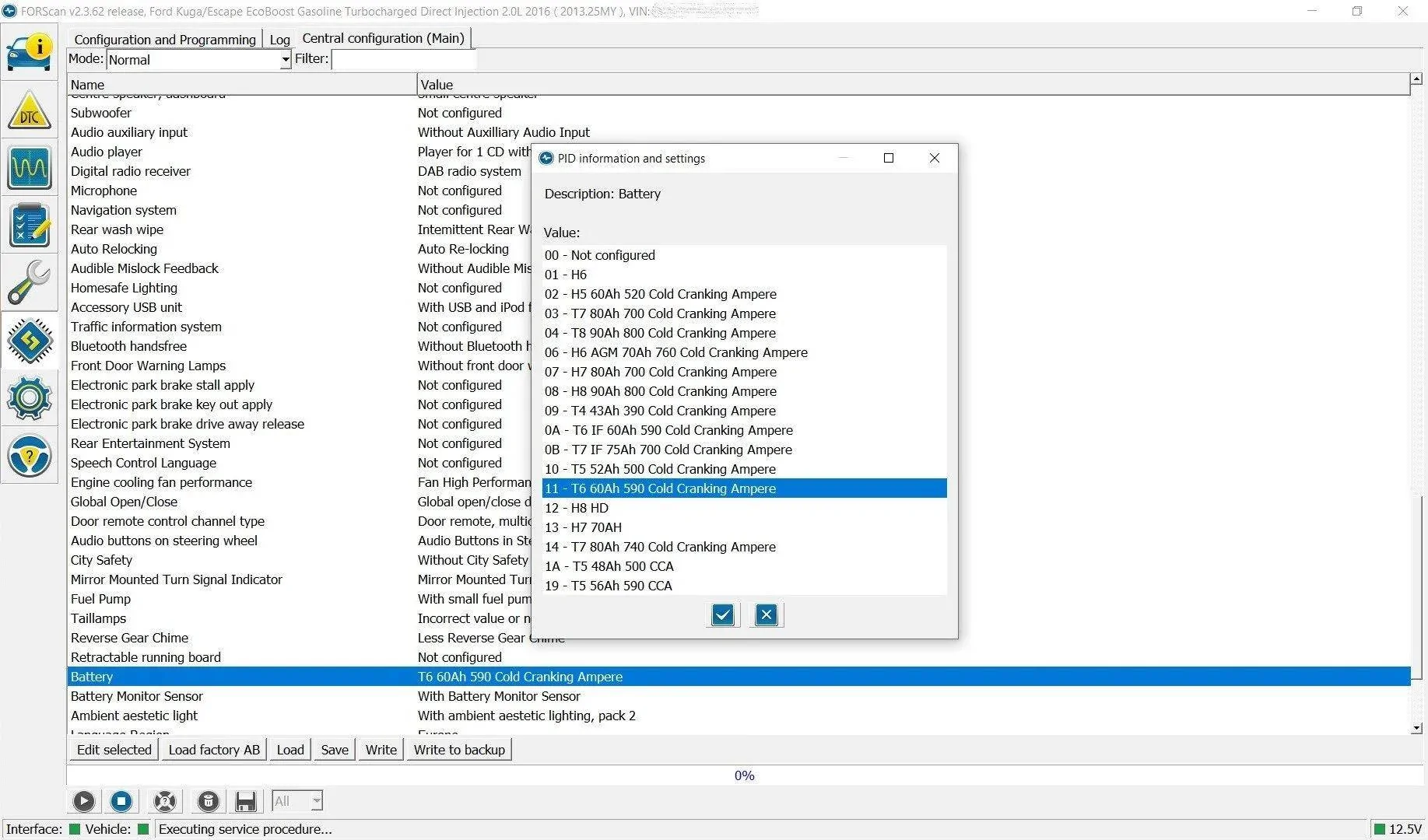
There is another avenue to reset that date - Forscan (Battery Type), note what is currently set (selected) change it to something else and then set it back.
I do not remember off hand if there was a (pre-programmed) selection in Forscan to upgrade up to the Lariat battery (800 CCA) from (720 or 760 CCA).
I do remember there was not a EXACT selection and you have the option to bump the size in either direction.
But the point is changing this selection, changes the Time Since Installed - Date

Another possibility - This makes sense - Forscan - Run a NEW PROFILE and see if it changes, this will force a new module scan and may update that PID.
Sponsored

 
Last edited:
airline tech

Well-Known Member
Joined
Aug 24, 2022
Threads
28
Messages
4,458
Reaction score
8,520
Location
Midwest - KS
Vehicle(s)
2022 Ranger Lariat-Super Crew, Cactus Gray
Occupation
Aircraft Tech
Example: Via Google Search


1731970996385-fx.webp
 

pboggini

Well-Known Member
First Name
Pete
Joined
Nov 30, 2018
Threads
12
Messages
235
Reaction score
253
Location
San Jose, CA
Vehicle(s)
2019 Lightning Blue XL Ranger 4x2 Supercrew.
There is another avenue to reset that date - Forscan (Battery Type), note what is currently set (selected) change it to something else and then set it back.
I do not remember off hand if there was a (pre-programmed) selection in Forscan to upgrade up to the Lariat battery (800 CCA) from (720 or 760 CCA).
I do remember there was not a EXACT selection and you have the option to bump the size in either direction.
But the point is changing this selection, changes the Time Since Installed - Date

Another possibility - This makes sense - Forscan - Run a NEW PROFILE and see if it changes, this will force a new module scan and may update that PID.
Hmm, well since I did take out the stock XL H6 battery and installed the Lariat H7 battery I did change that but it didn't 0 it out. When you say run a NEW PROFILE do you mean to not accept the saved profile when I first connect it?

peterb
 

airline tech

Well-Known Member
Joined
Aug 24, 2022
Threads
28
Messages
4,458
Reaction score
8,520
Location
Midwest - KS
Vehicle(s)
2022 Ranger Lariat-Super Crew, Cactus Gray
Occupation
Aircraft Tech
Hmm, well since I did take out the stock XL H6 battery and installed the Lariat H7 battery I did change that but it didn't 0 it out. When you say run a NEW PROFILE do you mean to not accept the saved profile when I first connect it?

peterb
YES - Try a New Profile and rename it, in fact with the latest update, I remember seeing a pop-up message stating it was recommended, or it was in the download notes when it updated. I do not remember which.
 

got3fords

Well-Known Member
First Name
James
Joined
Apr 12, 2021
Threads
131
Messages
5,322
Reaction score
13,826
Location
22973
Vehicle(s)
2026 Marsh Gray Ranger Raptor, 1995 Harley XLH1200
Occupation
Mom Joke Professional
I never tried setting the SOC to 100% with ASS active. You should be fine as long as you don't see major voltage spikes (> 14.4v) when coasting or braking. If you are seeing charge voltages higher you will be overcharging the battery. Seeing 13.7v - 14.4v range is what you are looking for.
Interesting. I frequently see charging voltages above 14.4V, in fact today, after the Ranger sat for almost a week, it started via app, and I saw charge voltages between 14.75 and 14.85V on the way to work. A/S/S didn't work all day due to "Vehicle Charging". I also see voltages way less, it varies greatly. I've been running an onboard desulfator for quite a while.


dtech

Well-Known Member
Joined
May 10, 2020
Threads
38
Messages
3,137
Reaction score
7,583
Location
colorado
Vehicle(s)
Ranger Lariat FX4, chromed and forever damperless
Interesting. I frequently see charging voltages above 14.4V, in fact today, after the Ranger sat for almost a week, it started via app, and I saw charge voltages between 14.75 and 14.85V on the way to work. A/S/S didn't work all day due to "Vehicle Charging". I also see voltages way less, it varies greatly. I've been running an onboard desulfator for quite a while.
Agm battery can tolerate a charge as high as 15v , but only under certain conditions, like a partially discharged battery, as the soc ramps up towards 100% the charge voltage is lessened as the IR increases and thus the heat generated by too high of a voltage could harm the battery. Systems like Ford uses I believe also take into account either the ambient temps and/or a batt temp sensor so less voltage applied in warmer temps. So seeing 14.8v or so under certain conditions is not cause for alarm.
 

got3fords

Well-Known Member
First Name
James
Joined
Apr 12, 2021
Threads
131
Messages
5,322
Reaction score
13,826
Location
22973
Vehicle(s)
2026 Marsh Gray Ranger Raptor, 1995 Harley XLH1200
Occupation
Mom Joke Professional
Agm battery can tolerate a charge as high as 15v , but only under certain conditions, like a partially discharged battery, as the soc ramps up towards 100% the charge voltage is lessened as the IR increases and thus the heat generated by too high of a voltage could harm the battery. Systems like Ford uses I believe also take into account either the ambient temps and/or a batt temp sensor so less voltage applied in warmer temps. So seeing 14.8v or so under certain conditions is not cause for alarm.
Yeah, not really concerned as I have witnessed wide variances in charge voltage ever since I started monitoring it. I have not witnessed a trend based on outside temp. This morning's drive was probably low 40's. I am on about 3 years, 9 months of ownership, original battery.
 
OP
OP

TJC

Well-Known Member
First Name
Tony
Joined
Aug 28, 2020
Threads
45
Messages
3,940
Reaction score
9,892
Location
North Carolina
Vehicle(s)
93 Miata, 05 Ranger 4x4, 20 Ranger 4x4, 23 CX-5
My range is between 13.8v and 14.6v. Lower in the summer. I am measuring from in the cab so what I see on the meter is 13.6v - 14.4v. Same with my 4G Ranger.
 

got3fords

Well-Known Member
First Name
James
Joined
Apr 12, 2021
Threads
131
Messages
5,322
Reaction score
13,826
Location
22973
Vehicle(s)
2026 Marsh Gray Ranger Raptor, 1995 Harley XLH1200
Occupation
Mom Joke Professional
My range is between 13.8v and 14.6v. Lower in the summer. I am measuring from in the cab so what I see on the meter is 13.6v - 14.4v. Same with my 4G Ranger.
Yes, so that would make my max observed charge voltage just over 15V if the 0.2V drop holds true, and my device is somewhat accurate.
 

maxbottomtime

Well-Known Member
Joined
Jul 12, 2021
Threads
8
Messages
509
Reaction score
839
Location
NE OH
Vehicle(s)
2021 Ranger XLT SCAB 4x4
I found this statement in a Ford GSB on Batteries:
"Battery SOC drops about 10% a month in Transport Mode and more than 20% in Customer Mode"​
I find it interesting that Ford could quantify the Transport Mode drop, but chose "more than 20%" in Customer mode.

Ford targets a SOC of 70% (12.36v) for XL and XLT models, and 75% (12.4v) for Lariat models. That means your brand new battery never sees a full charge using the Ford BMS defaults and starts sulfating immediately, and the process speeds up as the dark current drains your battery to 12v by morning. This is the voltage that I was seeing after my truck sat overnight. Fully charging your battery with a charger doesn't help. As soon as you start your truck Ford BMS drains the battery down to target SOC of 70% or 75%.

Sulfation begins at <=12.4v. It’s also important to note that the battery is best at temperatures of 75F degrees. The rate of self-discharge doubles for every 10 degrees above 75F.

And now you know why people are replacing their batteries between 18 months and 3 years.
I found this statement in a Ford GSB on Batteries:
"Battery SOC drops about 10% a month in Transport Mode and more than 20% in Customer Mode"​
I find it interesting that Ford could quantify the Transport Mode drop, but chose "more than 20%" in Customer mode.

Ford targets a SOC of 70% (12.36v) for XL and XLT models, and 75% (12.4v) for Lariat models. That means your brand new battery never sees a full charge using the Ford BMS defaults and starts sulfating immediately, and the process speeds up as the dark current drains your battery to 12v by morning. This is the voltage that I was seeing after my truck sat overnight. Fully charging your battery with a charger doesn't help. As soon as you start your truck Ford BMS drains the battery down to target SOC of 70% or 75%.

Sulfation begins at <=12.4v. It’s also important to note that the battery is best at temperatures of 75F degrees. The rate of self-discharge doubles for every 10 degrees above 75F.

And now you know why people are replacing their batteries between 18 months and 3 years.
So my first battery lasted 12 months before all remote start features were immediately useless (it was winter, you know, when you'd want to warm the car).

My second battery lasted about 18 months before premature battery preservation. Still starting the car, but clearly on its way. I expect ford will tell me to pound sand, and i'm on my own.

What are best practices? I use my car say 3-5 days per week (depends on week), and average trip is probably 40 minutes, mostly highway. Plenty of time to keep a battery charged. I just changed the target SOC to 80% in forscan (default on my XLT was 75%).

What is the best battery to promote longevity?
 

RangerBill

Well-Known Member
First Name
Bob
Joined
Jun 8, 2022
Threads
3
Messages
1,609
Reaction score
2,132
Location
PA
Vehicle(s)
2019 Ford Ranger Lariat Super Crew FX4
Occupation
retired
So my first battery lasted 12 months before all remote start features were immediately useless (it was winter, you know, when you'd want to warm the car).

My second battery lasted about 18 months before premature battery preservation. Still starting the car, but clearly on its way. I expect ford will tell me to pound sand, and i'm on my own.

What are best practices? I use my car say 3-5 days per week (depends on week), and average trip is probably 40 minutes, mostly highway. Plenty of time to keep a battery charged. I just changed the target SOC to 80% in forscan (default on my XLT was 75%).

What is the best battery to promote longevity?
I would change the battery target SOC to at least 90%, maybe 95%.
 

maxbottomtime

Well-Known Member
Joined
Jul 12, 2021
Threads
8
Messages
509
Reaction score
839
Location
NE OH
Vehicle(s)
2021 Ranger XLT SCAB 4x4

Metalshift

Well-Known Member
Joined
Dec 24, 2019
Threads
2
Messages
91
Reaction score
166
Location
Vancouver Island, BC
Vehicle(s)
2019 XLT
My battery is 66 months old and still at excellent rating. SOC is set at 95% and BMS connected (for discharge protection). About every three months I fully charge with a smart charger (ctek) for a couple of days.
 

FiveChime

Active Member
First Name
Matt
Joined
Sep 12, 2020
Threads
1
Messages
28
Reaction score
7
Location
Baltimore
Vehicle(s)
2019 Ranger
Occupation
Worker bee
I just spent several hours going thru the posts here as I’m at a juncture. Great stuff here!

I’m nearing the end of my original stock H6 battery life (2019 XLT), which was extended due to me installing an additional battery in parallel to help power an insanely large industrial compressor a year or so after getting the truck.

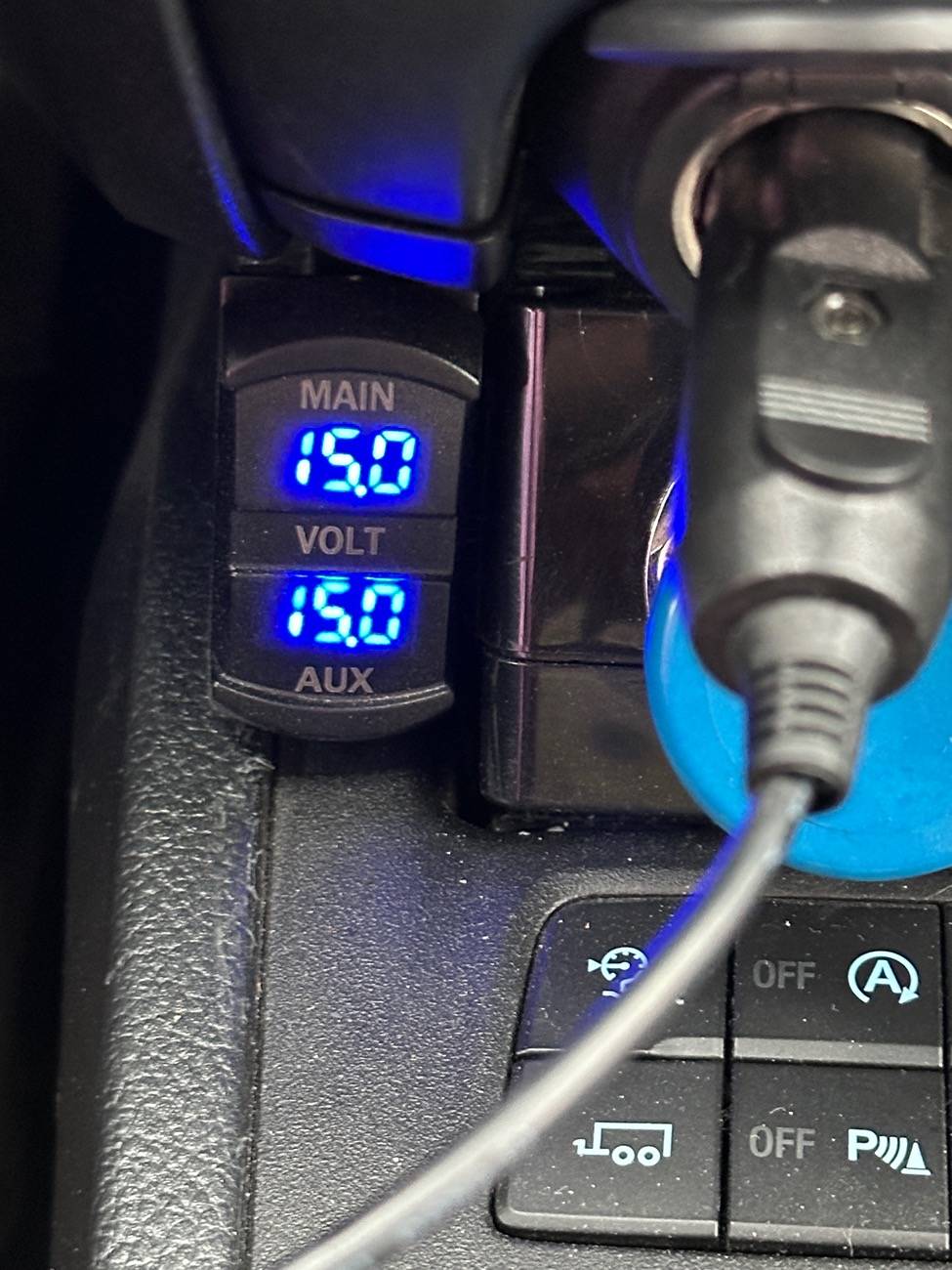
I’d noticed some instances of the ASS not working and installed a dual voltage meter so I could see what was going on with both batteries at all times. Photo added to show both batteries at 15v while driving. My guess is the alternator is going hard to recharge the batteries (they were showing 12.1v this morning when I turned the key to power up truck but before cranking).

Had the truck in for warranty work recently (was with Ford nearly a month getting a door rust issue resolved). Ford told me my battery was at 60% and should be replaced. I declined, as I already have replacements ready and they had no idea I have two batteries.

Given my high accessory amp draw (170amp compressor that runs as needed and only while truck is on/alternator working), I’ve been a bit tuned into monitoring the battery usage and unhappy with the BMS. How could Ford invest in technology that wasn’t good for batteries? Haha. After reading @TJC and @Airline tech’s trials and tribulations I am convinced I need to pull the plug when I install the new batteries.

My questions are:

which onboard desulfator is the way to go (I’ve seen two referenced)?

Does simply unplugging solve the charge rate issue or do I need to invest in Forscan to change the SOC percentage?

Do I need to disable other systems to prevent dark drain? I have a remote start key fob that I use regularly and want to keep.

What does telematics control?

Thanks!

As info, the batteries I’ll be installing in parallel are:

Odyssey Battery ODP-AGM94RH7L4 Performance Series AGM Battery https://www.odysseybattery.com/products/odp-agm94r-h7-l4-battery-94r-850/

And a Odyssey Battery - ODX-AGM27M - ODYSSEY 27M-PC1750 https://www.odysseybattery.com/products/odx-agm27m-battery-nsb-agm27m/

IMG_8625.jpeg
 
Last edited:
OP
OP

TJC

Well-Known Member
First Name
Tony
Joined
Aug 28, 2020
Threads
45
Messages
3,940
Reaction score
9,892
Location
North Carolina
Vehicle(s)
93 Miata, 05 Ranger 4x4, 20 Ranger 4x4, 23 CX-5
My questions are:

which onboard desulfator is the way to go (I’ve seen two referenced)?

Does simply unplugging solve the charge rate issue or do I need to invest in Forscan to change the SOC percentage?

Do I need to disable other systems to prevent dark drain? I have a remote start key fob that I use regularly and want to keep.

What does telematics control?
Answers in order of your questions
  1. I trust the BatteryMinder model. Been using it for years with success. I've mentioned a link in this thread where you'll get the best price that I have found. It is at an RV Accessories sales web site for ~$70.

  2. If you unplug the sensor, the BMS resorts to the charging system methodology used in the 4G Rangers, but charge voltages are 0.2v higher, probably due to the AGM battery that comes standard in the 5G Rangers. If you choose to keep the sensor plugged in, you'll need Forscan to turn off ASS and set SOC to 90%-100% range.

  3. If you want the fancy gadgets there is a price to be paid, and it is a higher dark current draw. I disabled telematics, the cellular modem, and a lot of lights, bells and whistles that draw power. My dark drain rate is now comparable to my 4G Ranger.

  4. Telematics doesn't really control anything. It piggybacks on the remote (Ford Cloud) convenience features. It constantly collects data about every aspect of your driving habits, vehicle performance, user preferences, etc., and sends that data to Ford Corporate, which Ford can then share/sell to whoever. There are terms of agreement, but Ford can really do whatever they want with the data.

    Ford uses the two way remote communications with the truck for diagnostics and upgrades as well.
The above is my opinion. And we all know what opinions are like... we all have them! :LOL:

Best of luck figuring out your path forward.
Sponsored


Top