janitorjim
Well-Known Member
how the hell do they expect me to wrap my leg around that!?
Sponsored

how the hell do they expect me to wrap my leg around that!?
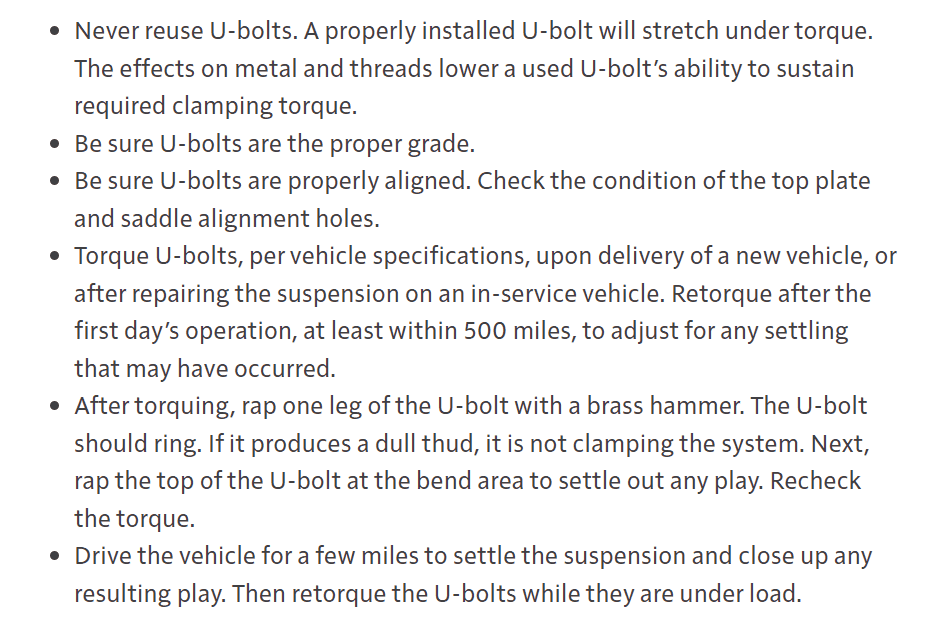
Hmmm, couldn't that also continue to stretch the u-bolt beyond its spec, if it's ductile? It seems that this should depend on the property of the specific u-bolt.Re-torqueing continues to move the nut up to new threads.
Long question and answer here.Hmmm, couldn't that also continue to stretch the u-bolt beyond its spec, if it's ductile? It seems that this should depend on the property of the specific u-bolt.
They also said it depends on the manufacturer. So if Ford said that it may have a lower torque and be okay, maybe that's a better answer.
I think this re-enforces the question I was wondering, though: Eaton is talking about aftermarket (and even put in a "quality" qualifier). Ford gave guidance for their own bolts -- whose tensile strength we don't know (i think) -- to not re-torque.Long question and answer here.
Reinstalling U-Bolts - EATON Detroit Spring
Basically,
" Quality aftermarket u-bolts are made to SAE standard J429 using SAE1541 steel. 1541 provide a 150,000 PSI minimum tensile strength, and 130,000 PSI minimum yield strength and a 120,000 PSI proof load. So stretching, or exceeding the yield is not something one needs to be concerned with. "

at least it will never grow to the level of the TG Damper.
that one item alone has shifted the earth off its axis and is tempting fate with the magnetic poles.
if any more Ranger owners wimp out and buy the damper, we might very well be spinning out of orbit and being sucked into the suns gravitational pull, and impending doom as the suns UV rays start to fade all our black plastic parts.
Covid wont be any more than a pimple on our ass as we search for a Space Force crew that can convert dogecoin into super magnets that we shoot at the sun with a potato gun, and put the earth back on track.


Necro!That face says it all!


Hey Mike,So when re-torquing the fastener should be loosened, then re-torqued, we used to mark it with a sharpie, back it off, re-lube it (depending on application) and re-torque, the sharpie marks will show if there is a change.
If the fastener is close to torque but still is under, the stiction between the nut and the bracket will not allow it to move even though it's below torque, it has to be low enough in torque to overcome the stiction.
Unless you have a tailgate damper, then it gets really complicated.
I was the first guy to convert a Swift DB6 to FF trim on the West Coast. There was a guy back east that did it, but he wasn’t very successful with it.Wow, what a small world, yes, we did it in the back of the engine build shop, it was 10 feet behind me for a year or so.
I came in during the final placement and fitment of the externals, oil tank, fuel pump everything external of the engine.
I got into a big tiff with one of the engineers, he wanted to mount the fuel pump on the oil pan, no joke, I got him a trip to Star Mazda to look at a proper in tank setup.
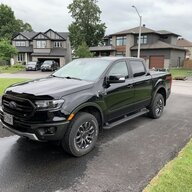
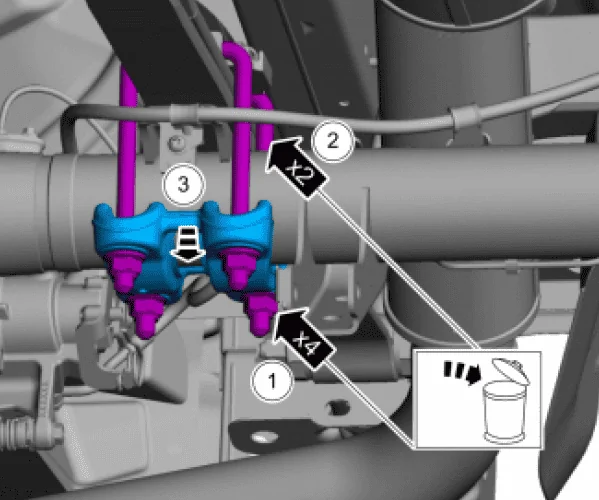
I checked the torque on my truck and discovered an odd thing. The two bolts on the front side of the axel were tight to the point that I don’t know what touque they were set to, for sure it is over 98 ft ibs. The other two, the back/rear of the axel around started 70ish. Brought those up to 98 and went out for a drive. Came back and retested. I found that the two nuts on the front side of the axel were still tighter than 98. The two on the rear side had loosened and needed to be further tightened. They needed a surprising amount of additional tightening.After someone brought up in the discussion about start up shudder that their rear leaf spring U-bolts were not torqued correctly, I decided to check mine. I was a little surprised to see that mine were also not to spec, so I recorded the process of torquing them correctly on one side of the truck. The other side is done exactly the same way.
I have not noticed any change to my start up shudder, but I've previously also lowered my center carrier bearing which almost completely eliminated the start up shudder... it's barely a flutter now. I do plan to put my carrier bearing back to the stock height to see if it's any better now that the leaf springs are torqued down correctly... but I suspect it won't really have made much difference.
Anyhow, here is how to torque your rear leaf spring U-bolts, per the shop manual:


